BLOG

Insights, stories and updates about The Cartiers

Cartier London Egyptian Revival Brooch

Cartier London Egyptian Revival Brooch

So enjoyed diving into the life of Jacques Theodule Cartier for an interview with Juncker Capucine's "Property of a Lady".

1 min read
Read More →

Emerald elephant and lapis lazuli brooch above a vintage photo of three people.

So enjoyed diving into the life of Jacques Theodule Cartier for an interview with Juncker Capucine's "Property of a Lady". The youngest of the three brothers, Jacques was an artist at heart who ran the London branch through the 1920s. But his work took him further afield too.

Travelling with his wife Nelly, he crossed the globe (without planes, this involved boats, cars, trains, even donkeys). From New York to Paris and from Egypt to India (as in this photo), Jacques was on the lookout for precious gems, 'apprets' and new ideas — never copying, only creating.

The result was unique jewels like this Egyptian Revival brooch where an ancient green-glazed faience bust of the goddess Sekhmet (dating from c. 700 BC!) is updated for the stylish 1920s woman (love the lapis lazuli sky twinkling with diamond stars).

And 100 years later that magic mix of ancient, exotic and Art Deco that Jacques and his brothers brought to the fore is still in demand: when this Cartier London brooch came up for auction at Sotheby's in 2013, it smashed its $300–500k estimate, selling for over a million dollars.

Master Cartier Horologist Maurice Couët

Master Cartier Horologist Maurice Couët

One of Louis Cartier's greatest gifts was his ability to spot talent in others.

1 min read
Read More →

Craftsman at workbench, next to an ornate Art Deco Egyptian mystery clock.

One of Louis Cartier's greatest gifts was his ability to spot talent in others.

What was so remarkable was that he often did this before they had even recognized it themselves: he found his head jewellery designer installing a balcony up a ladder and spotted his future artistic director looking stylish in a fashionable Parisian restaurant. One of the lesser-known collaborators — but arguably one of the most talented of all — was master horologist Maurice Couët.

Louis may have had no horological training himself but he wasn't going to let a little detail like that stop him from making the most magnificent clocks in the world.

Ten years younger than Louis and born to a Rouen family of clockmakers, Maurice Couët was in his mid-20s, with his own fledgling business, when Louis asked him to create table clocks exclusively for Cartier.

A huge range of Cartier Paris desk clocks followed, with inventive features that still seem modern today (including months and days of the week, rotating dials, and more). But Louis wasn't content to stop there, and the creations dreamed up by the pair became more and more ambitious. In this image of Couët in his Paris workshop, he's working on a chimera mystery clock (more to come on this style — sadly this one was dismantled in 1953) while on the top shelf behind him sits this Egyptian temple clock.

It's an exceptional piece, not just in terms of design but also in its clockmaking and craftsmanship. Covered in intricate hieroglyphics and made in some of the most sought-after materials of the day (gold, mother-of-pearl, coral, lapis lazuli and emeralds), it also features a concealed panel that drops on an invisible hinge to reveal the winding mechanism.

I love this ingenious detail — a subtle wink to the secret openings discovered deep within the Egyptian pyramids and tombs. This clock reappeared at Christie's in 1991, and extraordinary Couët clocks continue to surface at the major auction houses to this day.

Image Gallery

My First Jewelry Webinar: Thanks GemX

My First Jewelry Webinar: Thanks GemX

Thank you to all who joined for the jewellery webinar I did on Wednesday.

1 min read
Read More →

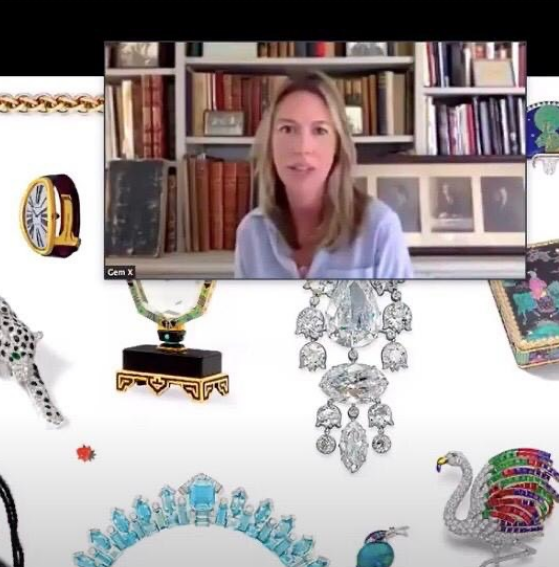
Francesca Cartier Brickell holds a book; split screen compares 1926 and 2016 field scenes.

Thank you to all who joined for the jewellery webinar I did on Wednesday. It was my first one so I was slightly wary — used to speaking to an audience I can see! — but given that travel and lectures aren't happening any time soon, I figured it was worth a go.

And it sure was: I was very touched to see so many people tuning in, leaving comments and asking such interesting questions. Thank you also to GemX Club for hosting me on their platform — such a source of knowledge for jewellery lovers all over the world.

My talk was on the Cartiers — yes, there were glamorous clients and spectacular jewels on show, but I also wanted to take the audience into the lives of the three brothers: Louis Cartier, Pierre Cartier and Jacques Cartier, sharing untold stories and opening a window into a different world.

Once I got over the whole talking-to-a-screen lark, it seemed apt to be telling those family tales from my study, filled with my ancestors' books, in my late grandfather's house — almost like they were there with me (which in a way they were, looking out from their photographs behind me).

I also delved into some of my research behind the book — pictures of trips to India and Sri Lanka where I (and my lucky children!) met the descendants of those my globe-trotting, gem-buying great-grandfather had known. The slide here shows me and him on the Ceylon sapphire-buying trail.

I feel very privileged to have had the opportunity to follow in his footsteps and see such incredible things: those murky stones pulled from the earth and transformed into bright blue gems. I'm also holding up a 1927 newspaper article of Jacques on that very trip, which he kept carefully in a trunk of long-lost letters I discovered a decade ago.

Some of you have asked for more webinars in the future — I'm open to it. A couple of ideas that came out of that talk were India and Pearls, but I'd love to hear your suggestions.

Image Gallery

Image 2

!

Cartier’s Victory Brooch by Pierre Lemarchand

Cartier’s Victory Brooch by Pierre Lemarchand

VE Day, 75 years ago today, marked the end of WW2 in Europe. But for many, the beginning of the end had started some months earlier: "On 18 August the...

1 min read
Read More →

Black and white 1944 Paris liberation scene; gold, coral, enamel, diamond Cartier birdcage brooch.

VE Day, 75 years ago today, marked the end of WW2 in Europe. But for many, the beginning of the end had started some months earlier: "On 18 August the Cartier firm closed until further notice," the head Cartier Paris salesman wrote in 1944. "The Germans occupied the Place de la Concorde and the Tuileries and fired on all the passers-by who wanted to cross over."

A few days later, the French Resistance and Allies advanced into Paris under the cover of darkness. Arriving at the Hôtel de Ville shortly before midnight, they hoped to free the city from occupation but for those living there, the outcome remained uncertain: "We are currently living in historic hours. There is a lot of damage everywhere and yesterday evening the Germans sent us their bombing planes. There was light in the street at 11 o'clock in the evening, the sky was fiery pink… the area has become dangerous, the Germans have no reason to spare us."

But the next day, Paris' military governor surrendered, famously disobeying Hitler's orders to destroy the capital's monuments and bridges. Spontaneous displays of joy erupted as Parisians rushed out to hold impromptu street parties and De Gaulle gave a speech to a swaying mass of rapturous citizens at City Hall: "Paris! Paris outraged! Paris broken! Paris martyred! But Paris liberated! Liberated by itself. Liberated by its people."

It would be almost a year before Germany surrendered to the Allies. But that moment in Paris had been a crucial turning point: a sign to the world that the tide was finally turning. To commemorate the Liberation, the Cartier designer Pierre Lemarchand created a new bird brooch that in time would come to symbolise the end of the war. This one featured a bird in France's national colours: red (coral), white (diamonds), and blue (lapis lazuli), in proud acknowledgment of the symbolism the Germans had apparently suspected but been unable to prove. And this time, the bird was outside the cage, wings spread and singing in joy. It was free.

Cartier Paris and the Trapped Bird Brooch

Cartier Paris and the Trapped Bird Brooch

As we approach VE Day, I have been thinking about what it must have been like approaching the end of WW2 in Paris.

2 min read
Read More →

Hitler in occupied Paris; Cartier gold 'Caged Bird' brooch with diamonds, emerald, sapphire.

As we approach VE Day, I have been thinking about what it must have been like approaching the end of WW2 in Paris.

Years of occupation had taken its toll on the 'city of light': electricity and gas were scarce, water was often cut off and as the head Cartier salesman wrote to his wife "the supply is more and more difficult… we subsist by the black market.

For a month we have had very few vegetables or fruit, 0.90 grams of meat per week of poor quality." He was one of the lucky ones: many survived only on rutabagas, a turnip usually fed to cattle.

Others sought to stretch out their rations by keeping chickens or rabbits in corners of small apartments (dogs had long since been rounded up to de-mine the country and cats had ended up in stews).

But it wasn't just about going without: there was real fear too. Hitler had ordered his armies to destroy Paris if it was invaded by the allies. Under these conditions, businesses were severely tested but many did stay open — if only to stop themselves being requisitioned by the occupiers. Cartier Paris was not alone in resisting numerous attempts by the Nazis to move the Maison and its employees across the border to Germany.

And the enduring Cartier symbol of those times? The now iconic brooch of a bird trapped in a cage.

Designed by Pierre Lemarchand, the Cartier designer renowned for his animal creations (he was also behind many of the famous panther jewels for the Duchess of Windsor), the bird brooch represented the innocent French men, women and children imprisoned by the Germans in their own city.

Cartier Paris daringly displayed the brooch in their Rue de la Paix window in 1942. Some accounts suggest that Jeanne Toussaint, as the head of High Jewelry, was taken in for questioning and held for a short time before her friend Chanel managed to have her freed.

My quick trawl through the WW2 Parisian police records was unable to confirm this, but either way, displaying the brooch was an incredibly plucky move back then. And today, almost 80 years later, that simple bold little bejewelled creation survives as a reminder of what previous generations lived through.

Daisy Fellowes's Cartier Iris Brooch

Daisy Fellowes's Cartier Iris Brooch

An iris to celebrate 1st May. This brooch was made by Cartier London c. 1940: a flower in war time.

1 min read
Read More →

Cartier sapphire, diamond, and emerald iris brooch, with Daisy Fellowes and purple iris flower.

An iris to celebrate 1st May. This brooch was made by Cartier London c. 1940: a flower in war time. Was reminded of it today as the #irises in the garden are bursting with purple life, gloriously unaffected by the current world crisis in which we find ourselves... a reminder perhaps that ‘this too shall pass’.

Jacques Cartier who ran the London branch at the time this was made had travelled to be in his native France during wartime, and his son (my grandfather, Jean-Jacques) had been called up to his cavalry unit. In London, meanwhile the Cartier New Bond Street showroom remained open (engagement rings being particularly popular in wartime) and with it the English Art Works jewellery workshop upstairs, albeit at significantly reduced capacity. Many of the employees had either been called up to fight themselves or drafted to help the war effort in other ways (one designer for example was asked to exchange designs of #tiaras for those of fighter jets, while some skilled craftsmen were asked to turn their hands to creating munitions instead of #jewels).

Made of #diamonds and #sapphires, with an #emerald stem, this #flowerbrooch belonged to society heiress #DaisyFellowes. I’ve talked a bit about her before - strong, chic, savvy and rebellious (she famously had a penchant for cocaine and other women’s husbands), she was the perfect Cartier client- not just because she loved jewels (and had the funds to buy them) but because she made the trends others followed. Perhaps no surprise then that when her #iris brooch came up for auction @sothebysjewels in 2009, its exotic heritage attracted significant interest (it ended up selling for more than triple its estimate, over $650,000). Today though, with so many of us confined at home and unsure about the future, I just wanted to share it with you to wish you Happy May 1st, where-ever you are...

Grace Kelly's Cartier Engagement Rings

Grace Kelly's Cartier Engagement Rings

A bit of Hollywood glamour now... Grace Kelly, who was given not one but two Cartier engagement rings by her Prince Charming, Prince Rainier of Monaco.

1 min read
Read More →
[Grace Kelly](/glossary/grace-kelly/)'s Cartier Engagement Rings

A bit of Hollywood glamour now... Grace Kelly, who was given not one but two Cartier engagement rings by her Prince Charming, Prince Rainier of Monaco. The first was a ruby and diamond eternity band and the second a large solitaire — over 10 carats.

It was this one that she refused to ever take off, making it perhaps the most famous engagement ring in the world when she wore it in her last ever film, High Society, where she played the engaged socialite Tracy Samantha Lord (second image).

Almost immediately after filming was finished (and months before the movie was even released), Grace Kelly set sail across the Atlantic — with 80 bags and her dog — for her waiting Prince. Greeted by hundreds of reporters and thousands of well-wishers on her arrival in Monaco, she was adored from the start.

Her 1956 wedding — with 700 guests including Cary Grant, Ava Gardner and even my grandfather's cousin, Claude Cartier — was quite the society affair. Televisions had just become mainstream and this was one of the first major globally televised events (to approximately 30 million viewers).

Her high-necked, long-sleeved gown — designed by Helen Rose, who had also designed Elizabeth Taylor's first wedding dress — had been made from a phenomenal 275 metres of antique Belgian lace, 23 metres of silk taffeta and 90 metres of tulle.

On her head she wore a simple Juliet cap and, in the place of a traditional bouquet, she carried a prayer book covered with lily of the valley and pearls. There was also — unbeknownst to all those watching — a golden penny in her shoe for good luck.

And her wedding present from her prince? A Cartier diamond necklace of course — one that has survived through following generations, seen here worn by her granddaughter at her own wedding. For more on how The Cartiers survived vast changes in society to become the jeweller of choice for both blue-blooded royalty and Hollywood royalty, see my book.


Image Gallery

Jean-Jacques Cartier: 1919-2010

Jean-Jacques Cartier: 1919-2010

This is my grandfather, Jean-Jacques Cartier. I know I'm biased but he really was one of the most generous, kind men you'd ever meet — a true gentleman.

1 min read
Read More →

Diamond flower brooch with pink center, melting gold watch, and man with glasses and pipe.

This is my grandfather, Jean-Jacques Cartier. I know I'm biased but he really was one of the most generous, moral, kind men you'd ever meet — a true gentleman.

As I discovered when I recorded his memoirs he also lived a fascinating life: a peacetime baby born just at the end of the devastating First World War, he lived through the Roaring Twenties, the Great Depression and completed his Cartier apprenticeship in Paris during the final years of WW2 when clients included the terrifying (and gem-loving) Göring.

Obviously the French salesmen didn't want to cater to the occupying Nazis but they had no choice — if they hadn't, Cartier would have been moved to Germany (and even as it was, there were several attempts to do so).

When he took over Cartier London after the war, Jean-Jacques' clients included the royal family — this diamond flower brooch (with the 26-carat pink Williamson diamond at its centre) remains popular with the Queen today (see the second image of it starring during a meeting with the Obamas at Buckingham Palace). Princess Margaret liked it so much she swiftly commissioned her own version from Cartier London too.

But selling big jewels in Swinging Sixties London was tricky — there wasn't a lot of wealth around and people were rebelling against the status quo — and so Jean-Jacques, an artist at heart, turned his focus to designing more practical accessories like cases and watches, such as the Crash watch pictured here.

Stories have abounded about this one in recent years — my grandfather found that rather amusing and told me the real story behind its creation. For that and many other inside stories, see my book "The Cartiers" — published 100 years after the birth of the man who inspired it.

Image Gallery

The Cartiers Available Now

The Cartiers Available Now

And it's in the shops! Signed copies now available in Daunt Marylebone and Hatchards in London. If you're in the UK, I've just heard that Amazon.

1 min read
Read More →

Francesca Cartier Brickell smiles, signing red-covered copies of her book, "The Cartiers.

And it's in the shops! Signed copies now available in Daunt Marylebone and Hatchards in London. If you're in the UK, I've just heard that Amazon.co.uk is already out of stock — which is both great and not great! — but they will be restocking soon, or you can try Waterstones or independent bookstores too.

Hope you enjoy it, or that it makes a good Christmas present!

Image Gallery

The Cartiers: Sky News Interview

The Cartiers: Sky News Interview

Thank you to Sky News for having me on the show today to talk about my new book.

1 min read
Read More →

Three women conversing at a desk, with ornate diamond and gold jewellery on a red screen.

Thank you to @skynews for having me on the show today to talk about my new book. Hadn't been the studios before and was quite overwhelmed by how enormous it all was! Could get used to the hair and makeup though... Particularly grateful to the brilliant @skynewssamw and @isabelwebstertv here for making me feel so comfortable in the interview (quite nerve-wracking waiting to go on...) We talked about the rags to riches story behind Cartier, my discovery of a treasure trove of long lost family letters and dipped in to a few of the clients and gems like Evalyn McLean's purchase of the notoriously cursed Hope diamond over 100 years ago...

#thecartiersbook #hopediamond #thecartiers #cartiers

Image Gallery

Cartier Tiara in the V&A Museum

Cartier Tiara in the V&A Museum

How uplifting is this tiara?! Currently sits in the V&A museum where I’m excited to be giving a talk later this month.

1 min read
Read More →

Ornate Edwardian diamond tiara featuring heart designs, displayed with three women wearing it.

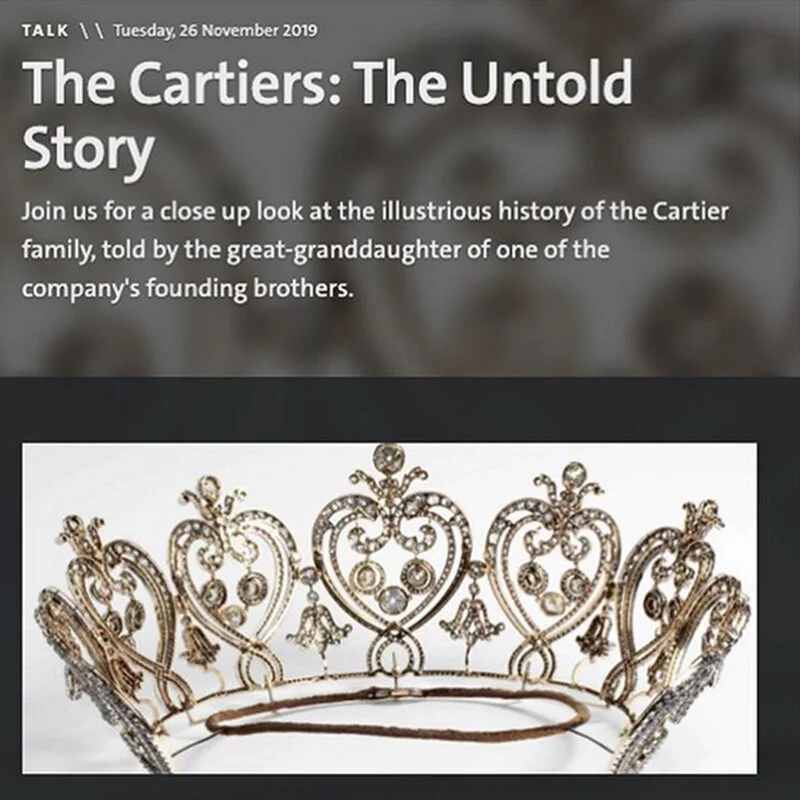
How uplifting is this tiara?! Currently sits in the V&A museum where I'm excited to be giving a talk later this month. Made in 1903 for Consuelo, the Cuban American Duchess of Manchester (pictured, centre), using over a thousand of her own diamonds, it was designed in the elegant 18th century garland style for which the Cartiers were just becoming so well known. When Consuelo married the Duke of Manchester in 1876, she became one of the first in a long line of 'dollar princesses' who were shipped over from America to bring a much needed boost of new-money funds to the land-rich but cash-poor British aristocracy. Later her namesake god-daughter, Consuelo Vanderbilt (pictured, left, but not in the same tiara!), would follow suit marrying the Duke of Marlborough in 1895 and through the early years of the 20th century, both Consuelos would become excellent clients of the Cartiers. After all, in an era where one changed one's outfits multiple times a day (from tea gowns with a string of pearls to a ball gown with diamonds), there was no shortage of demand for the high-end jewellers.

Consuelo had six years to enjoy this tiara before she passed away in 1909. After that the tiara passed not to one of her daughters but to her American daughter-in-law (pictured, right), despite the fact that Consuelo had not approved of her son's choice in bride (the wedding had been kept secret from her). Today you can see this tiara up close in the jewellery gallery @vamuseum, where I will be on the day of my book launch, November 26th (next page). The talk has sold out but, for those who would have liked to be there, I'm hoping to do another ticketed London lecture in the New Year. If you'd be interested in attending, let me know in the comments below and I'll keep you updated. Would also love to hear what you think of this tiara! #thecartiersbook #tiaras #duchess #edwardianjewelry

Image Gallery

Image 2

!

The Cartiers' Secret Code

The Cartiers' Secret Code

Guess the odd one out? It's the only object not inextricably connected to the Cartiers' history. So it's not the brooch or the watch of course..

2 min read
Read More →

Vintage gold Cartier watch, diamond bar brooch in its red box, with breakfast items.

Guess the odd one out? It's the only object not inextricably connected to the Cartiers' history.

So it's not the brooch or the watch of course... nor is it the notecard in the hand of my great-grandfather, Jacques Cartier, but, perhaps most surprisingly, neither is it the jam. ‘Confiture’ as jam translates in French, was deeply woven into the Cartier family history from the very early days.

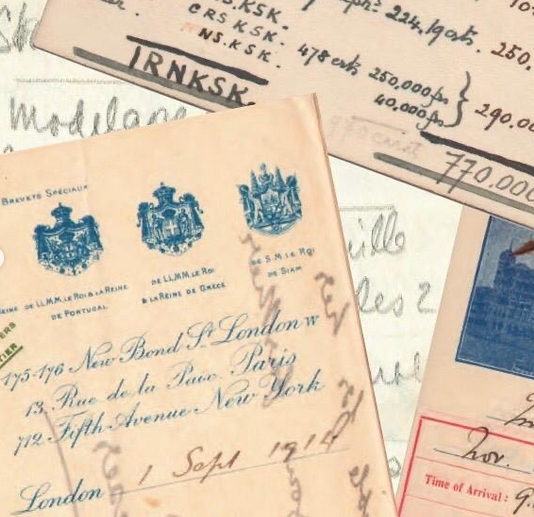
Not only was this ‘Bonne Maman’ one an absolute favourite of my grandfather (with good reason...) but as far back as the 19th century, his ancestors developed a code so that they could secretly record the prices they had paid for gems, jewels and other objects.

The code needed to be a 9 letter word with no repeated letters: they selected 'CONFITURES': where C=1; O=2; N=3 etc all the way to E=9 and S=0 (K was chosen to symbolize a repeated number).

The code was used by many generations of Cartiers: in Jacques' small card on the table here (from the 1920s), he records the price he paid in francs for certain gems with the following letters: "TUI.SKS," alongside the price in British pounds he hoped to sell it for (£35,000).

As he and his brothers and their teams were buying and selling all the time, they couldn't possibly remember the price they paid for each gem so Jacques would take cards like this - along with the jewels in question - to sales meetings as a reminder to himself.

That way, even if the client caught sight of it, they would have no idea of the margin he was making. The second image shows another example of one of these cards (within a montage of other letters, top left). For decades, there was absolute secrecy surrounding the family’s code.

Although it has long since been revealed in books, back then, it was treated almost like a state secret. And yet, for my grandfather, Jean-Jacques, it had a less serious side too: "It always amused me", he told me, "applying the word for jams to jewels. I think it showed the Cartiers' tongue-in-cheek sense of humor!” So the odd one out?

Image Gallery

Image 2

!

Louis-Francois Cartier’s 200th Birthday

Louis-Francois Cartier’s 200th Birthday

200 years ago this year, my great-great-great grandfather was born into a poor working class Parisian household.

1 min read
Read More →

1960s Elizabeth Taylor wearing a pearl necklace with a large pear-shaped diamond pendant.

200 years ago this year, my great-great-great grandfather was born into a poor working class Parisian household. With a mother who was a washerwoman and a metal worker father, his prospects weren’t exactly great. Instead of the education he longed for, he was sent out to earn his keep. After his father found him work as a jeweller’s apprentice, years of long gruelling days followed until, in 1847, the ambitious Louis-François Cartier - by then 27 years old with 2 children of his own - took over his master’s workshop. And with no doubt little idea of how this single transaction would propel his family name from obscurity into the limelight in the coming century, he renamed it "Cartier".

Pictured here is Louis-Francois Cartier as an older man (having made a success of his life, LFC was finally able to indulge in his passion for learning). And beside him some early jewels retailed (but not made) by Cartier. For those with keen eyes, you might be able to see the red box is stamped ‘Cartier Gillion’ - 12 years after founding his business Louis-François expanded by buying a far better known jewellery firm called Gillion and for years, even decades, he would market his firm as Cartier Gillion. Only when his eldest grandson, Louis Cartier, joined the business and the store moved to Rue de la Paix did it revert to being known simply as Cartier again.

So happy 200th birthday this year to aspiring and inspiring jewellery entrepreneur, Louis-Francois.

Choosing Images for My Book

Choosing Images for My Book

Choosing images for my book — not an easy task, but a lovely one. Nothing like a photo to whisk you back in time.

1 min read
Read More →

Woman's hands, wearing a Cartier watch, hold a drawing of a man, surrounded by old photos.

Choosing images for my book — not an easy task, but a lovely one. Nothing like a photo to whisk you back in time. Here I am holding a sketch of the eldest of the three Cartier brothers: my grandfather has written "Uncle Louis" on the back in soft pencil and still now, nine years after his death, seeing that handwriting brings back a sudden unexpected pang of missing him.

Other images he carefully preserved, labelled and passed down include ancestors back to my great-great-great grandparents — and many other colourful characters along the way.

In true Downton Abbey style, the bottom-left photo taken in the 1930s is of the below-stairs staff who worked for Jacques Cartier and Nelly Cartier at Milton Heath, their British country house in Dorking.

It's hard to see clearly, but they are standing around the same Rolls Royce that Jacques used to take not just on his daily commute to the office, but all the way to India as well.

In fact he became so close to Orr, the chauffeur, over years of travelling together that he offered Orr's son a position in the firm's New Bond Street workshop. And in an unexpected twist, the chauffeur's son went on to become one of Cartier's best craftsmen.

For those interested in seeing more images, there will be lots in my book: over 100 black-and-white ones throughout the text and two 8-page glossy inserts to show off some of the jewels and glamorous clients in all their colour. In fact, this picture I'm holding didn't even make the cut in the end — which is why I thought I'd share it here instead.

Image Gallery

Cartier's Belle Époque Pocket Watch

Cartier's Belle Époque Pocket Watch

Love this early example of the Cartier brothers' foray into timepieces.

1 min read
Read More →

Two gold and white enamel Cartier pocket watches: one pink guilloché, the other open.

Love this early example of the Cartier brothers' foray into timepieces. It wasn't until a few years later that Cartier's wristwatches for men (like the Santos and the Tank) were released onto the market but this example is interesting in that it is such a feminine take on the pocket watch, complete with Russian-inspired pink engine-turned guilloche enamel and white rims.

Russia (which, thanks to the Romanovs, held much of the wealth at that time) had been a hugely significant influence on the Cartiers' creative development ever since Carl Fabergé's masterpieces had stolen the show at the 1900 Exposition Universelle in Paris.

And when Louis visited St Petersburg a few years later, he wrote back to his father in excitement: "I am at a point of rejuvenation of my ideas and delighted to have come here....The stay here is more favourable concerning ideas than in Paris".

Created at the turn of the 20th century, this miniature Belle Époque lady's pocket watch is super sweet - less than 3cm wide and just 16 grams. The dial has been painted with Arabic numerals (in contrast to many of the slightly later Cartier watches which tended to have Roman numbers) and has blued Breguet steel hands.

Underneath the block capital "Cartier" signature is written "Paris - Londres" in italics, suggesting to me that it was made sometime between 1902-1909 as New York doesn’t feature yet (Cartier New York opened in 1909, 7 years after the London branch and 62 years after the Paris firm was founded in 1847).

I also wonder if Louis’ great watch collaborator, Edmond Jaeger, who specialised in extra-flat cases, might have been involved.This piece may be over 100 years old but I think you could get away with wearing it today...perhaps as a pendant on a gold chain with a pair of jeans and a crisp white shirt? Still keeps time too...

#pocketwatch #thecartiersbook

Cartier's Garland Style Tiara

Cartier's Garland Style Tiara

Louis Joseph Cartier (pictured) was not a model student.

1 min read
Read More →

Belle Époque diamond tiara, young man's portrait, and L. Cartier's signature.

Louis Joseph Cartier (pictured) was not a model student. In his school report, the eldest grandson of Cartier's founder had black mark after black mark - more than anyone in his year. He was intelligent, his teachers conceded, but his head was "in the clouds" and he struggled with following the rules. Ironically, it was those very same characteristics that would lead him to revolutionise the entire jewellery industry.

By the time the naughty schoolboy was old enough to join the family firm in 1898, art nouveau was all the rage. Louis, not one to follow convention, refused to abide by its strictures. He wanted to shake up the jewellery world, not slavishly follow the trends. Experimenting with platinum (then principally an industrial metal), he was able to create a lighter more delicate style of jewelry with its roots in 18th century Marie-Antoinette-style glamor.

Daringly different from the jewels of the time, Cartier's 'garland-style' tiaras, necklaces and corsage ornaments didn't take long to become a huge hit on both sides of the Atlantic. And the iconoclastic visionary with his head in the clouds was propelled from being criticized by teachers to being revered by queens. #thecartiersbook #cartierjewellery (p.s. thanks to @wartski1865 for this gorgeous tiara image!)

Image Gallery

My Book Is Almost Here

My Book Is Almost Here

My book is almost here! At long last, I am thrilled to be so close to sharing what I know of this amazing story with others.

1 min read
Read More →

Red book cover with gold Art Deco border and "THE CARTIERS" title.

My book is almost here! At long last, I am thrilled to be so close to sharing what I know of this amazing story with others. As some of you already know, after the discovery of a trunk full of old family letters in the cellar ten years ago, I have been lost in the past.

My research has taken me all over the world — from sapphire mines in Sri Lanka to palaces in India to dusty archives and jewellery workshops in Paris, London and New York — but for the last year, I have had my head submerged in my laptop trying to weave the various strands into a human story that encompasses the highs and lows of four generations.

The result, "The Cartiers: The Untold Story of the Family behind the Jewellery Empire", will be published before the end of this year, which is especially significant for me — 2019 marks 100 years since the birth of my beloved grandfather, Jean-Jacques Cartier, and 200 years since the birth of his great-grandfather who overcame his working-class roots to found the family firm in 1847.

The book is now available for pre-ordering — please share with anyone who might be interested! And a big thank you to all the people who've supported me with words of encouragement and ideas — it's really helped me to get to this point. Will also be doing some events related to the launch, so watch this space.

Maharajas and Mughal Magnificence

Maharajas and Mughal Magnificence

Fascinating to see this treasure trove of Indian art coming up for auction at Christie's in New York.

1 min read
Read More →

Man in hat, surrounded by eight colourful vintage Cartier jewels and artefacts.

Fascinating to see this treasure trove of Indian art coming up for auction at Christie's in New York.

So many incredible antique Cartier pieces being sold alongside the type of artefacts that led to their inception. "The ten centuries that preceded our era", Jacques Cartier wrote in his diary, "are one of the most wonderful periods in the history of the world. India's share in the intellectual discoveries of these times was paramount."

When Jacques Cartier travelled to India to meet with Maharaja clients or source gemstones, as he did regularly over 28 years, he wasn't just interested in buying and selling.

His diaries are filled with sketches and descriptions of India and its rich heritage — everything from gem-set sword hilts, temple carvings, enamel boxes and paintings. And when he returned to Europe his cases weren't just filled with gemstones but a myriad of objects that had excited his imagination.

He was an artist at heart and, in India, he found his greatest source of inspiration. This superb collection is testament to that heritage.

For further reading on the maharajas' jewellery collections and their relationship with European jewellers, see Katherine Prior and John Adamson's Maharajas' Jewels (Assouline, 2000) — the standard scholarly study of this subject.

Palm Beach Jewelry Fair

Palm Beach Jewelry Fair

Exciting to discover some beautiful old Cartier pieces at the Palm Beach Jewelry Fair last week.

1 min read
Read More →

Vintage gold and enamel bracelet ends with moonstone cabochons, above a luxury shopping street.

Exciting to discover some beautiful old Cartier pieces at the Palm Beach Jewelry Fair last week. Particularly loved this Sudanese-themed enamel, moonstone, onyx and diamond bracelet — always staggered by pieces like this: made 100 years ago (c.1919) and yet still managing to look super stylish today.

Just turn each head in alternate directions to gently open, insert your wrist, et voilà, you're all set.

Cartier’s Chinese-Inspired Vanity Cases

Cartier’s Chinese-Inspired Vanity Cases

A close up of one of Cartier’s Chinese-inspired [vanity cases](/glossary/vanity-cases/) from the 1920s. A miniature work of art but a feat of engineering too - you slide the eme...

1 min read
Read More →

Francesca Cartier Brickell, a gold Chinese-style Cartier vanity case, and an exhibition screen.

A close up of one of Cartier’s Chinese-inspired vanity cases from the 1920s. A miniature work of art but a feat of engineering too - you slide the emerald clasp to one side and the box pops open to reveal the little powder compartments and lipstick holder (which springs up helpfully) .

On the right is me holding the case to give you an idea of the scale - it’s pretty small compared to the myriad of make up items we tend to carry around with us today but wouldn’t you gladly sacrifice that eye liner and concealer for the chance to carry this around?! Pictured here at a Bamboo Art event in Nanjing.

I really enjoyed the relative calm and green of this historic city and it was a lovely place to share some of the family history - thank you to all who came#artdecocartier #vintagecartier #nanjing