The Tank is Cartier's rectangular wristwatch, conceived around 1917 and first entering production in 1919, still in continuous production today, making it one of the longest-lived watch designs in history. Its form, a clean rectangle with two parallel bars extending from the case to hold the strap, is among the most recognisable in watchmaking.
The name refers to the military tank, which had made its dramatic debut on the Western Front in 1916 during the First World War. Seen from above, the early tanks had a profile of rectangular body flanked by the long treads on either side, a silhouette that the Tank watch echoes.
What the Tank represented technically was a departure from the rounded, cushion, and oval case shapes that had dominated early wristwatch design; Cartier's own square Santos of 1911 was an early exception to that pattern. The right angle was a bold choice: it required precise cutting of the movement to fit within a rectangular case, and it demanded a different approach to how the lugs (the extensions holding the strap) connected to the case. The solution, the twin side bars (brancards), became part of the watch's identity.
Case and Dial
The classic Tank presents a rectangular white or silvered dial framed by the two vertical brancards. Roman numerals run around the chapter ring in the Cartier signature style: the XII at the top often slightly larger, the VI at the bottom sometimes replaced by a small seconds sub-dial on early examples. A fine railway-track minute chapter encircles the numerals. The hands are blued steel, typically in the sword (épée) profile that became one of the house's most recognisable elements. The winding crown carries a blue sapphire cabochon, a detail shared across the entire Cartier watch range from this period onward. The "Cartier" signature sits on the dial, usually below the XII. Dimensions of early Tank watches are modest by modern standards, the case proportions designed for an era when wristwatches were still considered jewellery rather than sporting instruments.
Variants
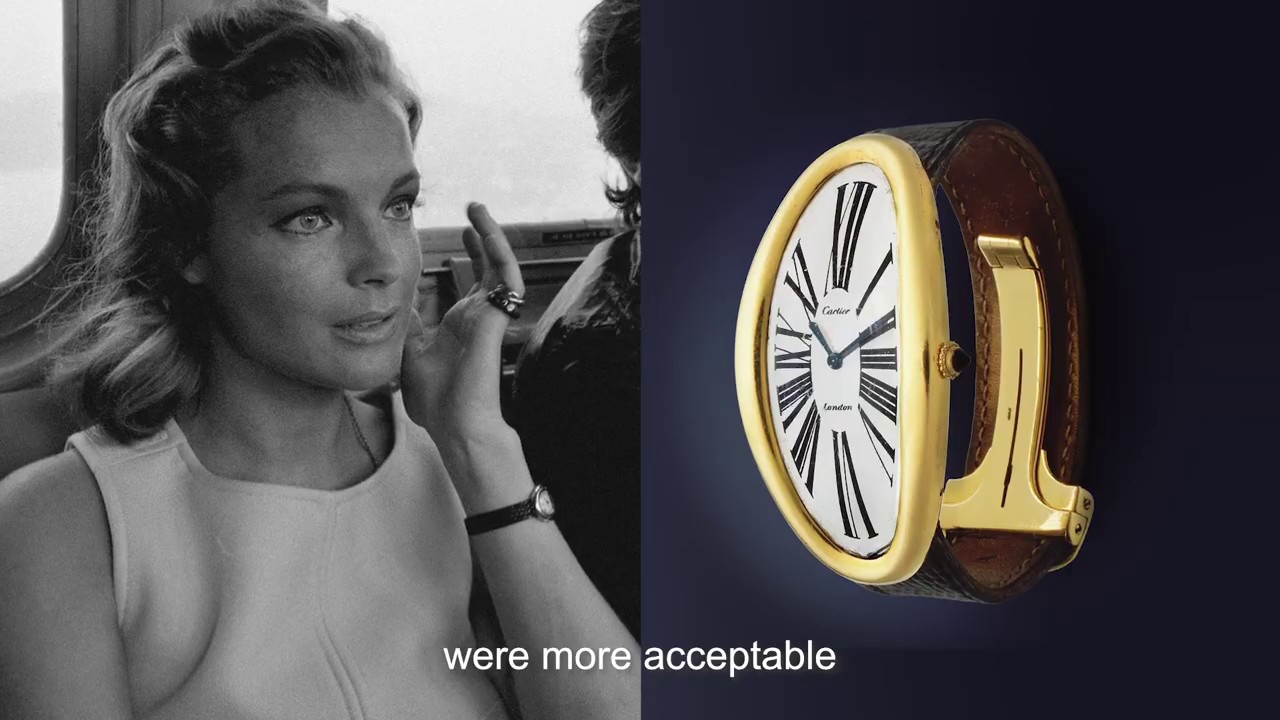
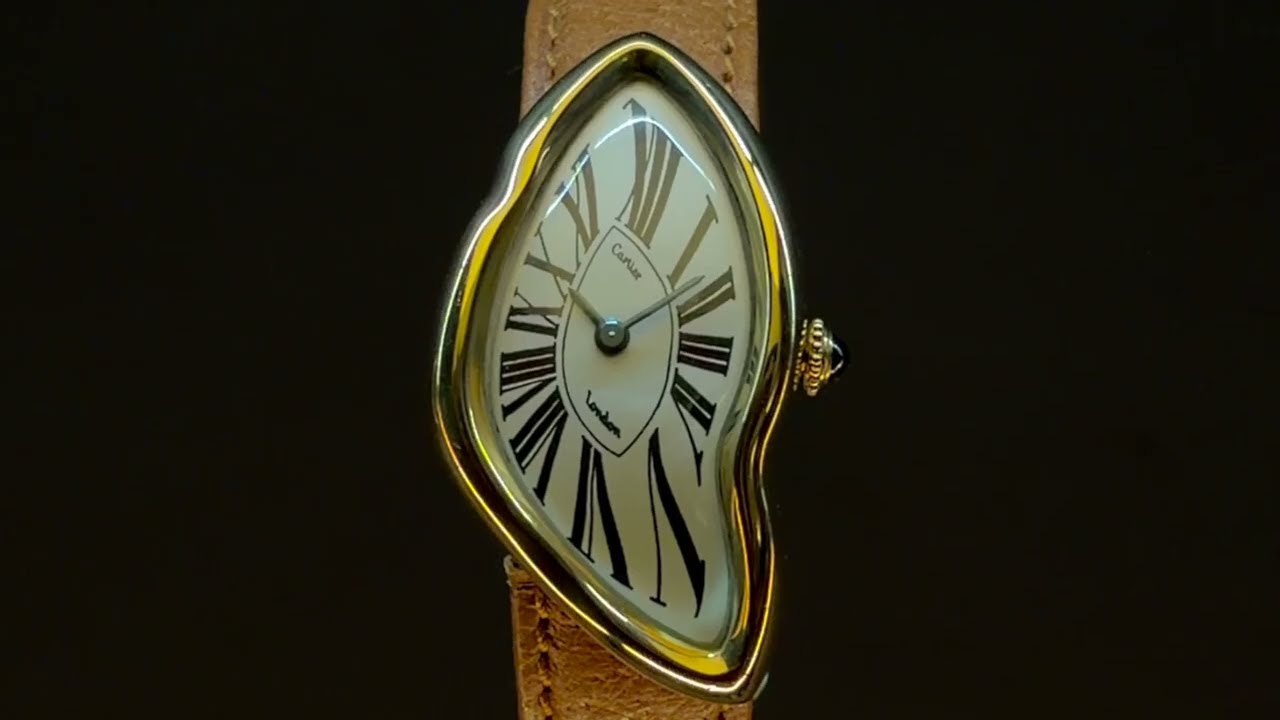
Over its long production history, the Tank has appeared in numerous variants. The Tank Louis Cartier uses curved lugs; the Tank Américaine has a curved case; the Tank Française uses a metal bracelet integrated into the design; the Tank Chinoise applies chinoiserie detailing to the case; and the 1928 Tank à Guichet replaced conventional hands with jumping hour and minute apertures. Cartier London Enamel Tank shows how the design was adapted with decorative enamel by the London workshop, the same branch that would later produce more radically reshaped watches such as the 1967 Crash.
The Tank found famous admirers almost immediately. Rudolph Valentino insisted on wearing one in his 1926 film The Son of the Sheik, an Arabian prince in the desert sporting a French wristwatch, the anachronism seemingly not troubling anyone involved.
The Tank's long production run means that examples vary considerably in their signed movements, case hallmarks, and dial typography. American-market pieces were often assembled or retailed by the European Watch & Clock Company, whose signature appears on movements rather than dials.
Sources
- Francesca Cartier Brickell, The Cartiers (Ballantine Books, 2019), ch. 2 (“Louis, 1898–1919”) and ch. 5 (“Stones Paris: Early 1920s”)
- Hans Nadelhoffer, Cartier: Jewelers Extraordinary (Thames and Hudson, 1984; revised 2007), p. 305.
- Wikipedia: Cartier Tank