The Baignoire is an oval wristwatch, the name deriving from the French word for "bathtub" in reference to the case's elongated oval form, somewhat deeper than it is wide, with a curvature that follows the wrist. Some sources suggest the name refers instead to the baignoire boxes at the Paris Opéra, the curved seats at stage level reserved for distinguished guests. Neither origin can be confirmed.
Vintage examples typically feature Roman numerals, blued steel hands, and a blue sapphire cabochon crown, set in cases of yellow gold, white gold, or occasionally platinum. Yellow gold is the most common in period pieces; white gold examples are scarcer.
Case and Dial
The Baignoire case is an oval, deeper than it is wide, with a smooth continuous bezel that follows the elliptical contour. The proportions are modestly elongated on the standard version, giving it a compact, jewel-like presence on the wrist. The dial is white or cream, with black Roman numerals arranged to follow the oval aperture rather than a strict circle. The XII and VI sit on the long axis; the III and IX on the short axis, slightly closer together than they would be on a round watch. Hands are blued steel swords, and the winding crown carries a blue sapphire cabochon, positioned at the three o'clock point on the oval's shorter axis. The minute chapter ring, where present, follows the oval contour. The Baignoire Allongée (Maxi Oval) stretches these same proportions dramatically, turning the compact oval into an elongated ellipse exceeding 58mm; the dial vocabulary remains the same but the spatial relationships between the numerals shift as the case lengthens.
The Ovale and the Baignoire name
The watch entered Cartier's catalogue in 1958 under the name Ovale. The Baignoire name was not formalised until 1973, when the house adopted it as the family name used since. The oval case form itself predates the catalogue name: Cartier was making oval-cased pieces in the early twentieth century, the same period that produced the rectangular Tank and the barrel-shaped Tonneau, and the Baignoire sits within that broader experimentation with non-circular case geometries.
Variants
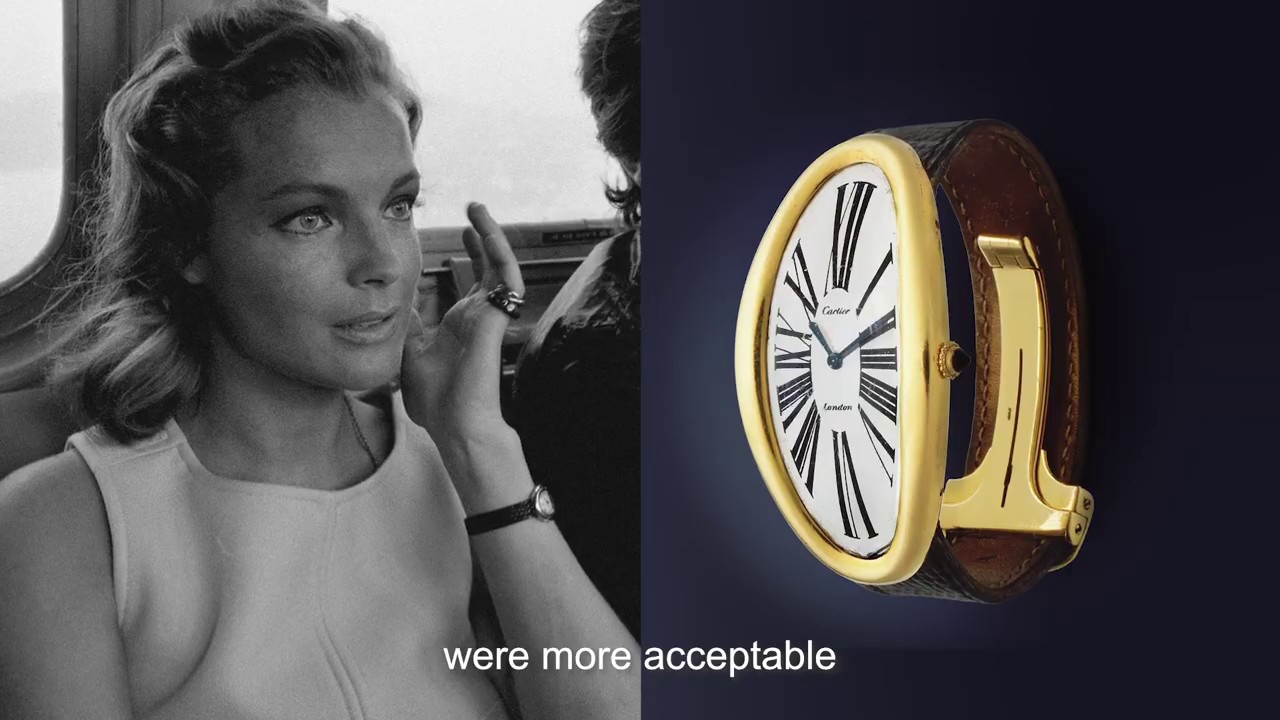
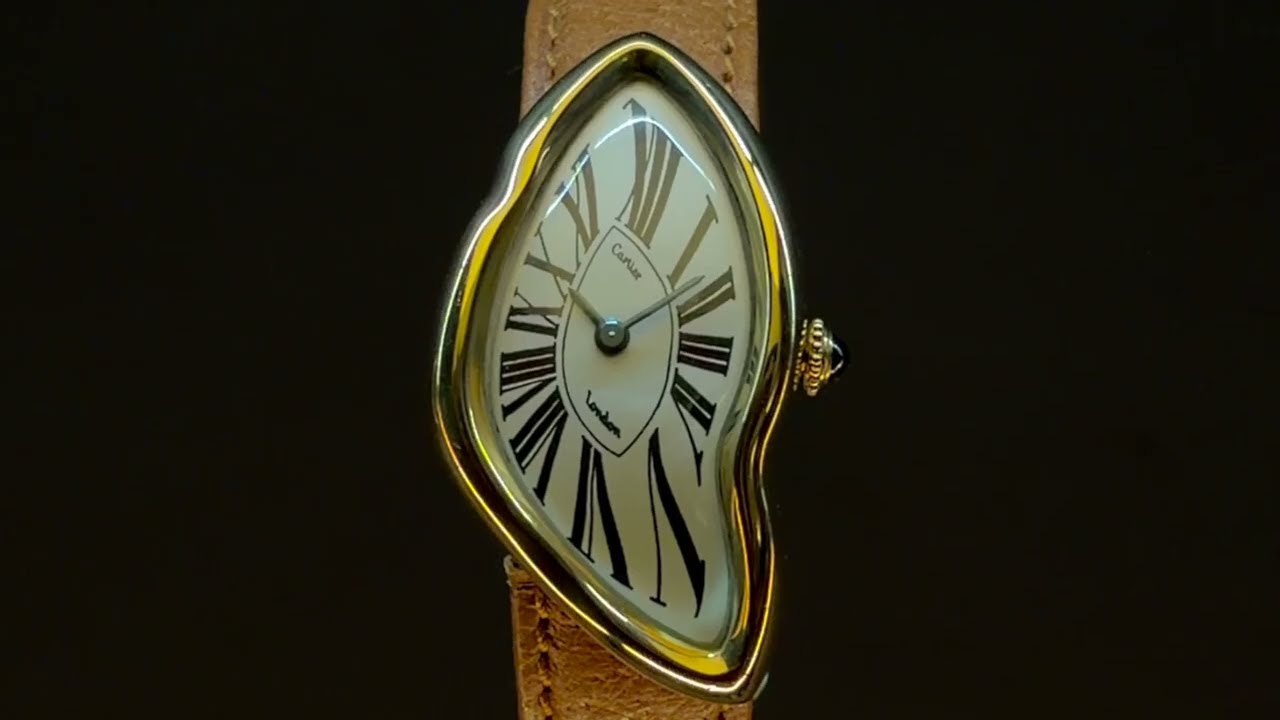
Two principal case forms define the family. The standard Baignoire is a modestly proportioned oval suited to everyday wear. The Baignoire Allongée (also known as the Maxi Oval) is a more dramatically stretched version, the proportions closer to an elongated ellipse, with cases exceeding 58mm in length and with cases exceeding 58mm in length. The Cartier Crash emerged from the Baignoire oval: Jean-Jacques Cartier's brief to designer Rupert Emmerson was to take the popular oval and distort it to look as though it had been in a crash, pinching the ends and putting a kink through the middle.
At auction
The Baignoire has long attracted collectors drawn to its combination of sculptural form and personal provenance. A reference 7672 in yellow gold dating from around 1960 sold at Sotheby's in December 2023; the piece carried a documented provenance as a gift to Oona Chaplin. A Baignoire from the collection of Dame Shirley Bassey sold at Sotheby's in October 2024.
Cartier's Watches & Wonders 2023 presentation introduced updated Baignoire models with new marquetry dials and revised case proportions, bringing renewed interest to the design and to the mid-century pieces that had inspired it.
Sources
- Francesca Cartier Brickell, The Cartiers (Ballantine Books, 2019), ch. 11 (“The End of an Era, 1957–1974”)
- Sotheby's, Important Watches, December 2023: Cartier Baignoire ref. 7672, yellow gold, provenance Oona Chaplin
- Sotheby's, Fine Jewels including the Collection of Dame Shirley Bassey, October 2024: Cartier Baignoire, lady's gold