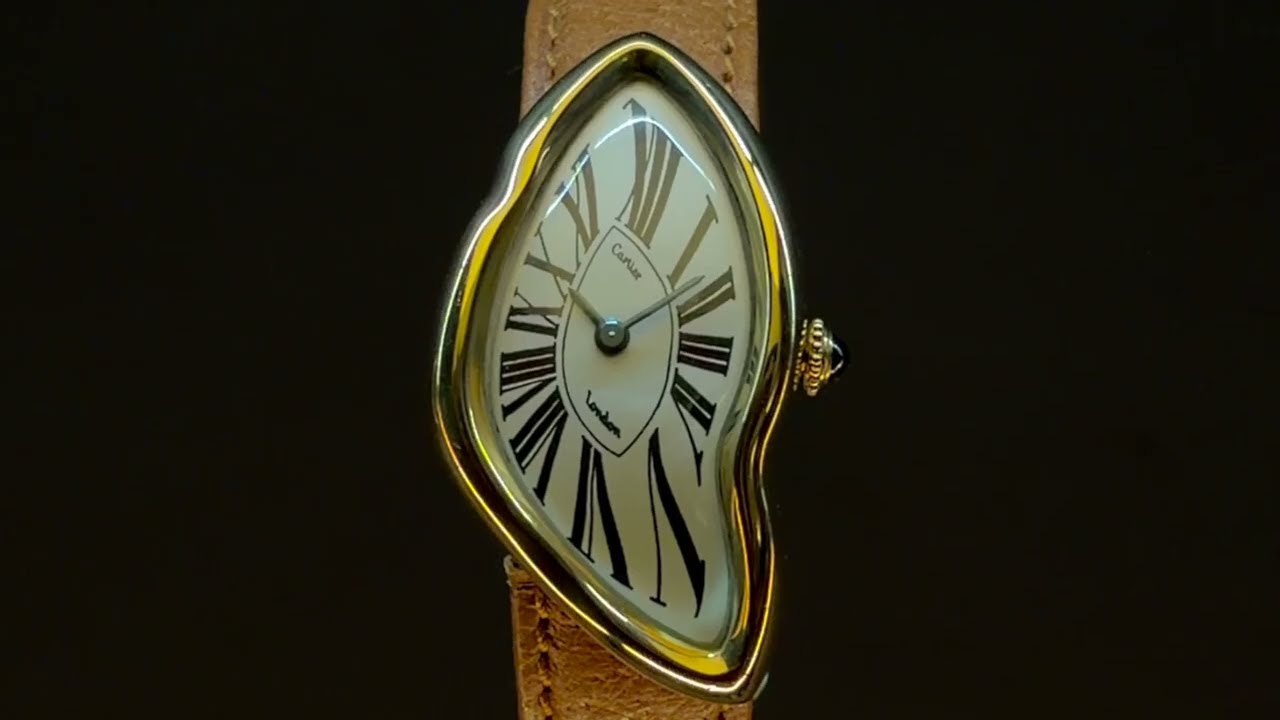
The Basculante takes its name from the French verb basculer, meaning to tilt, pivot, or swing. The defining feature is mechanical: the watch case is mounted within a fixed rectangular outer frame, and the case itself can be rotated 180 degrees, turning the dial face-down against the wrist. In this position the crystal and hands are shielded from impact, making the watch more resilient during sporting or physical activity.
Cartier introduced the Basculante in 1932, a period when the firm was producing a range of watches designed for active use. The Cartier Santos had already demonstrated that a wristwatch could serve a functional purpose beyond pure dress. The Basculante extended this thinking into the realm of protective engineering.
Case and Dial
The Basculante uses a rectangular inner case mounted within a fixed rectangular outer frame. The inner case carries the dial, typically white or cream with black Roman numerals in the standard Cartier arrangement: railroad-track minute chapter, blued steel sword hands, and a winding crown with a blue sapphire cabochon. The proportions echo those of the Cartier Tank, and the dial vocabulary is consistent with other Cartier watches of the early 1930s. What sets the Basculante apart visually is the visible frame surrounding the dial case: two parallel carriers on the long sides, with a gap between the inner case and the outer frame that reveals the pivot mechanism. When the case is flipped dial-down, the wearer sees the plain metal back, typically polished or brushed gold.
The Mechanism
The case typically sits in a rectangular outer carrier, echoing the proportions of the Cartier Tank. The pivot points are set at the midpoints of the longer sides, allowing the case to swing cleanly within the frame without separating from it. When worn dial-up, the watch functions as any other; when dial-down, the metal back presents itself to the outside world. The result is a watch that can survive conditions that would damage an exposed crystal.
Cartier Originality
The Basculante is sometimes compared to the Jaeger-LeCoultre Reverso, introduced in 1931. Both share the idea of a reversible or pivoting case, and both emerged in the same brief window of the early 1930s when sport watches were being reconsidered. The Reverso preceded the Basculante by approximately a year, and the mechanical approaches differ. The Reverso slides along rails; the Basculante pivots on fixed pins. The two houses arrived at related solutions by different routes.
Sources
- Francesca Cartier Brickell, The Cartiers (Ballantine Books, 2019)
- Christie's, Watches Online Geneva Edit, May 2024: Cartier 18K gold rectangular reversible wristwatch, CHF 35,280
- Christie's, Important Watches, November 2014: Cartier 18K gold rectangular reversible wristwatch, USD 18,750