
The Cartier story begins
Louis-François Cartier, born in Paris in 1819, acquires master jeweller Bernard Picard's workshop on rue Montorgueil at the age of 28. The name Cartier appears on a jewellery business for the first time.

Four generations of a Parisian jewellery dynasty, from a craftsman who took over a small workshop in 1847 to the three brothers who built an international house. Told through unpublished family papers by Jacques Cartier's great-granddaughter.
Based on The Cartiers by Francesca Cartier Brickell, Jacques Cartier's great-granddaughter. See also: The Cartier Family Tree →
Louis-François Cartier, born in Paris in 1819, acquires master jeweller Bernard Picard's workshop on rue Montorgueil at the age of 28. The name Cartier appears on a jewellery business for the first time.
Louis-François wins royal clients from the French imperial court, including Princess Mathilde, cousin of Napoleon III. The house begins its long association with European royalty.

Alfred Cartier joins his father and the business moves to 13, rue de la Paix, Paris — the address that will define the maison for the next century.
Alfred's three sons enter the business. Louis will lead Paris, Pierre will open New York, and Jacques will build London. Together they transform their father's jewellery house into a global empire.
Cartier opens in London. The timing is deliberate: the British royal family, soon to be crowned at Edward VII's coronation, are among the most jewel-conscious clients in Europe.
King Edward VII grants Cartier a royal warrant of appointment as jewellers to the crown. The recognition confirms Cartier's position at the summit of European jewellery and opens the doors of royal courts from London to St Petersburg.

Louis Cartier makes a wristwatch for the Brazilian aviator Alberto Santos-Dumont, who needed to read the time without taking his hands from the controls of his aircraft. The square-cased watch with exposed bezel screws becomes one of the earliest purpose-built wristwatches and the prototype for a design still in production.

Cartier develops the Tonneau: a wristwatch with a barrel-shaped case, wider at the centre than at the lugs. The form belongs to a broader project at Cartier Paris in the early twentieth century to move beyond the standard round case and develop geometric shapes that would become the house's signature watch vocabulary.

Cartier works for nine royal courts simultaneously, supplying tiaras, parures, and presentation pieces from London to St Petersburg. Queen Alexandra is among the most loyal clients.

Pierre Cartier acquires the legendary blue diamond in London and sells it to American heiress Evalyn Walsh McLean. One of the most storied gems in history passes through Cartier hands.

King George V is proclaimed Emperor of India at the Delhi Durbar. Cartier supplies jewels for the occasion. The Indian connection, long cultivated by the brothers, reaches its ceremonial peak.
In collaboration with movement-maker Maurice Couet, Louis Cartier perfects the mystery clock: a timepiece in which the hands appear to float in mid-air, with no visible connection to the mechanism.
Pierre Cartier secures the mansion at 653 Fifth Avenue in a remarkable exchange: a double-strand natural pearl necklace for a building. Cartier is now a presence on three continents.

Louis Cartier launches the Tank: a rectangular watch with lateral brancards flanking the dial, inspired by the aerial silhouette of a Renault FT tank on the Western Front. The design is unlike anything in watchmaking at the time and becomes one of the most enduring watch silhouettes of the twentieth century.

Louis in Paris, Pierre in New York, Jacques in London. At the height of their collaboration, the three brothers run the most internationally connected jewellery house in the world — sharing clients, stones, and ideas across continents.
The discovery of Tutankhamun's tomb sends a wave of Egyptian imagery across European art and fashion. Cartier Paris responds immediately: scarab brooches, lotus flower motifs, and hieroglyphic-set pieces that translate ancient forms into the Art Deco vocabulary Louis has been developing for a decade.

Louis Cartier creates the Trinity Ring for the poet Jean Cocteau: three interlocking bands of white, yellow, and rose gold. It becomes one of the most enduring designs in the history of the house.

The Exposition Internationale des Arts Décoratifs et Industriels Modernes gives its name to Art Deco. Cartier's geometric, lacquered, diamond-set pieces define the spirit of the age.

The Maharaja of Patiala brings his treasury to Paris and asks Cartier to remake it. The work includes a necklace set with 2,930 diamonds at its centre — one of the most extraordinary commissions in the history of jewellery.
Jacques Cartier's buying trips to India bring carved rubies, emeralds, and sapphires to Paris. The resulting bracelets and necklaces, mixing Western platinum settings with Indian carved stones, define a style later known as Tutti Frutti.
The Japanese cultured pearl industry floods the market and natural pearl prices collapse. Cartier, which built much of its fortune on natural pearl necklaces, must adapt. The age of the great pearl commissions is over.

Daisy Fellowes — heiress, editor of French Vogue, and one of Cartier's most audacious clients — commissions the Collier Hindou: a necklace of carved rubies, sapphires, and emeralds set in platinum and diamonds, in the Indian style Jacques had been perfecting through decades of buying trips. It becomes the defining statement of the Tutti Frutti genre.

Jacques Cartier is closely involved with Edward VIII and Wallis Simpson during one of the most dramatic chapters in royal history. The commissions they place — jewels to mark an extraordinary relationship — are among the most charged in the history of the house. Edward abdicates in December 1936 to marry Wallis.

Jacques Cartier dies on 10 September 1941 in Dax, France, aged 57. The youngest of the three brothers, he had been the driving force behind the London branch and the buying trips to India.

Louis Cartier, the creative force behind the Paris house, dies in 1942. He had shaped the maison's aesthetic identity more than any other individual: from the garland style to Art Deco, from mystery clocks to the Tank watch.
The Duke of Windsor commissions Cartier London to create a three-dimensional panther jewel for the Duchess — a crouching panther in black onyx and diamond, mounted on a large cabochon sapphire. Jean-Jacques Cartier oversees the work. It is the first of several panther commissions for Wallis that define a new era for the house.
Jean Cocteau is admitted to the Académie française and commissions Cartier Paris to make his ceremonial sword. He designs it entirely himself: a star in diamonds and rubies at the handguard, Orpheus in profile on the blade, the iron grille of the Palais-Royal on the scabbard, friends including Coco Chanel contributing gems. He carries it in his left hand throughout his two-hour inaugural address.

Pierre Cartier, the last of the three brothers, dies in Geneva aged 85. He had built Cartier's American presence and steered the business through two world wars. His death marks the end of the brothers' era.
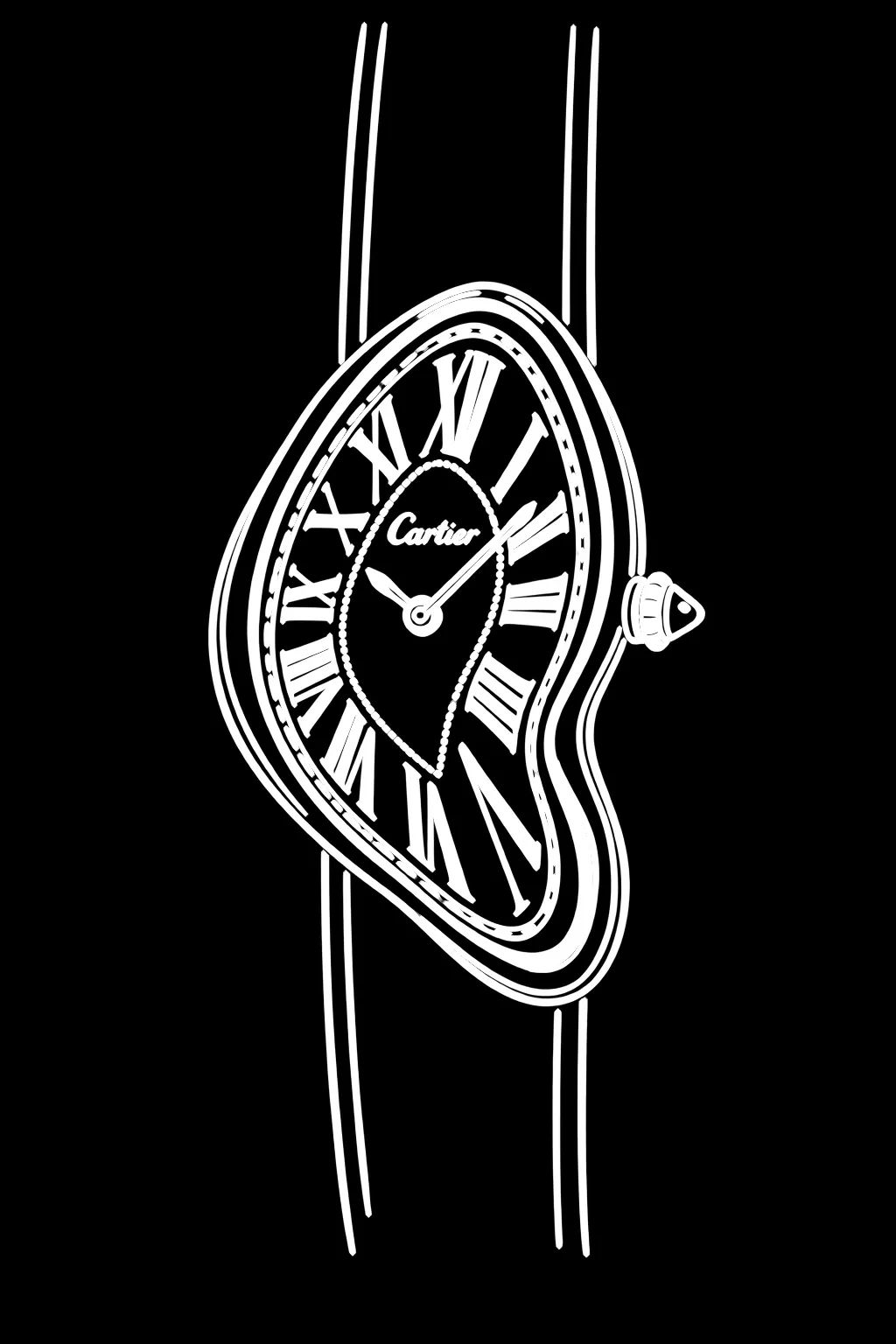
Jean-Jacques Cartier and designer Rupert Emmerson create the Crash at 175 New Bond Street: a wristwatch with a deliberately distorted, asymmetric case that appears to have been melted out of shape. Produced from 1967, it becomes one of the most distinctive watch designs of the twentieth century and, in time, among the most avidly collected vintage Cartier pieces.
The Mexican actress María Félix commissions Cartier Paris to make her a necklace in the form of two articulated diamond snakes. She arrives at the rue de la Paix atelier with live boa constrictors for the craftsmen to study. The resulting piece, set with yellow and white diamonds, becomes one of the most celebrated individual commissions in the history of the house.
Cartier purchases a 69.42-carat pear-shaped diamond at auction and briefly displays it in their New York window as the Cartier Diamond. Richard Burton then buys it for Elizabeth Taylor. The story makes front pages worldwide.

In December 1974, Jean-Jacques Cartier, son of Jacques, completes the sale of Cartier London — the last branch of the business in family hands. After 127 years, the Cartier story as a family enterprise comes to a close. The jewellery house continues, but without a Cartier at its head.
The full story, drawn from family archives and personal correspondence, is told in The Cartiers by Francesca Cartier Brickell.
Get the bookStart typing to search across all content
Try searching for pearls, British Crown, or mystery clocks