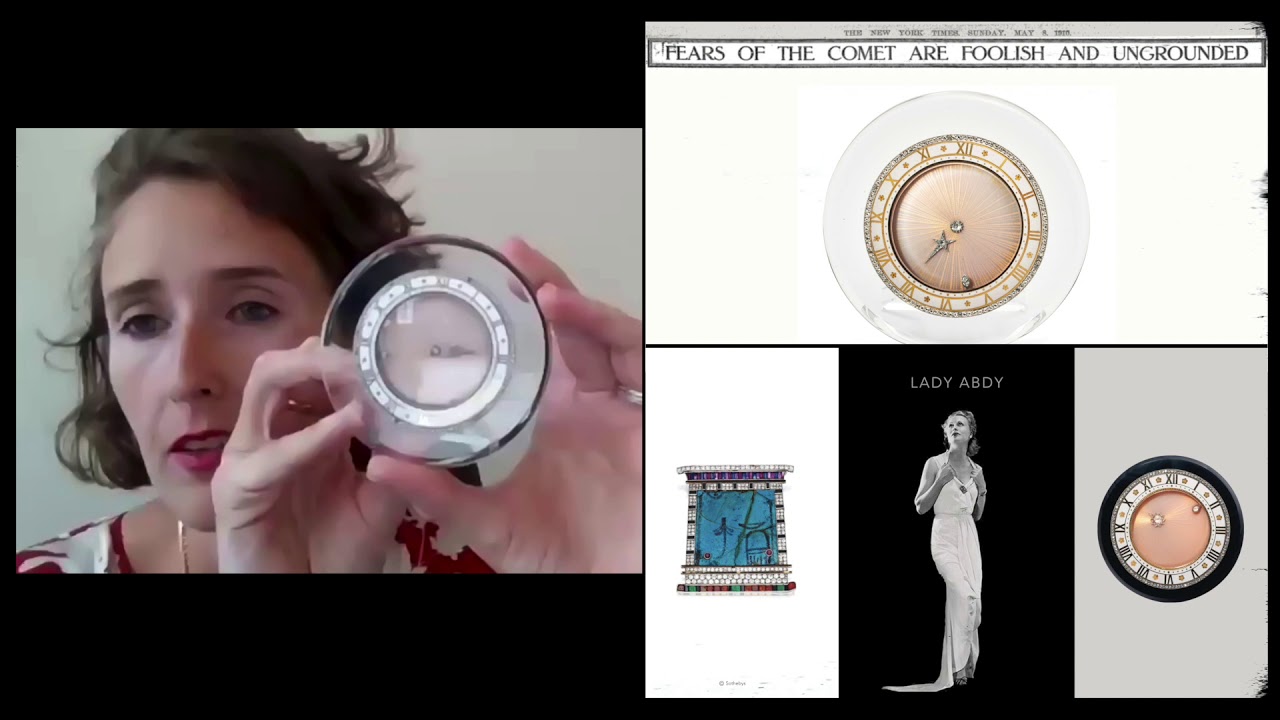
What Is a Mystery Clock?
A mystery clock is a timepiece in which the movement (the mechanical engine that drives the hands) is concealed from view, leaving the hands appearing to rotate with no visible connection to any power source. The effect, when well executed, is genuinely startling: two hands turn steadily in mid-air within a crystal cage, with nothing apparently making them move.
The mechanism behind this illusion relies on the hands being mounted not directly on a central arbor but on thin glass or crystal discs set within the transparent case. Each disc rotates imperceptibly, driven by hidden gearing concealed in the base or frame of the clock. Because the discs are transparent and the movement is elsewhere, the eye cannot trace the source of motion. The result looks like clockwork magic.
Cartier and Maurice Couët
The form was not invented by Cartier. Earlier French clockmakers had explored the concept during the nineteenth century, and the illusionist Robert-Houdin had used the floating-hands effect in stage performances. Cartier, working with the master clockmaker Maurice Couët, became the form's most prolific exponent, producing mystery clocks from the early twentieth century onwards. Couët's designs went far beyond simple transparency: the movements were integrated into sculptural cases (figures, temples, animals) that themselves became the spectacle. The first recorded buyer of a Cartier mystery clock was J. P. Morgan, who acquired a Model A example in 1913.
The Five Principal Groups
The mystery clocks fit into five distinct models, as first recognised by Hans Nadelhoffer in his 1984 monograph and catalogued by Harry Fane in his 2000 exhibition catalogue The Mystery of Time. Nadelhoffer counted ninety mystery clocks in total; Fane's more recent research suggests the figure is just over one hundred.

The Model A clocks, first produced in 1912, take their form from the French roadside milestone: a pair of transparent rock crystal columns supporting a circular dial, the hands appearing to float within. The case is invariably rock crystal, mounted most usually on a base of black onyx or obsidian. The Model A uses a double-axis mechanism and continued to be produced through the late 1940s, the longest run of any group.
The Central Axis clocks, born in 1920, use a single central axis rather than the Model A's double-axis mechanism. At least twenty-one variations of this model were created, making it the most numerous of the five groups. The range of forms is wide: tall columns of black onyx with turquoise enamel dials, shorter columns with Chinese-style chapter rings, rectangular ebony versions, and one tiny 1931 model with an aquamarine dial.

The Portique clocks are the most monumental: each stands over fourteen inches tall and takes the form of an oriental doorway, with a massive rock crystal dial suspended from a black enamelled gold lintel. Only six examples are known, produced in the Couët workshop between 1923 and 1925. Each pair of columns weighs in excess of 5,000 carats. They are, as Fane observed, certainly the most imposing mystery clocks and far the largest Cartier mystery clocks made.

The Screen clocks (also called Enseigne clocks, after the decorative fire-screen panels whose shape they echo) take the form of a screen with a decorative frame enclosing the crystal dial. Seven were produced between 1923 and 1928: five with coral batons, one with jade, and one with moonstone.

The Animal clocks (called Chimeras by Nadelhoffer and Fane) are the most overtly sculptural: twelve variants were produced between 1922 and 1931, incorporating carved jade elephants, mandarin ducks, rock crystal turtles, jade lions, and Chinese goddesses.
The production gap of 1914 to 1919, when no mystery clocks were made, reflects the disruption of the First World War to the Couët workshop and to the firm's capacity more broadly.
A 1925 notice in the Gazette du Bon Ton described these clocks as “marvels of the clockmaker's art, unreal and seemingly woven from moonbeams,” veiling “the mystery of time in the shadow of an ancient divinity.” That description, written at the height of their production, still holds.
Technical Demands
Mystery clocks are among the most technically demanding objects in the history of decorative clockmaking. The gearing that transmits motion invisibly must be precise enough not to introduce any visible wobble or irregularity into the sweep of the hands, while the overall construction must remain reliable over decades of use. The most ambitious examples required months of work to complete.
The crystal discs are central to the illusion. Chips or crazing affect the mechanism as much as the appearance, since the precision of the whole depends on the integrity of every component working together. Condition of the discs is among the first things specialists examine when assessing a mystery clock.
Collecting and the Auction Market
Cartier mystery clocks rank among the most sought-after objects in the decorative arts auction market. Their combination of technical ingenuity and sculptural ambition (many incorporate jade, coral, onyx, and carved hardstone figures) places them at the intersection of horology, jewellery, and fine art. The most elaborate examples, particularly the figural Animal clocks, regularly set records in major auction rooms.
Condition of the movement and crystals, integrity of the case and any gemstone components, and the quality of the overall design all affect value significantly. The market for mystery clocks has expanded considerably among collectors in Asia as well as in Europe and North America. A Portique mystery clock No. 3 (1924), one of only six Portique examples known, sold at Phillips Geneva in May 2025. A Model A mystery clock of circa 1914, in rock crystal, yellow gold, white agate, enamel, and diamonds, sold at Bonhams Hong Kong in November 2025.
New examples still surface. In 2021, Fane noted the appearance of a previously unknown mystery clock at the Parisian auction house Piasa -- a rhodonite example with hands shaped like the Empire State Building that even Nadelhoffer had not listed. Fane, characteristically, was sceptical of its quality: "All Cartier's known Mystery clocks are so jewel-like what is this ugly duckling doing joining the ranks?"
Sources
- Francesca Cartier Brickell, The Cartiers (Ballantine Books, 2019), ch. 2 (“Louis, 1898--1919”) and ch. 5 (“Stones Paris: Early 1920s”)
- Hans Nadelhoffer, Cartier: Jewelers Extraordinary (Thames and Hudson, 1984; revised 2007), pp. 281, 282 et al.
- Harry Fane, The Mystery of Time: The Mystery Clocks of Cartier (loan exhibition catalogue, International Fine Art and Antique Dealers Show, New York, 2000)
- V&A Museum, London, “Cartier” exhibition (April--November 2025): featured Model A mystery clock, Cartier Paris, 1914
- Wikipedia: Mystery Clock
- Bonhams, Hong Kong, 2025, lot 830: Cartier Paris Pendule Mysterieuse Model A, c.1914