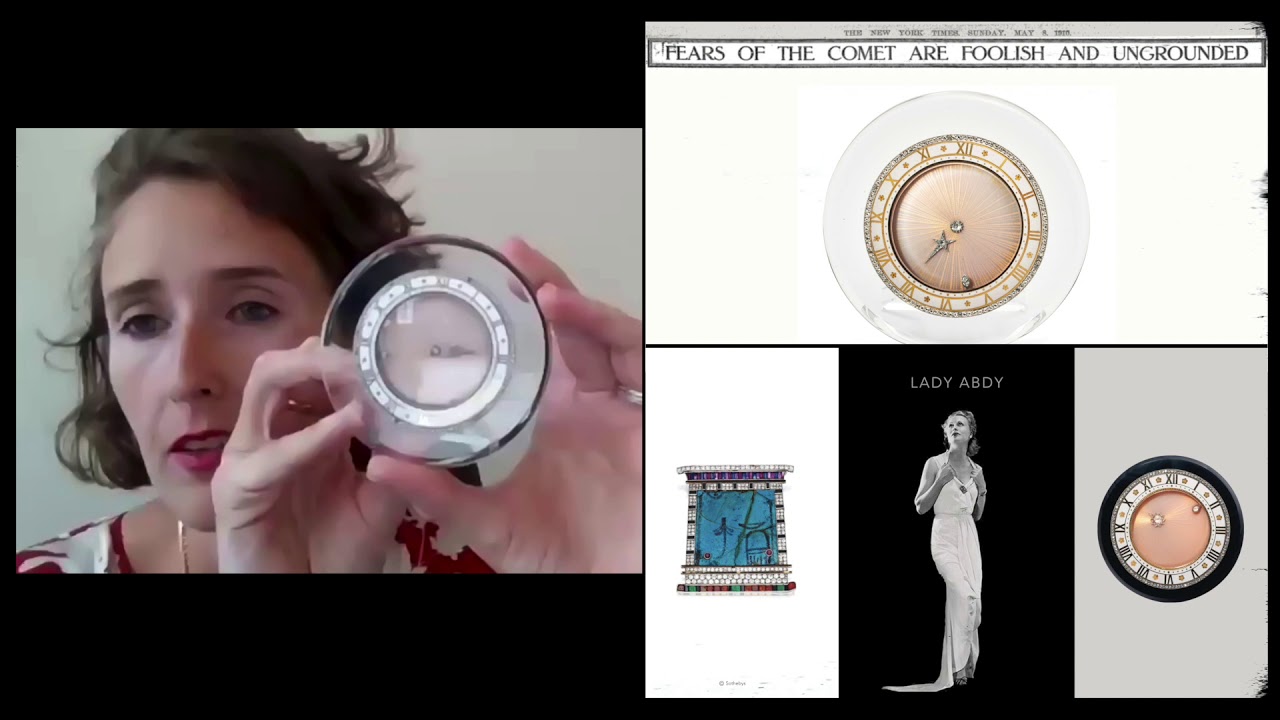
The Central Axis mystery clock is the second of the five principal Cartier mystery clock forms identified by Hans Nadelhoffer. Where the earlier Model A uses a double-axis mechanism, the Central Axis clocks rely on a single central axis, a mechanical distinction that allowed greater variety in the shape and proportion of the cases.
Origins and Production
The first Central Axis mystery clocks appeared in 1920, the year after Cartier established its dedicated clock-making workshop at 53 rue Lafayette under Maurice Couët. At least twenty-one variations of this model were created, making it the most numerous of the five groups.
Design and Variations
The range of forms within the Central Axis group is wider than in any other. As Harry Fane catalogued in his 2000 exhibition The Mystery of Time, some of the most elegant are raised on tall columns of black onyx with circular dials in turquoise enamel. Others, on shorter columns, have round dials of topaz mounted within Chinese-style enamel chapter rings. There are rectangular ebony versions with oval topaz dials. One tiny version, made in 1931, has an aquamarine dial, and others have hexagonal crystal dials with blue enamel borders.
All have platinum and rose-cut diamond hands and, in one version, the diamond chapter ring bearing diamond numerals is captured within the crystal dial.
Sources
- Harry Fane, The Mystery of Time: The Mystery Clocks of Cartier (loan exhibition catalogue, International Fine Art and Antique Dealers Show, New York, 2000)
- Hans Nadelhoffer, Cartier: Jewelers Extraordinary (Thames and Hudson, 1984; revised 2007)
- Francesca Cartier Brickell, The Cartiers (Ballantine Books, 2019)