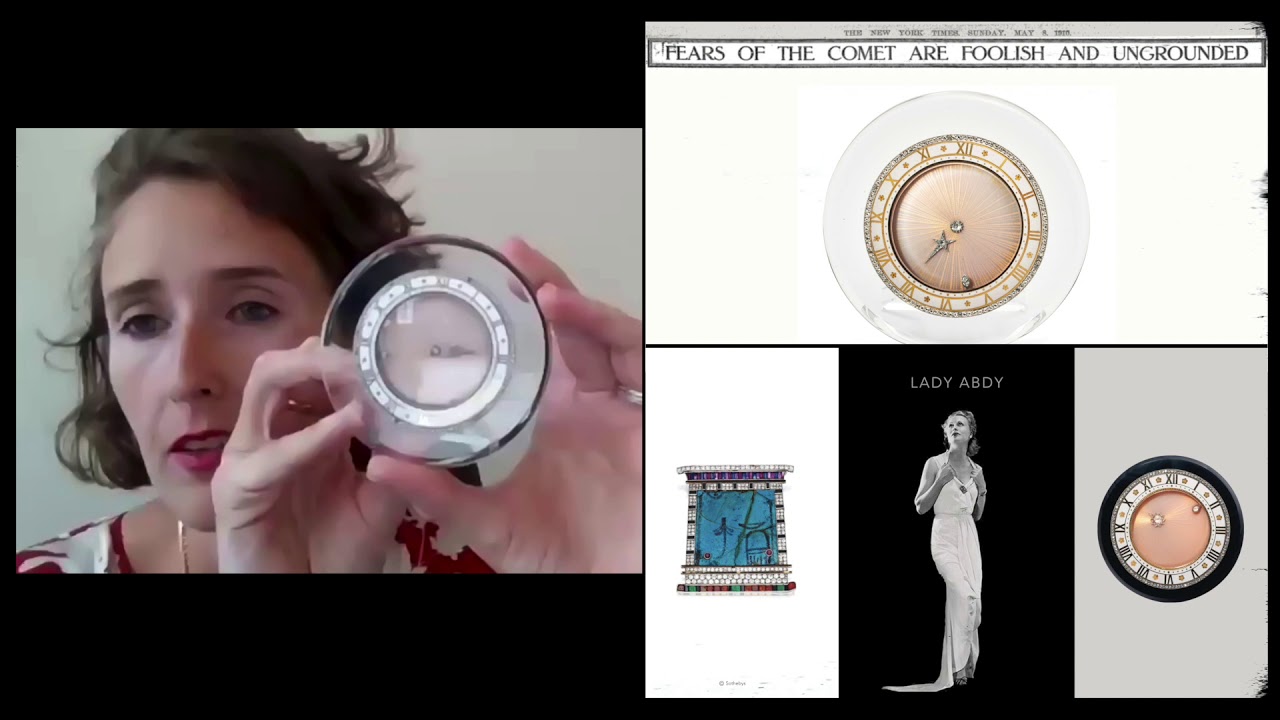
The Model A was the first of Cartier's mystery clock forms. Its design takes its cue from the French roadside milestone: a pair of transparent rock crystal columns supporting a circular dial, the hands appearing to float within. The effect, when the clock is well preserved, is genuinely startling: time seems to pass in mid-air, with nothing apparently driving the mechanism.
Origins
The first Model A clocks were produced in 1912, the work of Maurice Couët, the master clockmaker whose collaboration with Cartier defined the firm's most ambitious horological output. The form quickly attracted attention. The first recorded buyer was J. P. Morgan, who acquired a Model A example in 1913.
Design and Materials
The Model A uses a double-axis mechanism, distinguishing it from the later Central Axis clocks. The case is invariably rock crystal, mounted most usually on a base of black onyx or obsidian, though versions with bases of nephrite, agate, and gold are known. The chapter-rings, enclosed within the crystal cases, vary from model to model: either mother-of-pearl or white enamelled gold panels decorated with applied gold laurel leaves or arrow-pattern decoration. In some later models the chapter-rings are in polished platinum, and in one version the borders are decorated with a mosaic of kingfisher feathers. All have delicate and finely wrought platinum and rose-cut diamond hands.
The Model A continued to be produced through the late 1940s, a longer run than any of the other mystery clock groups, and is the type most frequently encountered at auction. In 1928 at Cartier New York, a Model A mystery clock cost $1,350.
The Model A in the Auction Market
Model A clocks appear at major auction houses with some regularity, though condition of the rock crystal discs and integrity of the concealed movement are critical to value. A Model A mystery clock of circa 1914, in rock crystal, yellow gold, white agate, enamel, and diamonds, sold at Bonhams Hong Kong in November 2025.
The V&A's 2025 Cartier exhibition in London featured a Model A mystery clock from 1914.
Sources
- Francesca Cartier Brickell, The Cartiers (Ballantine Books, 2019), ch. 2 ("Louis, 1898–1919")
- Hans Nadelhoffer, Cartier: Jewelers Extraordinary (Thames and Hudson, 1984; revised 2007), pp. 281, 282 et al.
- Harry Fane, The Mystery of Time: The Mystery Clocks of Cartier (loan exhibition catalogue, International Fine Art and Antique Dealers Show, New York, 2000)
- V&A Museum, London, "Cartier" exhibition (April--November 2025): featured Model A mystery clock, Cartier Paris, 1914
- Bonhams, Hong Kong, 2025, lot 830: Cartier Paris Pendule Mysterieuse Model A, c.1914