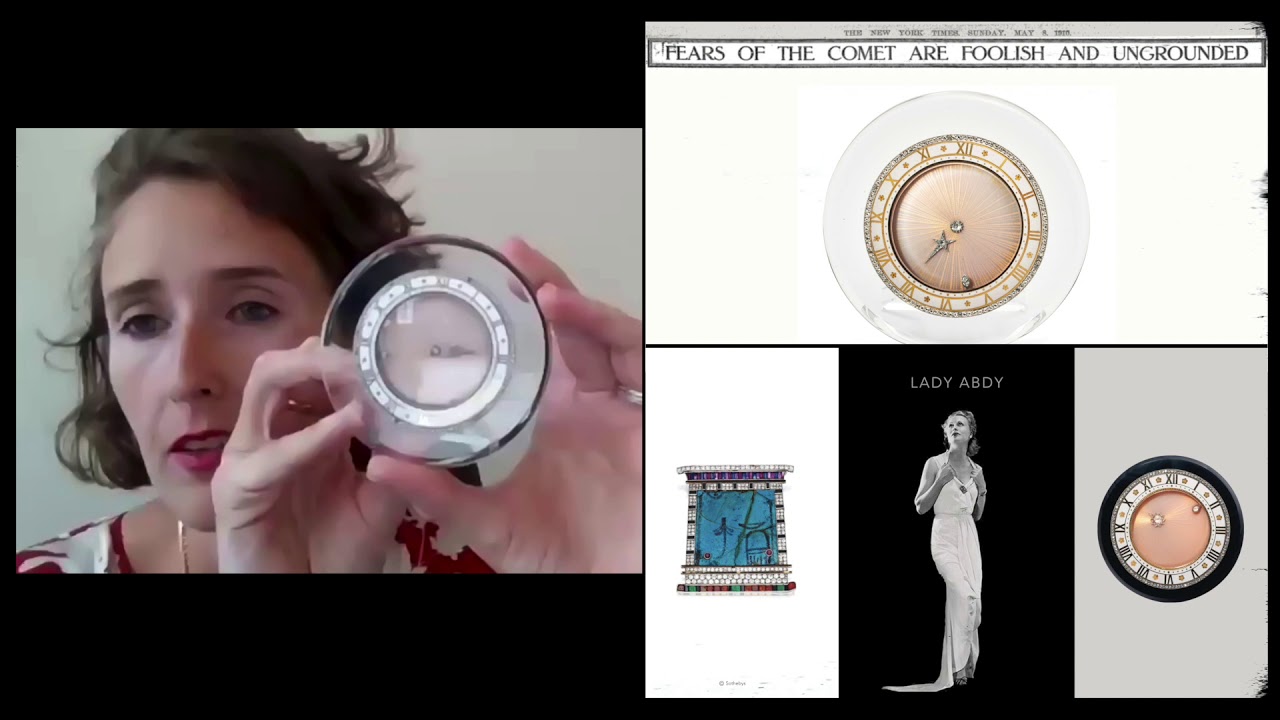
Cartier's clock output tells a parallel story to the watches and the jewellery. The clocks followed the same shifts in style, drew on the same sources of inspiration, and were often worked on by the same craftsmen: the mounters, setters, enamellers, lapidaries, and polishers who moved between jewels and timepieces. Like the jewels, the clocks were adapted to their period -- the opulence of the Belle Epoque, the geometric discipline of Art Deco, the oriental influences that the brothers brought back from their travels. The webinar The Cartiers and Their Clocks, recorded in connection with the Christie's Geneva sale of 101 Cartier clocks in 2020, covers the full history.
Belle Epoque Desk Clocks
Cartier's earliest clocks were desk clocks and small travel clocks in guilloché enamel, inspired by Fabergé. After the Cartier brothers saw Fabergé's creations at the 1900 Paris Exposition Universelle, Pierre Cartier travelled to Russia in 1904 and Louis Cartier followed in 1910, and the firm began incorporating the bright polychrome enamels and engine-turned metalwork into its clock production. The results were small, vivid objects in a range of colours -- blue, pink, purple, green, yellow -- often square or round, with movements housed in conventional cases.
These clocks were fashionable gifts, frequently inscribed with initials, dates, or messages. A clock in the Christie's Geneva sale of 101 Cartier clocks bore the inscription "Miriam and Albert" with the date 15 December 1910 -- a gift made for a Rothschild wedding. Queen Alexandra chose a Cartier clock as her gift to her son George V at his 1911 coronation, inscribed "May God lead and protect you." Several Cartier clocks remain in the Royal Collection.
Urn clocks from this period took the form of Louis XVI-style garlanded vases in dark-blue opaline glass, white enamel, and silver gilt, echoing the pendules à cercles tournants of the eighteenth century, with a rotating band dial driven by a movement set horizontally in the body of the urn.
Travel Clocks
Cartier produced miniature clocks designed for travel, small enough to fit in a pocket or handbag, often in fitted leather cases. Some included a petite sonnerie mechanism that struck the quarter-hours automatically. These were personal objects -- monogrammed, inscribed, sometimes paired as his-and-hers bedside clocks. Their portability reflected the lives of Cartier's interwar clients, who moved between London, Paris, Saint-Moritz, Cairo, and India with the seasons.
Comet and Astronomical Clocks
Halley's Comet passed close to the Earth in 1910, causing widespread public fascination and some alarm. Maurice Couet, who began working with Cartier in the early 1910s, was inspired by the event to create a series of "comet" semi-mystery clocks: a circular enamel dial with a diamond-set comet-shaped hand for the hours and a marquise diamond circling a concentric ring for the minutes. Related "planet" clocks featured superimposed dials with day-and-night indicators -- a sun for daytime, a crescent moon in diamonds for night. One such clock bore the Latin inscription "I do not count the hours if they are not brilliant."
These astronomical clocks are called "semi-mystery" because, unlike the fully transparent mystery clocks, the mechanism is concealed within opaque materials rather than hidden in plain sight behind crystal.
Art Deco Clocks
The 1920s and 1930s brought a shift in materials and form. Art Deco clocks were typically square or rectangular, incorporating onyx, nephrite jade, lapis lazuli, enamel, and precious stones. Oriental influences shaped many of these designs: Jacques Cartier's travels to India and the Far East, and Louis Cartier's purchases from Chinese antique dealers in Paris, fed directly into the clock vocabulary. Dials of carved jade or mother-of-pearl, hands shaped as Persian tulips or arrows, and panels of iridescent kingfisher feathers all appear in clocks of this period.
Some Art Deco clocks were architectural in character, with case forms that echoed buildings -- angular, large-scale pieces with a visual weight that set them apart from the delicate enamel clocks of the Belle Epoque. Couet's workshop also produced chronoscope clocks from 1919, in which three hidden arms, each bearing four numerals, revolved on an axis, appearing one at a time through a dial window. Some of these also served as photograph frames.
The Mystery Clocks
The mystery clocks are covered in detail in their own entry. In brief: these are clocks in which the hands appear to float with no visible mechanism, an illusion achieved through transparent rock crystal discs driven by hidden gearing. Couet produced them from 1912 through the late 1940s, in five distinct groups classified by Hans Nadelhoffer and Harry Fane. Around one hundred examples are known. They remain among the most sought-after objects in the decorative arts auction market.
The Prism Clocks
The prism clocks of the 1930s represent a separate line of development. Using mirrors and prisms on the periscope principle, the dial is readable from the front but transparent from the back. These were the work of Gaston Cusin, a protege of Couet.
Couet's Workshop
Maurice Couet is the central figure in Cartier's clock history. Louis Cartier recognised his talent early and eventually brought the clockmaking operation in-house: Couet's workshop, employing around thirty people, was established within Cartier in 1919 -- a decade before the firm opened its own jewellery workshop in Paris. That priority tells you how seriously Louis took the clocks. The full story of Couet and his workshop is at Master Cartier Horologist Maurice Couet.
Sources
- Francesca Cartier Brickell, The Cartiers (Ballantine Books, 2019), ch. 2 ("Louis, 1898--1919") and ch. 5 ("Stones Paris: Early 1920s")
- Hans Nadelhoffer, Cartier: Jewelers Extraordinary (Thames and Hudson, 1984; revised 2007), pp. 281, 282 et al.
- Harry Fane, The Mystery of Time: The Mystery Clocks of Cartier (loan exhibition catalogue, International Fine Art and Antique Dealers Show, New York, 2000)
- Christie's, "Collecting guide: Cartier clocks" (12 October 2023)
- Christie's Geneva, A Lifetime of Collecting: 101 Cartier Clocks (21 July 2020)
- Royal Collection Trust, RCIN 2894: Desk clock by Cartier