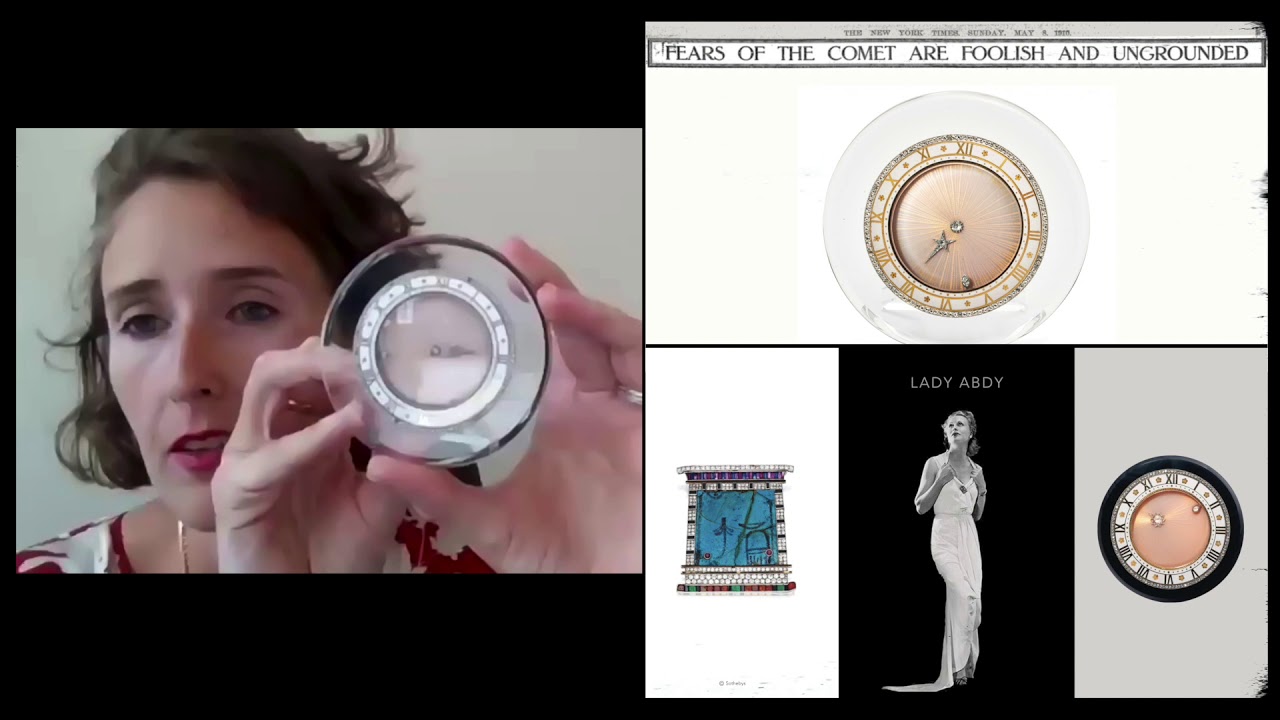
In 1910, Halley's Comet passed close to the Earth for the first time since 1835. The event caused widespread fascination and some alarm -- the New York Times carried reports of "a grave feeling of apprehension" among those "afraid of something they cannot understand." For Maurice Couet, who began working with Cartier in the early 1910s, it was a source of inspiration. The comet clocks that followed are among the more inventive objects in Cartier's clock output.
Comet Clocks
The comet clocks, produced between 1912 and 1920, are classified as "semi-mystery" clocks: the mechanism is concealed within opaque materials rather than hidden behind transparent crystal as in the fully transparent mystery clocks. The distinction is that you cannot see through a semi-mystery clock, but the way it tells the time is not immediately obvious.
A comet clock has a circular enamel dial with a diamond-set hand shaped like a comet -- a long tail trailing behind a bright head. This comet hand rotates to indicate the hours. The minutes are read from a separate marquise-shaped diamond that circles along a concentric ring around the dial. The movement is embedded inside the bezel, with the hour dial and minute ring each driven by hidden rotating elements concealed between layers of enamel.
Some comet clocks were produced in rock crystal with a diamond-set circle on the outside of the bezel. The mechanism was worked out by Couet, with the design drawing on the same combination of optics, mechanics, and visual surprise that would characterise the mystery clocks.
Planet Clocks
Related to the comet clocks are the "planet" clocks, which feature superimposed dials with day-and-night indicators. A typical planet clock has two faces: one showing a sun for daytime, the other a crescent moon in diamonds for night. The dial rotates to present the appropriate face according to the hour.
One planet clock bore the Latin inscription non numero horas nisi serenas -- "I do not count the hours if they are not brilliant." The same clock required two photographs to document, because the day and night faces could not be shown simultaneously.
A variant known as a "day chasing the night" clock combined both indicators on a single dial, with the sun and moon rotating past each other as the hours turned.
Semi-Mystery: the Distinction
The term "semi-mystery" distinguishes these clocks from the fully transparent mystery clocks. In a mystery clock, the hands appear to float in mid-air within a crystal case, and the viewer can see through the entire object. In a semi-mystery clock, the time-telling method is surprising or unclear, but the case is opaque -- you cannot see the mechanism, but neither can you see through it. The comet and planet clocks, the chronoscope clocks, and the strut clocks with hidden rotating dials all fall into this category.
Clients and Context
The astronomical clocks appealed to clients with a taste for the unusual. Lady Iya Abdy, a Russian emigre who had fled during the Revolution and married an English baronet, owned a planet clock -- evidence, alongside her Egyptian revival jewels, of a collecting sensibility drawn to Cartier's more adventurous output. The comet and planet clocks sat at the intersection of decorative art, mechanical ingenuity, and the early twentieth century's fascination with astronomy and the heavens.
Sources
- Francesca Cartier Brickell, The Cartiers (Ballantine Books, 2019)
- Christie's, "Collecting guide: Cartier clocks" (12 October 2023): "'Comet' clocks were produced between 1912 and 1920. They are characterised by a circular enamel dial with a diamond-set comet-shaped hand."
- Christie's Geneva, A Lifetime of Collecting: 101 Cartier Clocks (21 July 2020): lot 11 (comet semi-mystery clock, c.1912) sold for CHF 125,000; lot 5 (planet/day-night clock) in the same sale
- Hans Nadelhoffer, Cartier: Jewelers Extraordinary (Thames and Hudson, 1984; revised 2007), plate 330: "Day and night 'comet' clock. Cartier Paris, 1920"
- Olivier Bachet and Alain Cartier, Cartier: The Palais Royal Objets d'Art -- referenced in the webinar as the technical source for the comet clock mechanism