Jacques Théodule Cartier (2 February 1884 – 10 September 1941) was the youngest of the three brothers who led Cartier in the early twentieth century, and the one most closely associated with the firm's engagement with India and the Islamic world. He ran Cartier London and over twenty-eight years made repeated journeys to India, building relationships with maharaja clients and acquiring the gemstones, objects, and visual knowledge that fed back into the firm's creative work. His brothers Louis ran the Paris house and Pierre the New York branch.
On 3 November 1909, Jacques opened 175 New Bond Street, converting the ground floor into panelled showrooms: the main salon, the Louis XVI Room, and the White Room. The opening failed to garner much attention at first, but Jacques's persistence would make it one of London's most celebrated jewellers. On the morning of 28 May 1912, he staged a landmark exhibition of Indian-inspired jewels at the store: carved emeralds, large pearls, and Mughal jades from his recent travels. On 26 December 1912, the day after Christmas, Jacques married Nelly Harjes at the American Church of Paris, a small, intimate ceremony led by a minister from Ohio.
His diaries recorded the depth of that engagement. 'The ten centuries that preceded our era,' he wrote, 'are one of the most wonderful periods in the history of the world. India's share in the intellectual discoveries of these times was paramount.' The interest went beyond commerce. When he returned to Europe, his cases contained not only gemstones but also objects, textiles, and artefacts that had caught his eye, material that entered the firm's visual vocabulary and influenced its design direction.
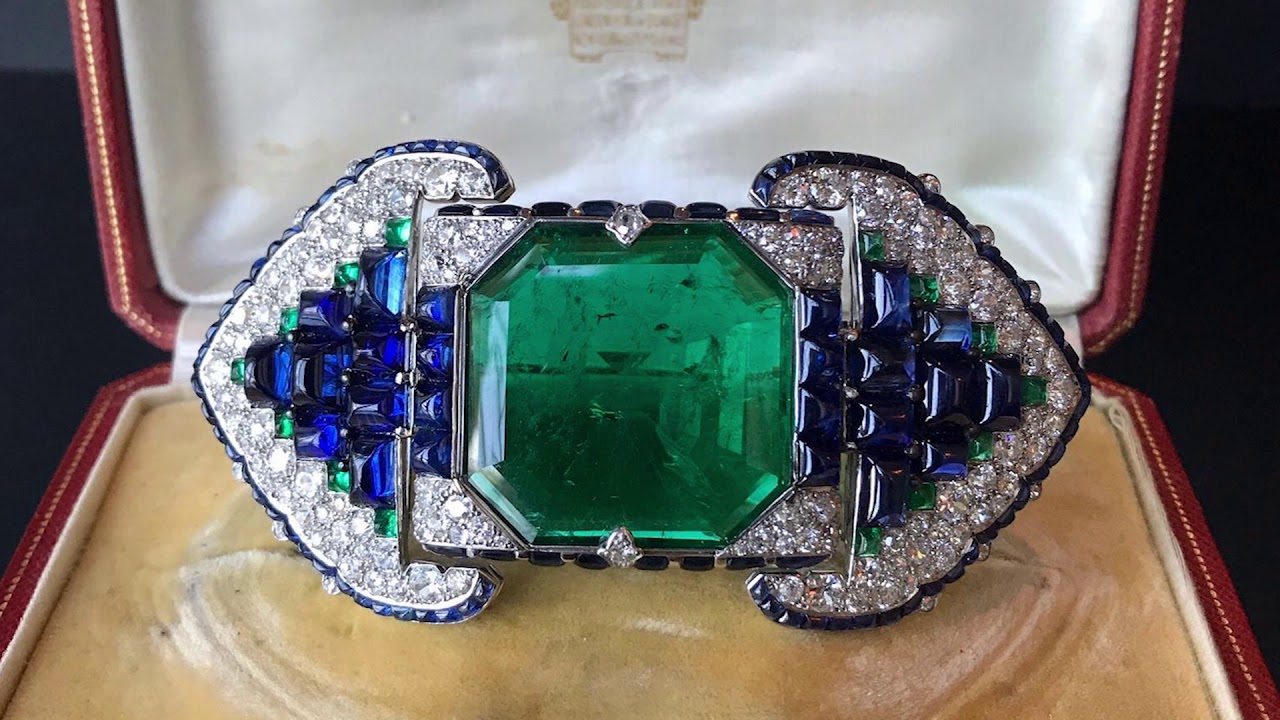
The Mughal tradition of carved gemstones (emeralds, rubies, and sapphires worked into leaves and floral forms) was central to what would later be called the Tutti Frutti style: dense, multicoloured jewelled compositions that became among the most distinctive and sought-after pieces the firm produced. The pieces and the journeys that inspired them are explored in Maharajas and Mughal Magnificence and Cartier and the Maharaja. Jacques's relationships with Indian royal clients were also a key source of some of the most significant stones that passed through the firm's hands. He also made repeated visits to Ceylon (now Sri Lanka) to source sapphires and pearls directly from local gem dealers, journeys that extended the firm's reach beyond the Bahraini pearl banks and the Indian royal courts, and the economics behind the pearl market that sustained it all.
On 13 March 1935, Jacques collapsed with hemorrhages on arriving at the Taj Mahal Hotel in Bombay; Nelly telegraphed the brothers in fear. It would be his last trip to India. On 20 December 1937, his head salesman Bellenger was lured to a London hotel by a fake aristocrat and robbed of nine diamond rings worth over 16,000 pounds; a night porter in Oxford spotted the thieves' suspicious Jaguar the following morning, 21 December, leading to their arrest. During the Blitz, which began on 6 September 1940, Jacques's Swiss son-in-law Carl Nater took shifts on the roof of 175 New Bond Street with hoses to douse incendiary bombs.
Jacques died on 10 September 1941, a year before his brother Louis. He was fifty-seven. On 17 September 1941, Pierre held a memorial for his youngest brother in New York. On 16 October 1941, Pierre discovered that his letters to Jacques during the war had been intercepted and never delivered. Among his children was Jean-Jacques Cartier (1919–2010), who would later run Cartier London, and in whose cellar Jacques's library and papers were eventually discovered and whose creative direction produced the Crash and Pebble watches.
Jacques Théodule Cartier is the great-grandfather of the author of The Cartiers.
Sources
- Francesca Cartier Brickell, The Cartiers (Ballantine Books, 2019), ch. 4 (“Jacques, 1906–1919”) and ch. 7 (“Precious London: Late 1920s”)
- Francesca Cartier Brickell, “Maharajas, Pearls and Oriental Influences: Jacques Cartier's Voyages to the East in the Early Twentieth Century,” JS12:103–115
- Hans Nadelhoffer, Cartier: Jewelers Extraordinary (Thames and Hudson, 1984; revised 2007), pp. 125, 126 et al.
- Wikipedia: Jacques Cartier