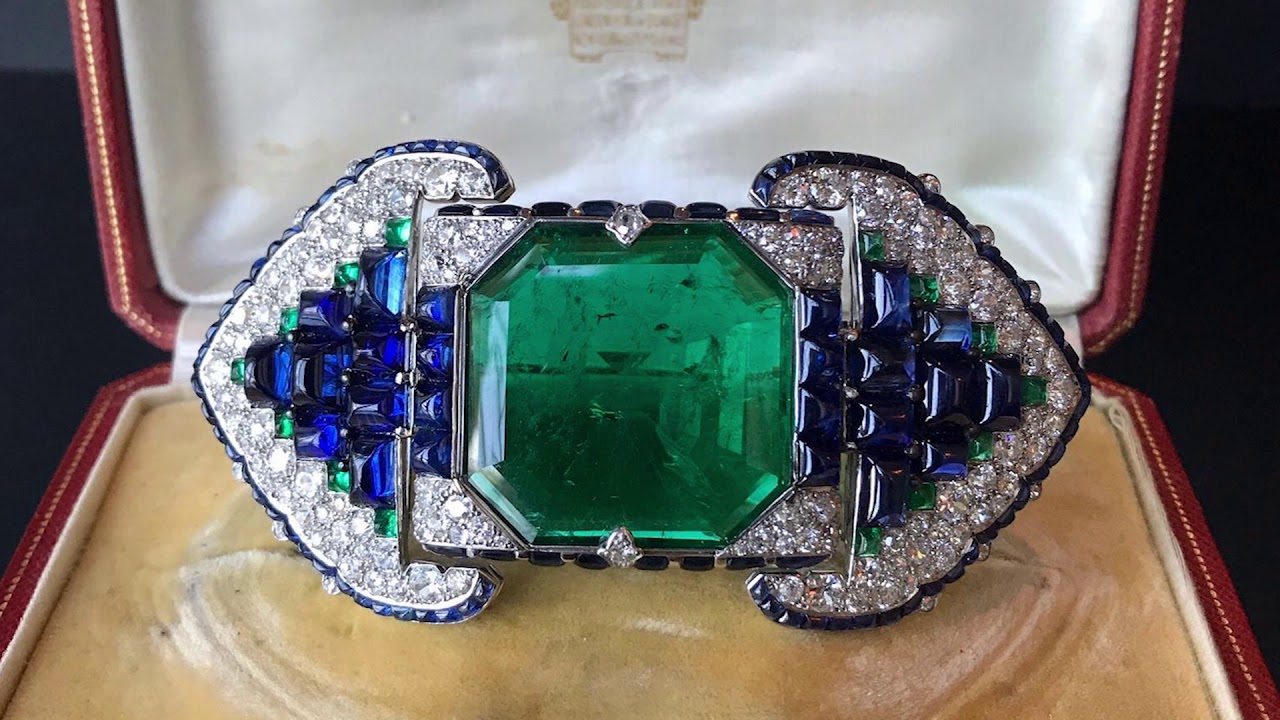
From the early 20th century, Cartier drew systematically on Persian, Islamic, and Mughal decorative traditions as sources of form, colour, and surface ornament. This was not a single defined movement, like the Egyptian Revival that followed the 1922 Tutankhamun discovery, but a sustained engagement running across several decades and expressed in different ways depending on which tradition was being drawn upon.
Persian miniature painting supplied a palette: deep turquoise, coral, jade green, and lapis lazuli used in flat, saturated combinations rather than the gradated shading of European naturalism. Cartier's enamellers and gem-setters translated this sensibility into enamel covers for vanity cases, cigarette cases, and clocks, often using geometric or floral borders drawn from Persian tilework and manuscript illumination.
Islamic geometric ornament provided a different kind of resource: the interlocking stars, hexagons, and arabesque patterns that appear across centuries of Islamic architecture and decorative arts from Spain to Central Asia. These geometric possibilities suited the emerging Art Deco aesthetic, where the interest in pure form and abstraction was already pulling designers away from the naturalistic motifs of the Belle Époque.
Mughal India supplied a third strand. The carved gemstones that Mughal jewellers had produced from the 17th century, emeralds, rubies, and sapphires carved with floral designs and inscriptions, circulated through the gem trade in the early 20th century. Jacques Cartier travelled repeatedly to India and the Persian Gulf, developing relationships with maharajas and gem dealers and acquiring stones directly from these sources. The carved Mughal gems he brought back were incorporated into Cartier pieces alongside European-cut diamonds, producing a fusion that drew equally on the two traditions.
This fusion was most fully expressed in the Tutti Frutti style of the 1920s, where carved emeralds, rubies, and sapphires were combined in jewellery that looked unlike anything produced in the European tradition alone. But the Mughal and Islamic influence also runs through pieces that are less obviously exotic in character: the use of colour, the approach to geometric patterning, the willingness to combine flat decorative surfaces with sculptural elements, all reflect the breadth of reference that Jacques Cartier and his colleagues brought back from their travels and absorbed into the house's visual language. That engagement is explored further in Maharajas and Mughal Magnificence and Cartier and Persian Islamic Inspiration.
Sources
- Francesca Cartier Brickell, The Cartiers (Ballantine Books, 2019), ch. 2 (“Louis, 1898–1919”) and ch. 4 (“Jacques, 1906–1919”)
- Hans Nadelhoffer, Cartier: Jewelers Extraordinary (Thames and Hudson, 1984; revised 2007), pp. 34, 45 et al.
- Francesca Cartier Brickell, “Maharajas, Pearls and Oriental Influences: Jacques Cartier's Voyages to the East in the Early Twentieth Century,” JS12:103–115
- Wikipedia: Persian and Islamic Influence