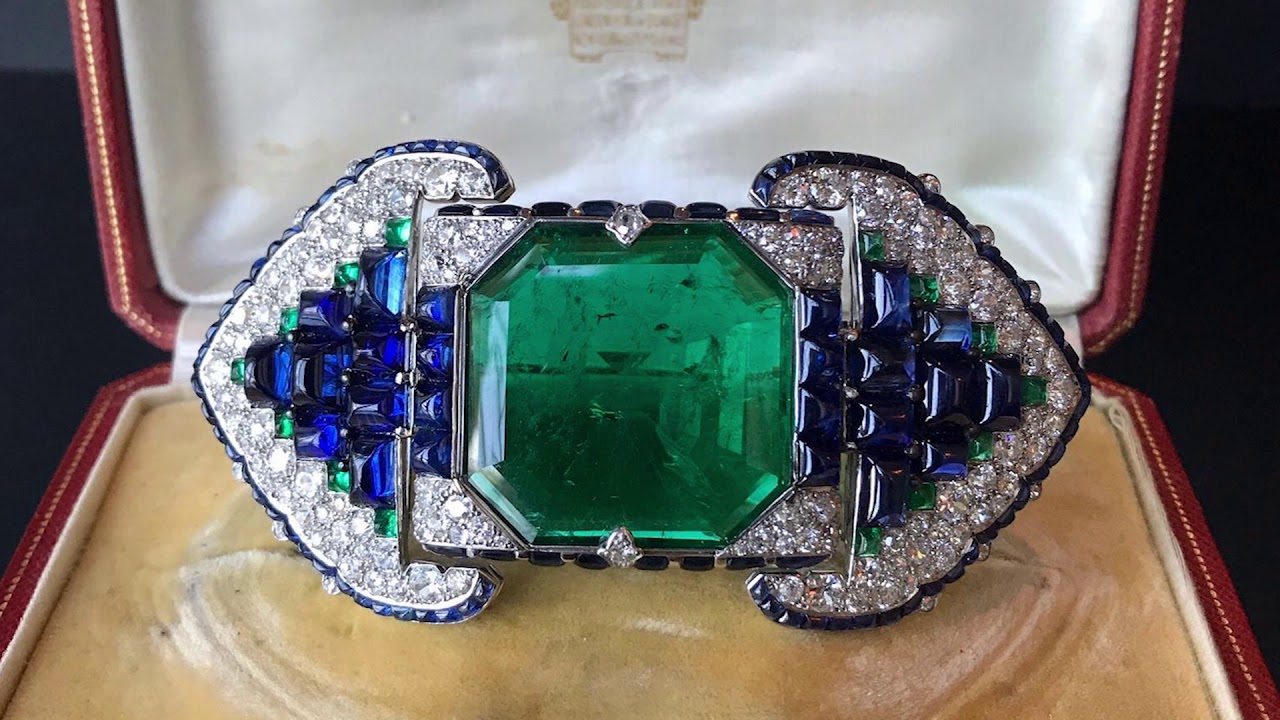
Cartier's engagement with Indian aesthetics developed from the early twentieth century and intensified as the firm built relationships with Indian maharajas who came to Paris seeking Western settings for their ancestral stones. The resulting work drew on Mughal jewellery traditions: carved, unfaceted coloured stones set in gold, with motifs derived from Indian decorative vocabulary rather than the diamond lace and garland forms of Cartier's European work.
Mughal Aesthetic Vocabulary
The Indian style at Cartier is characterised by several consistent features. Coloured stones, principally emeralds, rubies, and sapphires, are used in their carved and unfaceted forms rather than cut to exploit brilliance. Settings are in gold rather than platinum, reflecting the Mughal preference for warm metal. Motifs run to organic forms: the lotus, the leaf, the vine, and berry clusters. The overall effect is one of abundance and naturalism, quite different from the cool, geometric severity that defines Cartier's Art Deco platinum work of the same decades.
The aesthetic exchange ran in both directions. Maharajas brought their own ancestral carved stones to Paris to be reset in the new Western manner; Cartier's designers observed those stones and the surviving Mughal objects in which they had originally been set, and developed new compositions that referenced those sources.
"Hindou Jewels": Period Terminology
Pieces in this idiom were described at the time as "Hindou jewels" or under "pierres de couleur" (coloured stones). The term "Tutti Frutti" was not applied to the scattered carved-stone pieces during the period of their production; it entered wider use only in the 1970s, and Cartier trademarked it in 1989. This chronological gap between production and naming is worth noting when tracing descriptions of individual pieces in historical documentation.
The Tutti Frutti jewels are the most celebrated subset of the broader Indian style. They represent one specific compositional arrangement, with carved stones distributed across a flexible structure in a scattered all-over pattern, within a wider design vocabulary that encompasses more formal symmetrical compositions, single carved stone centrepieces, and hybrid pieces combining carved stones with faceted diamonds.
Distinction from Persian and Islamic Influence
The Indian style overlaps with but is distinct from the Persian and Islamic influence also documented in Cartier's work. Persian and Islamic-influenced pieces typically use geometric arabesque patterns, turquoise, lapis lazuli, and enamelled surfaces in compositions derived from Islamic architectural ornament and manuscript decoration. The Indian style, by contrast, draws on Mughal jewellery forms: carved organic stones in gold, with floral and vegetal motifs specific to the Mughal decorative tradition. In practice, pieces exist along a spectrum, and the two influences sometimes appear together, but the distinction in source material is clear in the pattern of the work.
Relationship to Tutti Frutti
The Tutti Frutti jewels represent the most commercially recognised form of Cartier's Indian output, but the underlying Indian style vocabulary extends across a wider range of objects. Formal necklaces with carved emerald drops, brooches centred on single carved rubies, and matching sets in which carved and faceted stones are combined all belong to this broader category. The maharaja commissions, explored in Maharajas and Mughal Magnificence and Cartier and the Maharaja, represent some of the most extensive documented uses of the Indian style vocabulary in Cartier's pre-war output.
Sources
- Francesca Cartier Brickell, The Cartiers (Ballantine Books, 2019)
- Hans Nadelhoffer, Cartier: Jewelers Extraordinary (Thames and Hudson, 1984; revised 2007), pp. 146, 155 et al.