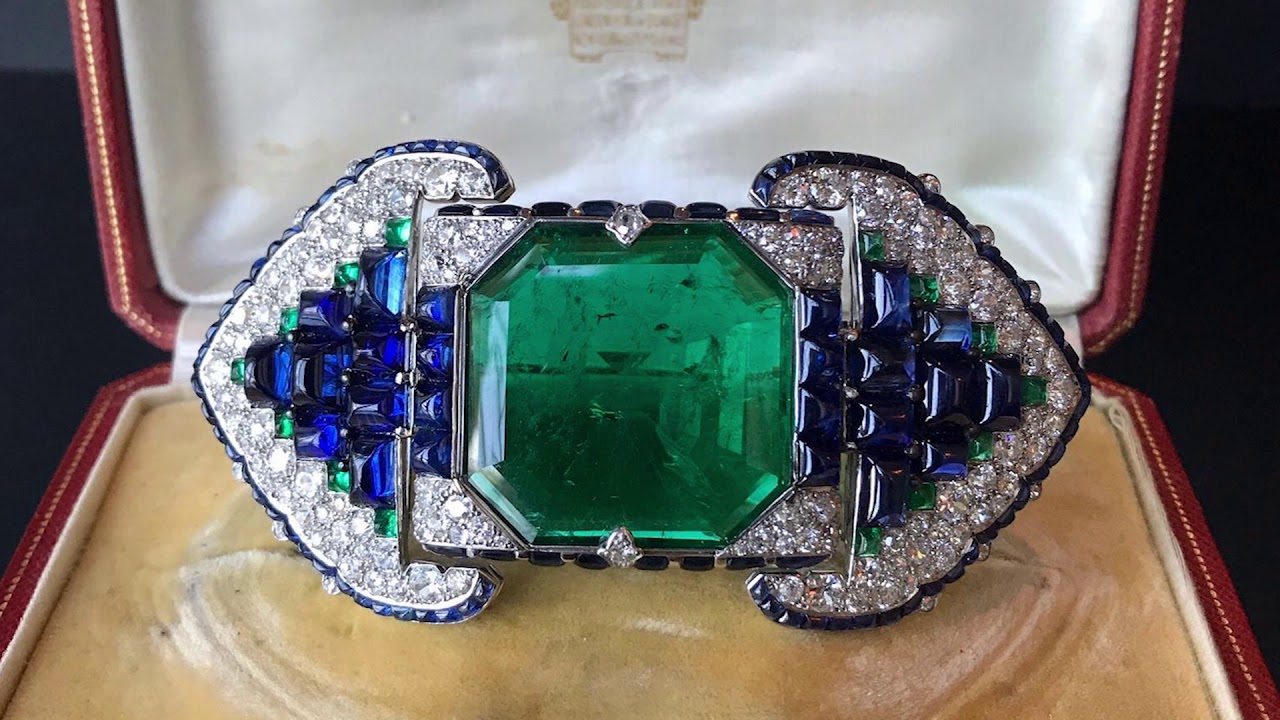
The relationship between Cartier and the courts of India's princely states is one of the more complex and consequential strands in the firm's history. It was not a simple retail relationship. The maharajas brought their own gem collections, built up over generations, and engaged Cartier to transform them. The traffic also went the other way: Cartier sought out Indian stones through dealers and auction, and the aesthetic encounter between Mughal jewellery traditions and Cartier's Paris workshops left traces in everything the firm designed for several decades.
Jacques Cartier and the Indian connection
The personal dimension of those relationships (what Jacques saw, what he brought back, and how it shaped the firm's work) is explored in Maharajas and Mughal Magnificence and Cartier and the Maharaja. Jacques Cartier was the brother most closely associated with building the Indian client network. He ran Cartier London and over twenty-eight years made repeated journeys to India, received maharajas and their representatives, and understood the strategic value of the relationship. The commissions he cultivated from the early 1900s onward were, in terms of the stones involved and the scale of the work, unlike anything the European market was generating at the time. Indian clients brought rubies, emeralds, natural pearls, and uncut diamonds from family treasuries that had been accumulating for centuries.
The Maharaja of Kapurthala
Among the Indian courts with a sustained relationship with Cartier, Kapurthala stands out for the depth and longevity of the connection. Jagadjit Singh, the Maharaja of Kapurthala, was a Francophile who built a replica of Versailles in the Punjab and spent decades in Paris society. His relationship with Cartier Paris ran from the early 1900s into the 1930s and encompassed turban ornaments, necklaces, and the remounting of stones from his personal treasury. He was present at the 1925 Paris Exposition des Arts Décoratifs, and the commissions that followed placed him among the most significant Indian patrons of that period.
The next generation extended the family's connection with Cartier in different directions. One of Jagadjit Singh's successors became a serious watch collector, acquiring multiple Cartier timepieces. Princess Amrit Kaur, whose style and jewels attracted attention in both Cartier's Paris circles and the fashion press, was described by Vogue as a figure whose aesthetic influence reached designers including Schiaparelli.
The Patiala necklace
The most publicised single commission was the Patiala Diamond Necklace, made in 1928 for Bhupinder Singh, Maharaja of Patiala. The piece used 2,930 diamonds, including the De Beers diamond (then the seventh-largest known diamond in the world) as the central stone. The necklace disappeared from the Patiala treasury after the 1940s. A portion of its original setting was traced to a London jeweller in 1998 and partially restored by Cartier with substitute stones, but the De Beers diamond and many of the original gems remain unaccounted for.
Remounting and aesthetic exchange
The remounting work (taking Mughal-era jewellery or loose Indian stones and resetting them in platinum in the Western taste of the 1910s and 1920s) raised questions that the trade was only beginning to think about. Indian clients wanted their stones in modern settings that would be accepted in European court and society contexts. The process also meant that Cartier's designers encountered carved Indian stones, engraved emeralds, and carved ruby beads, and absorbed that vocabulary into their own design language. The Tutti Frutti style, with its carved coloured stones set alongside diamonds, grew out of this encounter. The natural pearl trade was equally central: many maharajas held ancestral pearl collections of extraordinary scale, and transactions in pearls formed a significant part of the commercial relationship with Cartier.
Scale and significance
For the firm's finances, the Indian commissions mattered enormously in the 1920s and early 1930s. The stones involved were of a scale and quality that the European or American market could not easily match. That period of intense Indian patronage shaped Cartier's workshops, its designers, and its design vocabulary in ways that continued to show in the firm's work long after the political changes following Indian independence in 1947 fundamentally altered the purchasing power of the princely states.
Sources
- Francesca Cartier Brickell, The Cartiers (Ballantine Books, 2019)
- Francesca Cartier Brickell, "Maharajas, Pearls and Oriental Influences: Jacques Cartier's Voyages to the East in the Early Twentieth Century," JS12:103–115
- Hans Nadelhoffer, Cartier: Jewelers Extraordinary (Thames and Hudson, 1984; revised 2007), pp. 125, 155 et al.
- Wikipedia: Indian Maharajas