Jagatjit Singh became Maharaja of Kapurthala in 1877 at the age of five and reigned until his death in 1949. He is remembered as the most overtly Francophile of the Indian princes: a man who spoke French, spent long periods in Paris, and built his principal palace at Kapurthala in the Punjab in the style of Versailles. He appointed a French architect, employed French craftsmen, and filled the building with furniture, paintings, and decorative objects from French suppliers.
This orientation towards France made Cartier the natural jeweller for his major commissions. His relationship with the firm began in the early 1900s and continued through the 1930s, spanning the tenures of Louis Cartier, Pierre Cartier, and Jacques Cartier.
The Turban Ornament
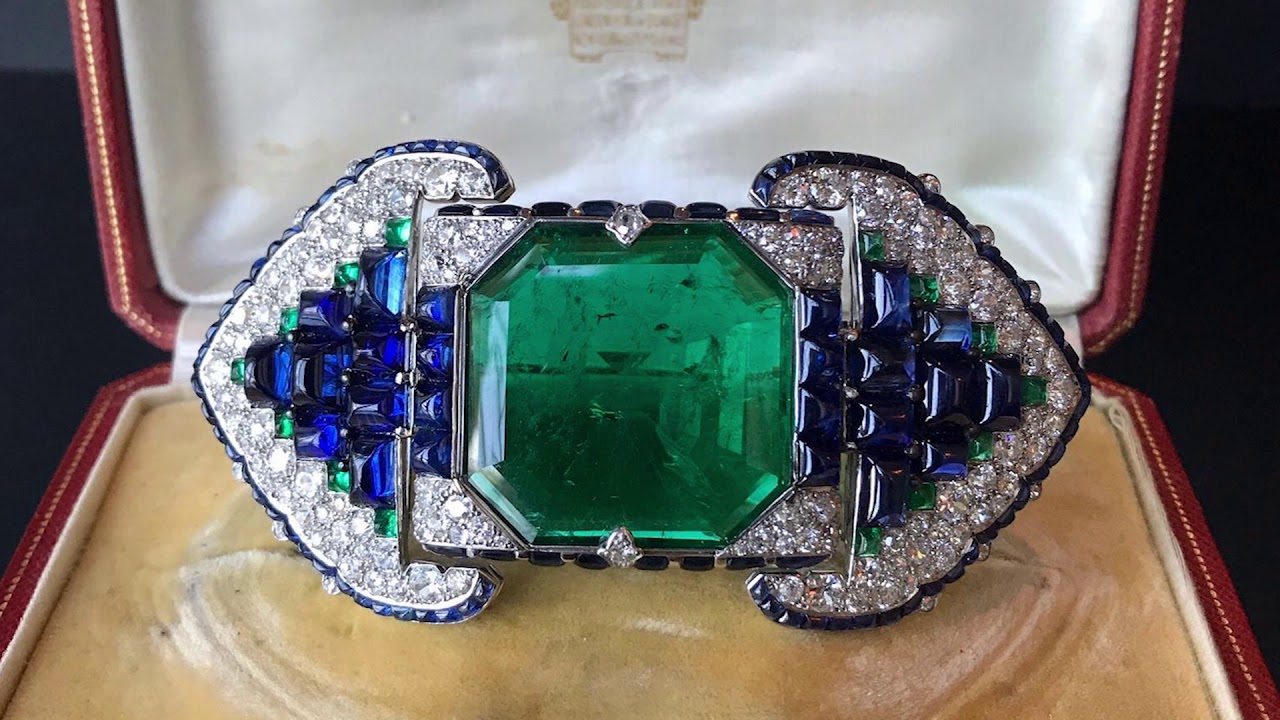
Among the most celebrated pieces Cartier created for Kapurthala is a turban ornament set with a carved emerald of exceptional size and quality. The emerald, weighing 177.4 carats, is hexagonal in form and carved in the Mughal tradition with floral motifs. Cartier mounted it in a platinum setting with supporting diamonds, producing a piece that combined a stone from the Mughal decorative tradition with the materials and techniques of the Paris workshop. The result was characteristic of the best Indo-European commissions of the 1920s.
The Scope of the Relationship
Beyond individual pieces, Kapurthala's relationship with Cartier encompassed the remounting of stones from his existing treasury: emeralds, rubies, diamonds, and spinels that had accumulated over generations were brought to the Paris workrooms and reset in new mountings reflecting the fashions of the 1910s and 1920s. This was a pattern common to the major Indian commissions. Maharajas rarely sold stones; they remounted them, keeping the material in the family while refreshing the settings.
Kapurthala also commissioned necklaces, bracelets, and other jewels for members of his household. His multiple visits to Paris, where he maintained an apartment in a fashionable quartier, meant that the relationship was maintained through direct contact rather than through agents or correspondence alone.
The 1925 Exposition
Kapurthala was present at the 1925 Exposition Internationale des Arts Décoratifs et Industriels Modernes in Paris, the event that codified what would later be called Art Deco. The timing of his major Cartier commissions overlaps with the geometric phase of the firm's design, and some of his pieces from this period reflect the bold, angular aesthetic of the mid-1920s.
Legacy
Jagatjit Singh died in 1949, having outlived the princely order that had produced him. The Kapurthala jewels dispersed over subsequent decades through inheritance and auction sales. Pieces from the collection appear in specialist auction catalogues, sometimes with their Cartier provenance documented, sometimes not. The turban ornament is among the most reproduced images of Indo-European jewellery collaboration.
Sources
- Francesca Cartier Brickell, The Cartiers (Ballantine Books, 2019), ch. 2 (“Louis, 1898–1919”) and ch. 4 (“Jacques, 1906–1919”)
- Hans Nadelhoffer, Cartier: Jewelers Extraordinary (Thames and Hudson, 1984; revised 2007), pp. 145, 155 et al.
- Wikipedia: Maharaja of Kapurthala