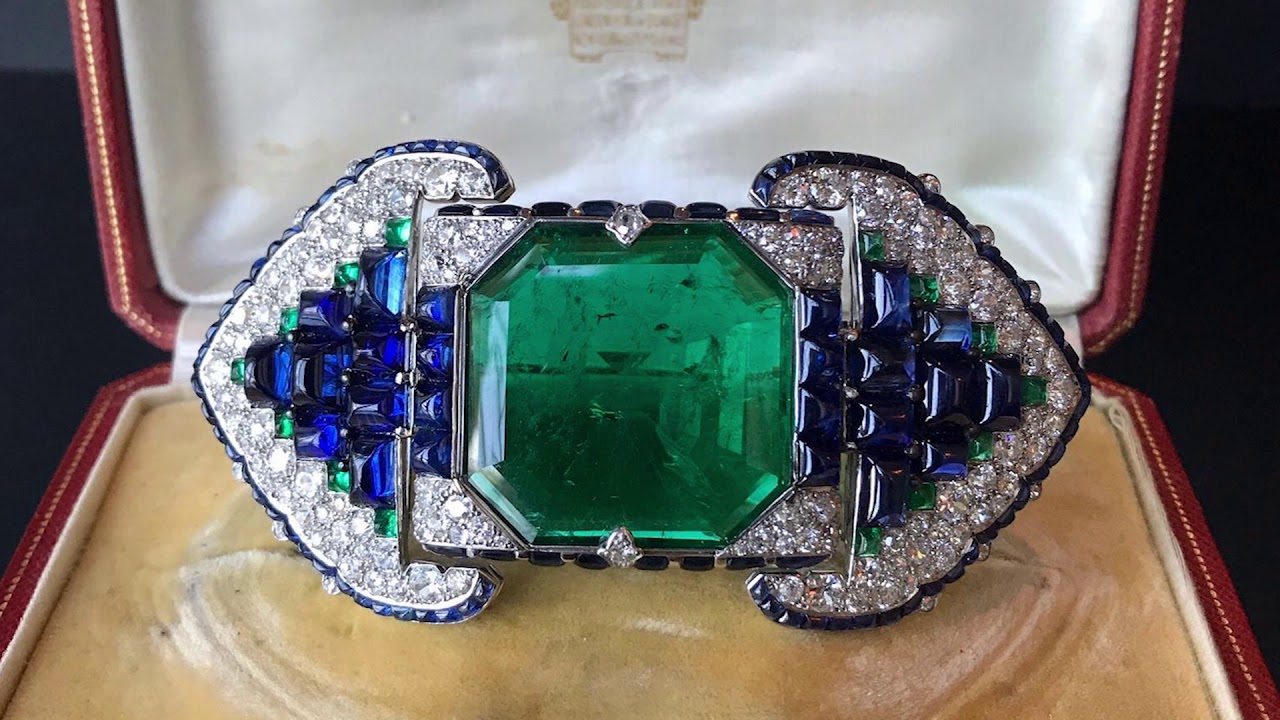
Tutti frutti is the collector's nickname for a style of Cartier jewellery (particularly bracelets, necklaces, and brooches) in which carved coloured gemstones are combined in dense, multicoloured compositions evoking the rich decorative tradition of Mughal jewellery. The name is not one Cartier itself used; it was applied retrospectively by the market as a vivid shorthand for a distinctive and immediately recognisable aesthetic.
The signature materials of the style are carved emeralds, rubies, and sapphires, shaped into leaves, berries, and floral forms, set alongside diamonds in platinum or gold mounts. The carving is essential to the effect: the stones are not simply faceted in the conventional manner but worked into three-dimensional forms that give the jewellery a sculptural quality absent from standard gem-set pieces. The combination of the three coloured stones with diamonds creates an effect of abundant, jewelled botanicals.
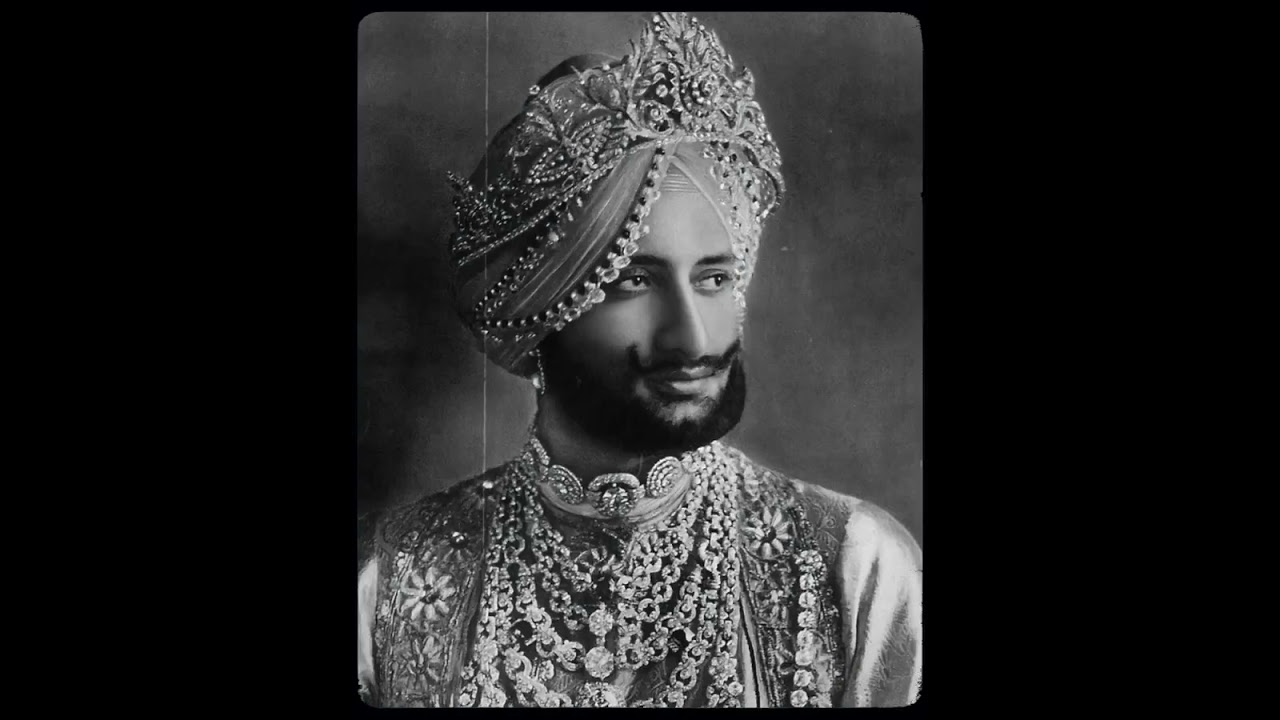
The inspiration came from Cartier’s engagement with the art and jewellery of Mughal India, and with the Persian and Islamic decorative traditions that informed many of the firm’s designs, where carved gemstones had a long tradition and where European jewellers had been acquiring exceptional stones and commissions since the late nineteenth century. Jacques Cartier’s travels to India (sustained over twenty-eight years), alongside his visits to Ceylon to source sapphires directly, and the relationships the firm developed with Indian royal clients were central to this creative exchange.
Jacques Cartier’s diaries record the depth of his intellectual engagement with Indian history and art, a perspective that went well beyond commercial gem-buying.
Maharajas and Mughal Magnificence and Cartier and the Maharaja explore this relationship and its creative consequences in detail.
The style flourished particularly during the late 1920s and into the 1930s, overlapping with the Art Deco period (explored in Cartier Art Deco: A Beautiful Adornment) while drawing on a different source tradition. The pieces are notable for the quality and quantity of their carved stones, which were themselves historic objects (often recycled from older Indian jewellery) given new settings in Paris.
The story of how the style developed, and the clients who commissioned the defining pieces, including Daisy Fellowes, is covered in Maharajas and Mughal Magnificence and Cartier and the Maharaja, and in The Cartiers, ch. 7 and 8.
Sources
- Francesca Cartier Brickell, The Cartiers (Ballantine Books, 2019), ch. 7 (“Precious London: Late 1920s”) and ch. 8 (“Diamonds and Depression: The 1930s”)
- Hans Nadelhoffer, Cartier: Jewelers Extraordinary (Thames and Hudson, 1984; revised 2007), p. 170.
- Sotheby's, "The Story of Cartier Tutti Frutti Jewels, As Told by a Descendant"
- Sotheby's, Magnificent Jewels, New York, 2015, lot 356: Iconic 'Tutti Frutti' Bracelet, Cartier