The Persian Gulf was, for centuries, the world's most important source of natural pearls. The beds off the coast of Bahrain, together with those along the coasts of what are now Qatar, the UAE, and Kuwait, produced pearls that found their way into the treasuries of India, Persia, and Europe. It was this trade that drew Jacques Cartier to Bahrain for the first time in 1912, on what he described in a letter to his brother Louis as "the most important mission bestowed on me during this trip to the East": to investigate the pearl market and establish a direct channel for purchasing.
The economics of the pearl trade in the early twentieth century were striking. By some contemporary accounts, a good-quality natural pearl was priced at roughly four times the value of a diamond of the same weight. It has been written that a matched pearl necklace could command a sum greater than a Rembrandt painting. The best examples from the Gulf were perfectly round, with a deep orient (the characteristic iridescent glow produced by nacre layers), and they commanded the highest premiums of any gem material in the pre-war luxury market.
Jacques Cartier was not operating in isolation. The Rosenthals, another group of jeweller brothers with international reach, had already established trusted relationships with the pearl sheikhs of Bahrain and the wider Gulf. The trade was built on personal connections, and gaining the confidence of the local merchants required repeated visits and sustained engagement. Jacques would return to the Gulf and the broader pearl-producing regions several times, combining pearl buying with his wider travels through Ceylon and India.
The pearls sourced from the Gulf fed directly into some of Cartier's most celebrated creations, including the double-strand necklace that Pierre Cartier exchanged with Maisie Plant for the 653 Fifth Avenue mansion in 1917. The full story of the Cartier brothers and the pearl market is explored in The Cartiers and the Pearl Market and Bahrain: Exploring the Land of Pearls.
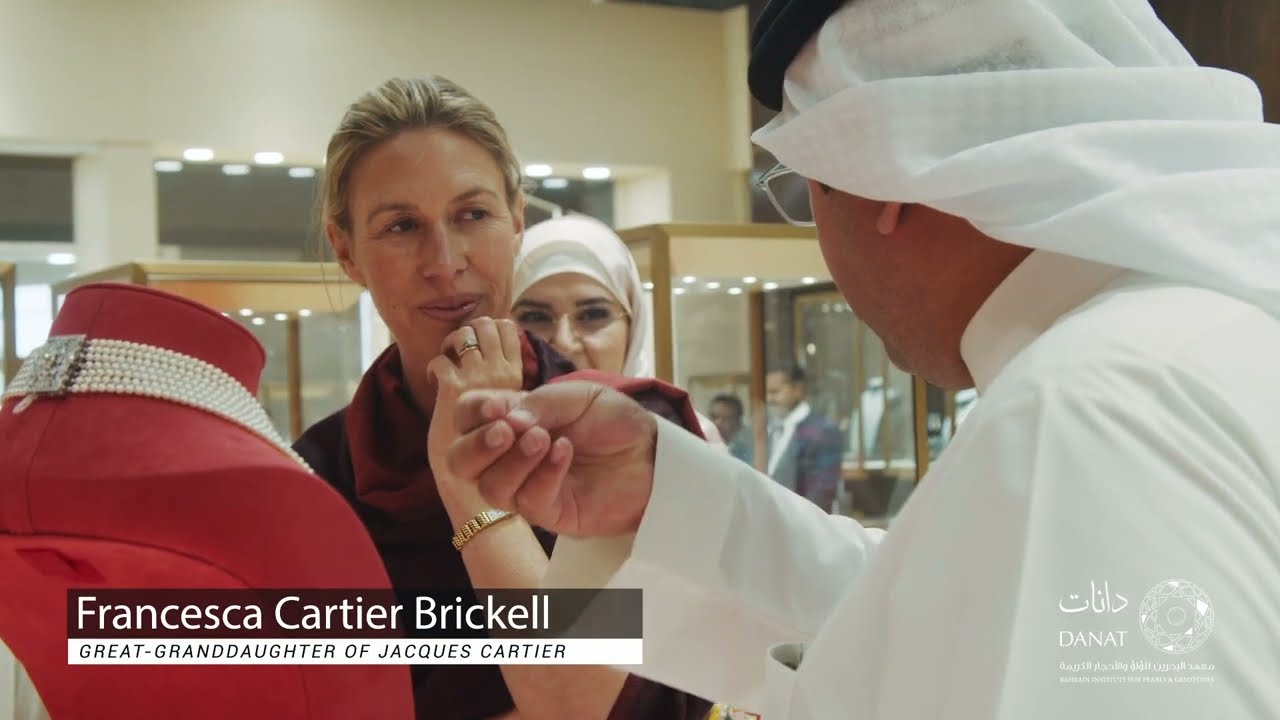
Today, DANAT (the Bahrain Institute for Pearls and Gemstones) maintains the heritage of the Gulf pearl trade and hosts events connecting descendants of the merchant families Jacques Cartier knew with the broader history of the trade.
Sources
- Francesca Cartier Brickell, The Cartiers (Ballantine Books, 2019), ch. 4 ("Eastern Missions")
- Francesca Cartier Brickell, "Maharajas, Pearls and Oriental Influences", The Journal of the Swiss Society of Jewellery Studies, 12 (2021), pp. 103–115