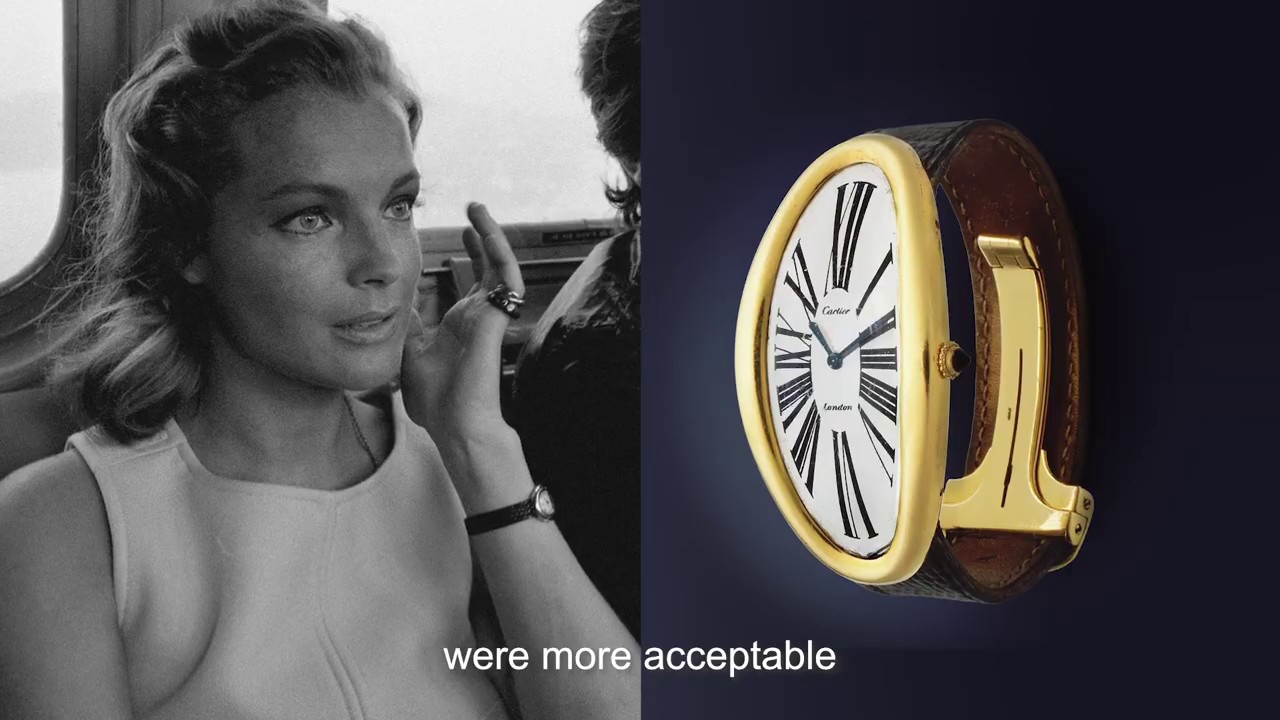
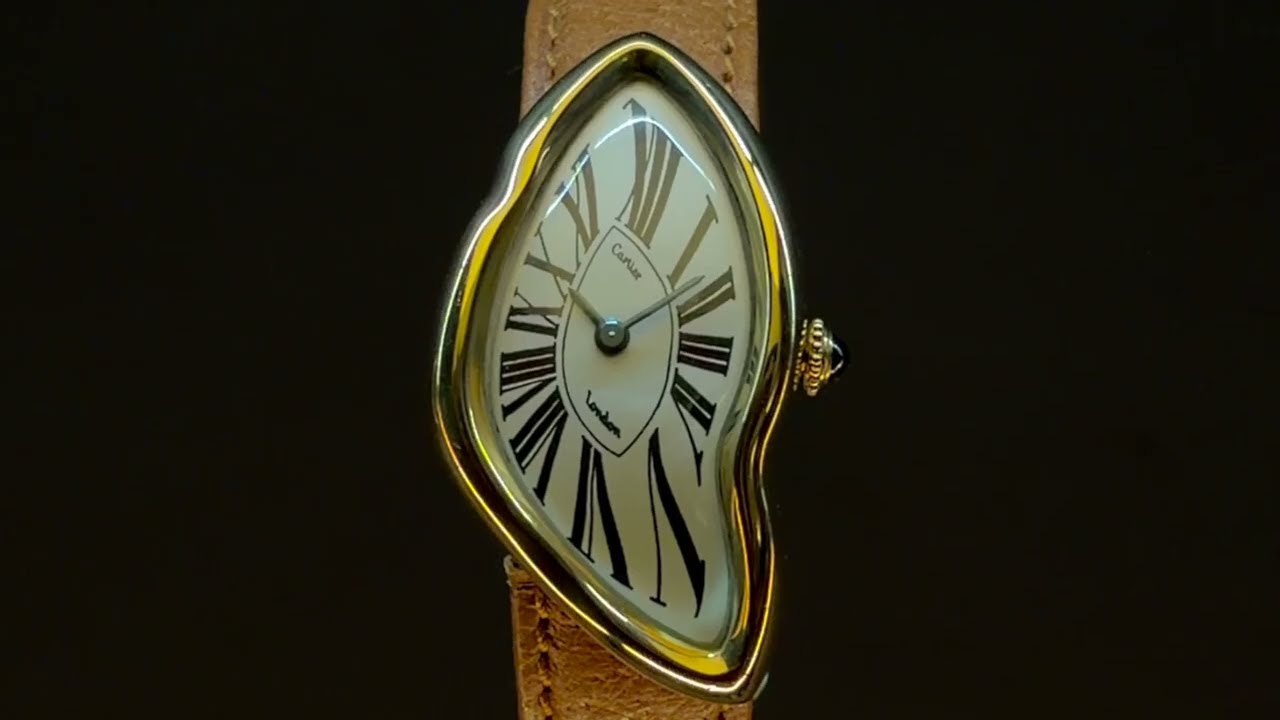
Tonneau is the French word for barrel, and in watchmaking it describes a case whose outline curves outward at the widest point (the horizontal centre) then tapers toward the top and bottom where the strap attaches. Viewed from the front, the shape resembles a cross-section of a barrel or cask.
The tonneau case was developed in the early twentieth century as watchmakers moved away from the round pocket-watch form toward shapes better suited to the wrist. The curved outline follows the natural contour of the wrist more sympathetically than a rectangle, and the tapered ends reduce the perceived bulk at the top and bottom of the case. The form was popular across several manufacturers in the pre-war period (Vacheron Constantin adopted the tonneau shape as early as 1912, and Patek Philippe introduced its own versions within a few years) and is particularly associated with Cartier's early wristwatch output.
Cartier produced tonneau-cased watches from 1906 onwards, and surviving examples from this period are among the earliest and most historically significant Cartier wristwatches in existence. The Tortue followed in 1912 and the Tank in 1917; it was the Tank that came to dominate, and the Tonneau receded in Cartier's output through the mid-century decades.
A 1914 Tonneau Watch Sold by Cartier London is a period example. A 1915 Tonneau Cintrée á Pattes once belonged to the photographer Baron Adolph de Meyer, a figure at the intersection of fashion and the avant-garde.
The tonneau is sometimes confused with the Tortue (turtle) case, which has a more pronounced curve and a specifically convex top and bottom as well as sides. In collector usage, tonneau generally refers to the symmetrically barrelled outline, while tortue describes the more complex curved form in which the case bows outward on all sides.
The tonneau has generally been produced as a time-only or dual-timezone watch. Where Cartier housed complications, it was typically in the Tortue case.
Case and Dial
The tonneau case curves outward at the midpoint of each side, producing the barrel profile, then tapers toward the top and bottom where the strap lugs attach. Seen face-on, the outline describes a gentle symmetrical convexity on the left and right, with straighter lines at the top and bottom. The dial on period examples is typically white or cream enamel, carrying black Roman numerals within a fine railway-track minute chapter ring. Hands are blued steel, usually in the sword profile. The winding crown at the twelve o'clock position carries a blue sapphire cabochon. The "Cartier" signature appears on the upper half of the dial, and the numerals are arranged to follow the curvature of the case rather than sitting on a strict circular chapter, which gives the tonneau dial a subtly different rhythm from that of a round watch.
The case proportions are relatively compact by modern standards. Early twentieth-century tonneau watches were typically under 30mm across at the widest point, reflecting the period's preference for watches that sat discreetly on the wrist. The curved case band follows the barrel profile on its sides, and the bezel (where present) follows the same contour, so the entire object reads as a single curved form.
Specialists dating vintage tonneau watches look at case proportions, lug design, dial typography and material, and the movement inside. Early Cartier wristwatches (including tonneau pieces) were typically fitted with movements from specialist Swiss suppliers rather than made in-house.
Modern Versions
Cartier revived the Tonneau under the Collection Privée Cartier Paris (CPCP) programme, which ran from 1998 to 2008 and produced watches in very limited numbers. In 2006, marking the Tonneau's centenary, Cartier released a hand-wound time-only Tonneau XL and a Tonneau XL Two Time Zone under CPCP. The tonneau case also found new life at other houses: Franck Muller's Curvex (from 1992) and Richard Mille's RM001 (2001) both adopted the barrel profile for different purposes.
Sources
- Francesca Cartier Brickell, The Cartiers (Ballantine Books, 2019), Notes to Chapter 2, p. 62: lists the Tonneau (1906) among early Cartier watch models
- Hans Nadelhoffer, Cartier: Jewelers Extraordinary (Thames and Hudson, 1984; revised 2007), pl. 10
- Christie's, lot 5674794: Cartier Tonneau Cintrée á Pattes, 18K gold, case no. 7118, c.1915, ex-Baron Adolph de Meyer
- Chris Hall, "A History of Tonneau" (i-m magazine, June 2023)
- Ken Kessler, "The Tonneau: 10 Barrel-Shaped Watches" (Revolution Watch, October 2019)
- Monochrome Watches, "Pre-SIHH 2019: Cartier Privé Collection, The Comeback of the Cartier Tonneau" (December 2018)