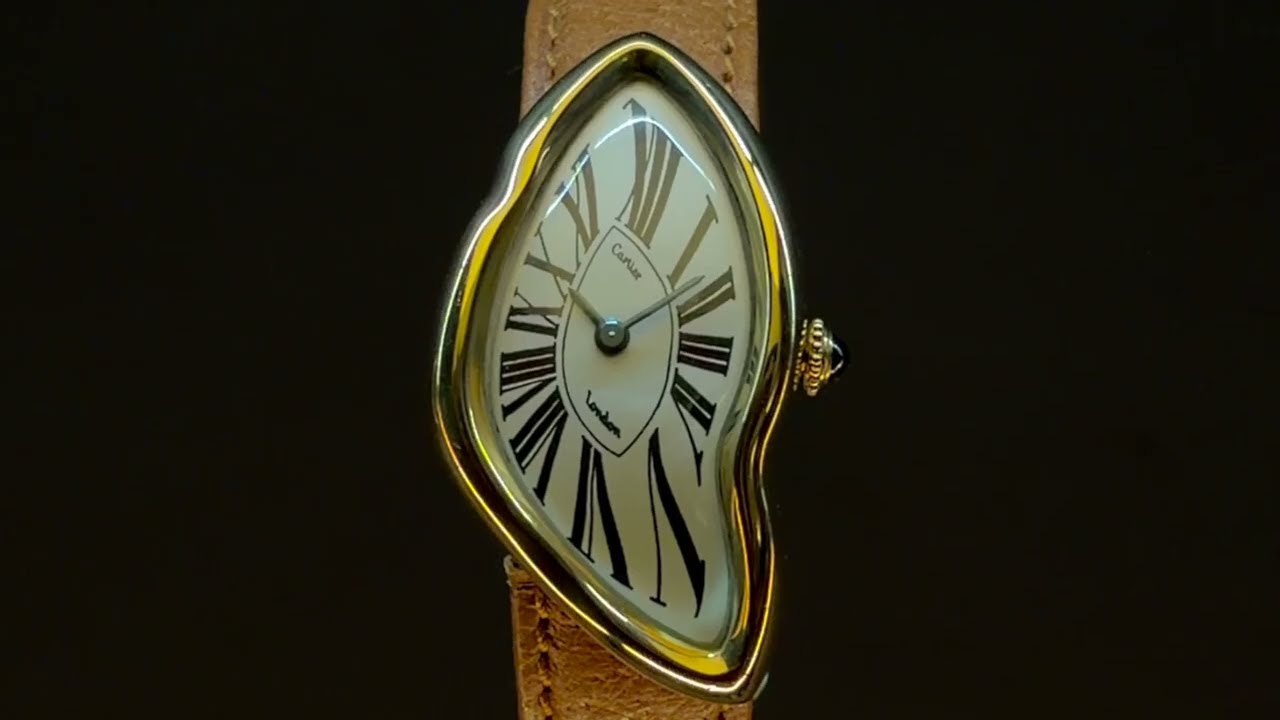
The Cartier Octagonal is a wristwatch case form produced by Cartier London under Jean-Jacques Cartier at 175 New Bond Street in the 1960s and 1970s. An octagon has eight sides; in its standard watch case form, the Octagonal is an approximately symmetrical polygon, the eight flat sides meeting at defined angles and producing a case that is neither circular nor rectangular but sits distinctly between the two. The form has a clarity and compactness that distinguishes it from the round Ronde or the elongated variants such as the Octagonal Allongée.
Cases were fabricated by the Wright & Davies workshop in Clerkenwell and brought to New Bond Street for movement fitting and finishing by Eric Denton, the same production arrangement used for all Cartier London watches of the period.
Case and Dial
The eight-sided case is compact and approximately symmetrical, each of its flat sides meeting its neighbour at a defined angle of 135 degrees. The dial is typically cream or silvered, with black Roman numerals arranged in a near-circular pattern within the octagonal aperture. Hands are blued steel swords, and the winding crown carries a blue sapphire cabochon. The bezel, following the eight-sided outline, catches light at each facet in a way that distinguishes it from a round watch even at casual glance. The proportions are moderate: the Octagonal was not designed to make a bold statement about size or presence, but to demonstrate that a polygon could serve as a watch case with as much visual coherence as a circle or rectangle.
Geometric case range
The Octagonal is the base form from which the Octagonal Allongée derives. Where the Allongée stretches the octagon on one axis to produce a more elongated case, the standard Octagonal keeps the eight-sided geometry in a compact, nearly symmetrical proportion. The two forms are related in the same way as the Baignoire and the Baignoire Allongée: a base geometry and a stretched version of it, both viable as distinct watch designs.
The Octagonal belongs to a wider family of case forms produced simultaneously at Clerkenwell in the 1960s and 1970s. Alongside it, the workshop was making Decagonals, Rounds, Tanks, Ovals, and the Crash, The octagonal case form itself has a long history in watchmaking: Cartier had been producing octagonal cases from the early twentieth century, and the form sits naturally alongside the house's other geometric departures from the circle, including the rectangular Tank and the barrel-shaped Tonneau.
A yellow gold Octagonal was among the pieces in the 88-watch collection sold at Monaco Legends in 2021, which brought together Cartier London pieces made under Jean-Jacques Cartier and offered a detailed public view of the range produced at 175 New Bond Street in that period.
Sources
- Hans Nadelhoffer, Cartier: Jewelers Extraordinary (Thames and Hudson, 1984; revised 2007), pp. 75, 237 et al.