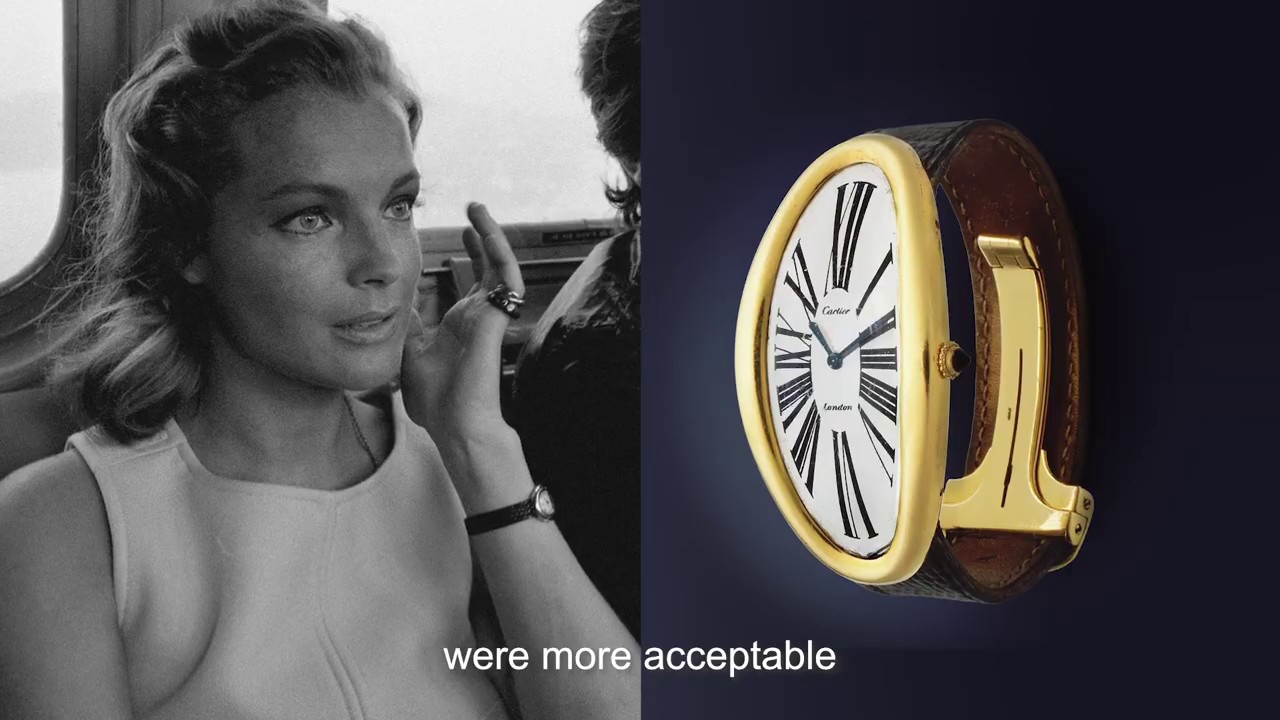
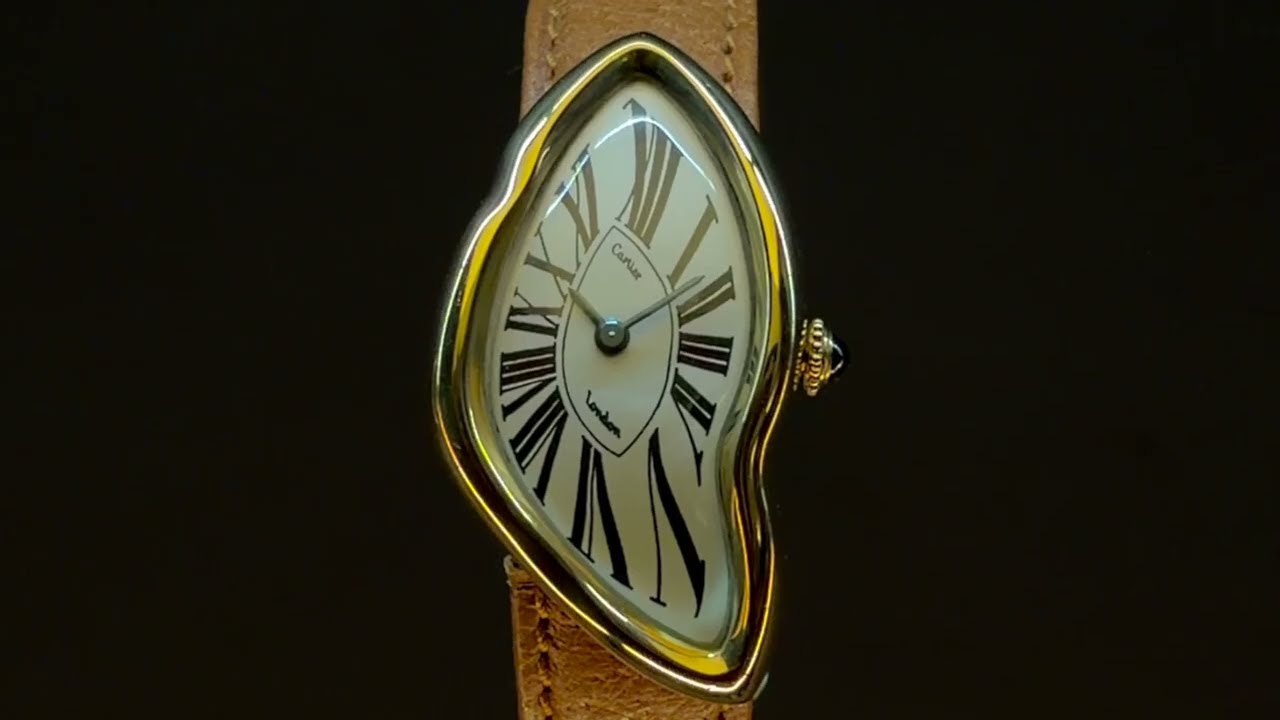
The Cartier Maxi Oval (also called the Baignoire Allongée, French for "elongated bathtub") is an elongated oval wristwatch produced by Cartier London under Jean-Jacques Cartier at 175 New Bond Street in the 1960s and 1970s. The case is a stretched version of the standard oval Baignoire form: wider at the centre than at the strap ends, with a pronounced horizontal emphasis that gives it a more dramatic proportion than a symmetrical oval.
Cases were made by the Wright & Davies workshop in Clerkenwell, following the same production pattern as other Cartier London watches of the period: fabricated in Clerkenwell, then brought to New Bond Street for movement fitting and finishing by Eric Denton.
Case and Dial
The Maxi Oval case is a dramatically elongated ellipse, wider at the centre and tapering to narrow rounded ends where the strap attaches. Cases can exceed 58mm in overall length, giving the watch a bold horizontal presence on the wrist. The dial is cream or silvered, with black Roman numerals arranged along the oval contour. On the most elongated examples, the numerals near the III and IX are stretched wider apart while those near the XII and VI are compressed, following the logic of the case geometry rather than a standard circle. Hands are blued steel swords, proportioned to the oval dial. The winding crown is set at the three o'clock position (on the long side of the case, at its widest point) and carries a blue sapphire cabochon. The overall impression is of a watch that treats the wrist as a canvas for an elongated jewel-like form, closer to a bracelet than to a conventional timepiece.
The oval family and the Crash
The Maxi Oval, the Cartier Crash, and the standard Baignoire all draw from the same oval vocabulary: they are variants within a related family of case forms rather than a simple sequence. When Jean-Jacques Cartier briefed designer Rupert Emmerson on the Crash, the starting point was "the popular Oval": the brief was to take that form and adjust it to look as though it had been in a crash. The Crash and the Maxi Oval were being produced in the same workshop, in the same period, from the same oval geometry: one enlarging it, one distorting it.
Cartier London oval variants
The Cartier London oval family encompassed several related forms. The standard Baignoire and the Maxi Oval share the same basic geometry at different scales; the Baignoire Allongée name describes the elongated proportion specifically. In the 88-watch collection that appeared at auction in Monaco (comprising Cartier London pieces made under Jean-Jacques Cartier in the 1960s and 70s), a white gold Maxi Oval appeared alongside an Octagonal, a Decagonal, a Round, a Tank, and an Octagonal Allongée, giving a sense of the range of case forms the London branch was producing in that period.
Sources
- Francesca Cartier Brickell, The Cartiers (Ballantine Books, 2019), ch. 11 (“The End of an Era, 1957–1974”)
- V&A Museum, London, “Cartier” exhibition (April–November 2025): featured the Maxi Oval (1968) among iconic Cartier London designs
- Phillips, New York Watch Auction X: Cartier Maxi Oval in 18K yellow gold, 1969
- Christie's, lot 6460483: Cartier Maxi Ovale in 18K gold, London date letter 1968