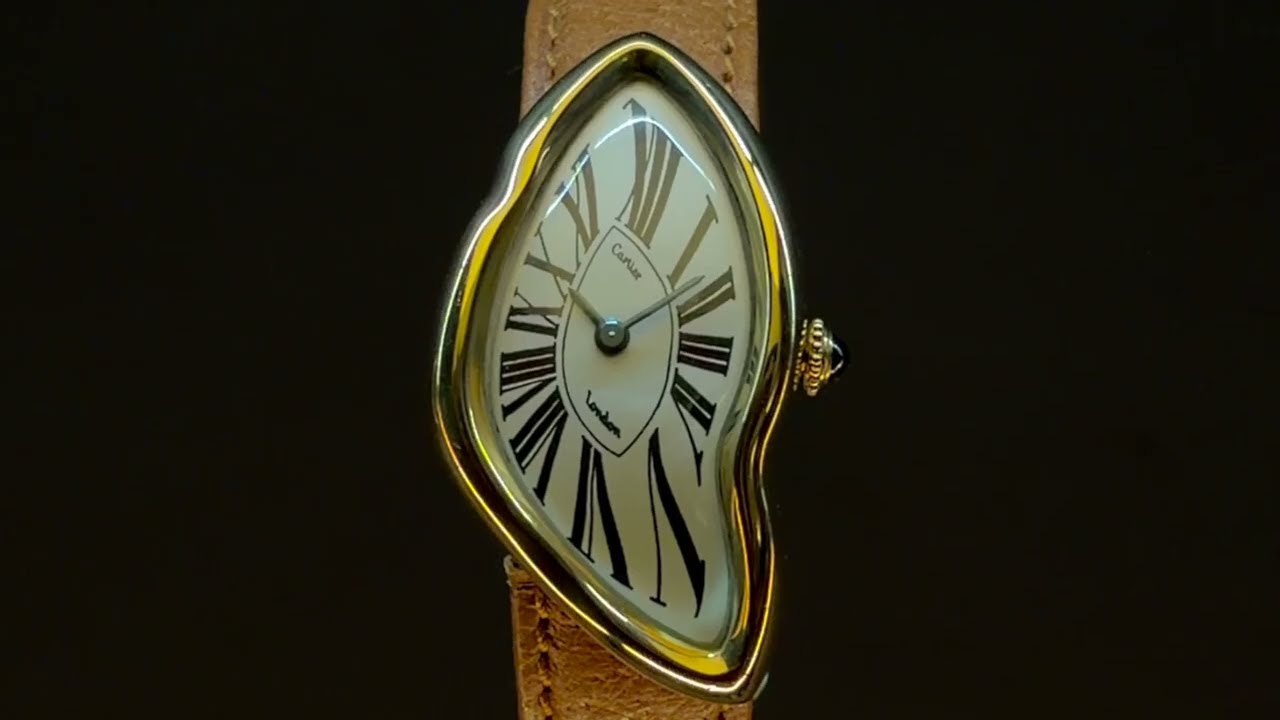
The Cartier Decagonal is a wristwatch case form produced by Cartier London under Jean-Jacques Cartier at 175 New Bond Street in the 1960s and 1970s. A decagon has ten sides; applied to a watch case, the form approximates a circle at small scale but is clearly faceted, the ten flat or gently curved sides meeting at defined angles rather than resolving into a continuous curve. The result is a case that sits between the emphatic geometry of the Octagonal and the circularity of the Ronde: a more subtle polygon, but a polygon nonetheless.
Cases were fabricated by the Wright & Davies workshop in Clerkenwell and brought to New Bond Street for movement fitting and finishing by Eric Denton, following the production pattern shared by all Cartier London watches of the period.
Case and Dial
The ten-sided case produces a dial aperture that approximates a circle but retains visible faceting at each of the ten flat sides. The dial is typically cream or silvered, with black Roman numerals arranged around a fine chapter ring. Hands are blued steel swords, and the winding crown carries a blue sapphire cabochon. The "Cartier London" signature appears on the upper half of the dial. Because the case is nearly circular, the numeral spacing is regular, close to that of a round watch, and the visual distinction from a Ronde lies primarily in the bezel: where the Ronde's bezel follows a continuous curve, the Decagonal's catches the light differently at each of its ten flat facets, creating a subtle geometric play visible at close range but easy to miss at a distance.
Geometric case range
The Decagonal belongs to a wider family of case forms that Cartier London was producing simultaneously in the 1960s and 1970s. The Clerkenwell workshop was making Octagonals, Decagonals, Rounds, Tanks, Ovals, Baignoires Allongées, Octagonal Allongées, and the Crash across a production window of roughly fifteen years. The coexistence of these forms
The ten-sided case is among the less immediately recognisable forms in the range, its approximation of circularity making it easy to overlook at a distance. Up close, the faceting is evident and deliberate: the Decagonal is not a round watch with softened edges but a geometric object in its own right.
A yellow gold Decagonal appeared in the 88-watch collection sold at Monaco Legends in 2021, which assembled Cartier London pieces made under Jean-Jacques Cartier and provided one of the most detailed public views of the range of case forms produced at 175 New Bond Street in that period.