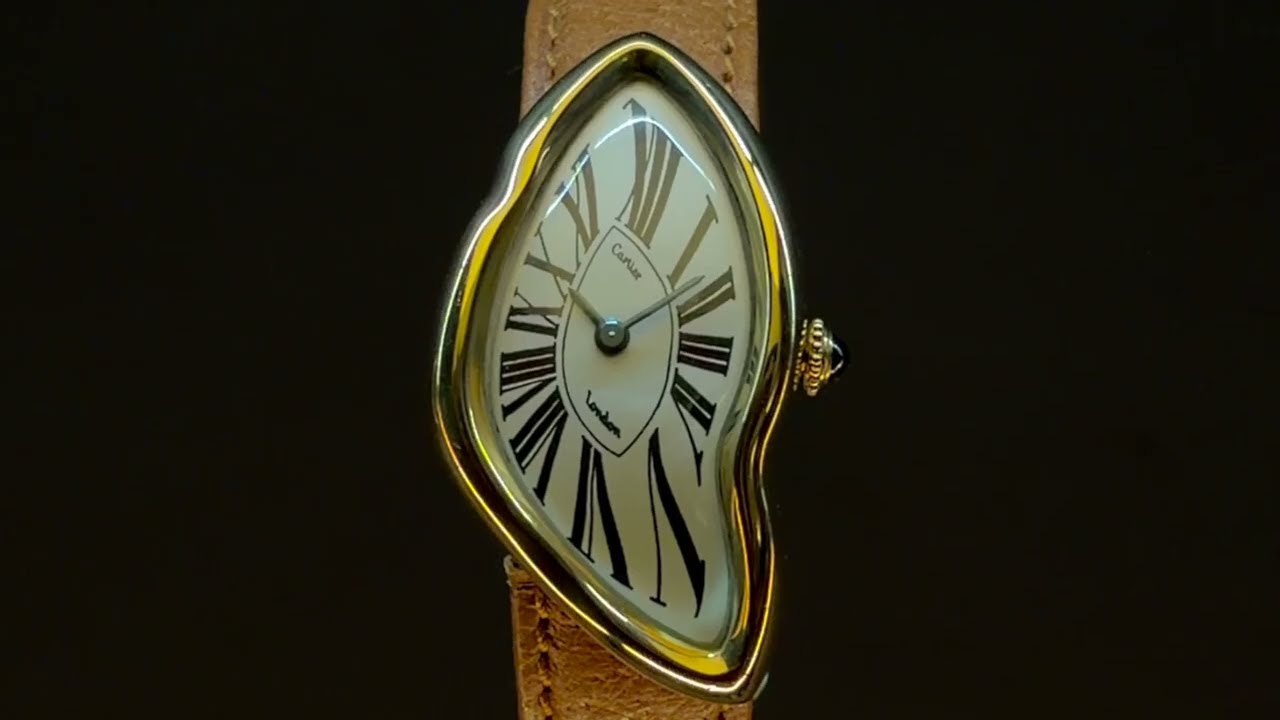
Cartier's reputation in watch design rests primarily on its geometric shapes: the rectangular Cartier Tank, the cushion-form Cartier Santos, the oval Cartier Baignoire, the elongated Cartier Tonneau. The round case (ronde in French) ran alongside these throughout the early and mid twentieth century as a quieter option, though it was not at the time called the Ronde or sold under that name. It was simply a round watch, and round was what most watches had always been.
The circle is the oldest case shape in portable timekeeping. Pocket watches were circular almost without exception, following the shape of the movement inside. When wristwatches emerged in the early twentieth century, many of the first examples simply carried a circular pocket movement into a bracelet mount. The round wristwatch carried no geometric novelty; its associations were with continuity and convention.
Case and Dial
The Ronde case is circular, carrying the same form that pocket watches had used for centuries. The bezel is a plain round ring in gold or platinum. The dial is white, cream, or silvered, with black Roman numerals evenly spaced around the circumference. A railway-track minute chapter ring (the chemin de fer) encircles the numerals, providing a precise minute scale in the form of fine radial tick marks between two concentric circles. Hands are blued steel swords, their colour contrasting sharply against the pale dial. The winding crown carries a blue sapphire cabochon at the three o'clock position. The "Cartier" (or "Cartier Paris", "Cartier London") signature sits on the upper dial, typically between the X and II. On some examples, a small seconds sub-dial appears at the six o'clock position. The overall impression is of classical restraint: the Ronde carries the full Cartier dial vocabulary without the geometric case forms that draw attention to themselves.
Round Watches from the Three Branches
The Paris, London, and New York branches each produced round-cased watches through the first half of the twentieth century. These carried the firm's standard visual language: Roman numerals, the railway-track minute chapter, blued steel sword hands, and the winding crown set with a cabochon , the same elements that appeared on the shaped models, applied to a form that made no bold statement about modernity.
Yellow gold suits the interwar and post-war years when it was fashionable for dress watches. Platinum and white gold examples appear across the same period, reflecting the material preferences of the jewellery-watch market. Some have diamond-set bezels, pulling them closer to bracelet territory than watch territory. Sizes vary considerably: small women's pieces sit alongside larger men's dress watches, both carrying the same dial vocabulary.
The dial signatures vary by branch and period. Paris-made pieces carry "Cartier Paris"; London and New York examples carry their respective signatures. Where a piece passed through more than one branch, or was retailed by a partner house, additional signatures may appear, reflecting the trade networks through which Cartier distributed its work.
What Made Them Cartier
The Roman numerals, sword hands, and sapphire cabochon crown translate onto the circular dial without the structural logic of the Tank case.
Many clients across the twentieth century wanted a dress watch that could move between contexts without drawing attention to itself. The round case fulfilled that role.
The Name "Ronde"
The name as a formal Cartier model designation came later, emerging in the 1980s as part of the Must de Cartier accessible-luxury line, where it distinguished the round-cased watch from other shapes in that range. Earlier in the century, round watches from Cartier were not sold under that name. Dealers and collectors applying the term to pre-war or mid-century examples are using a retrospective label rather than a contemporary one.
Some sources repeat a claim that the Ronde was "introduced in 1937," though the basis for that date is open to question: no primary-source documentation for a 1937 launch under that name has been identified in the horological record.
Sources
- Specialist auction catalogues and dealer records