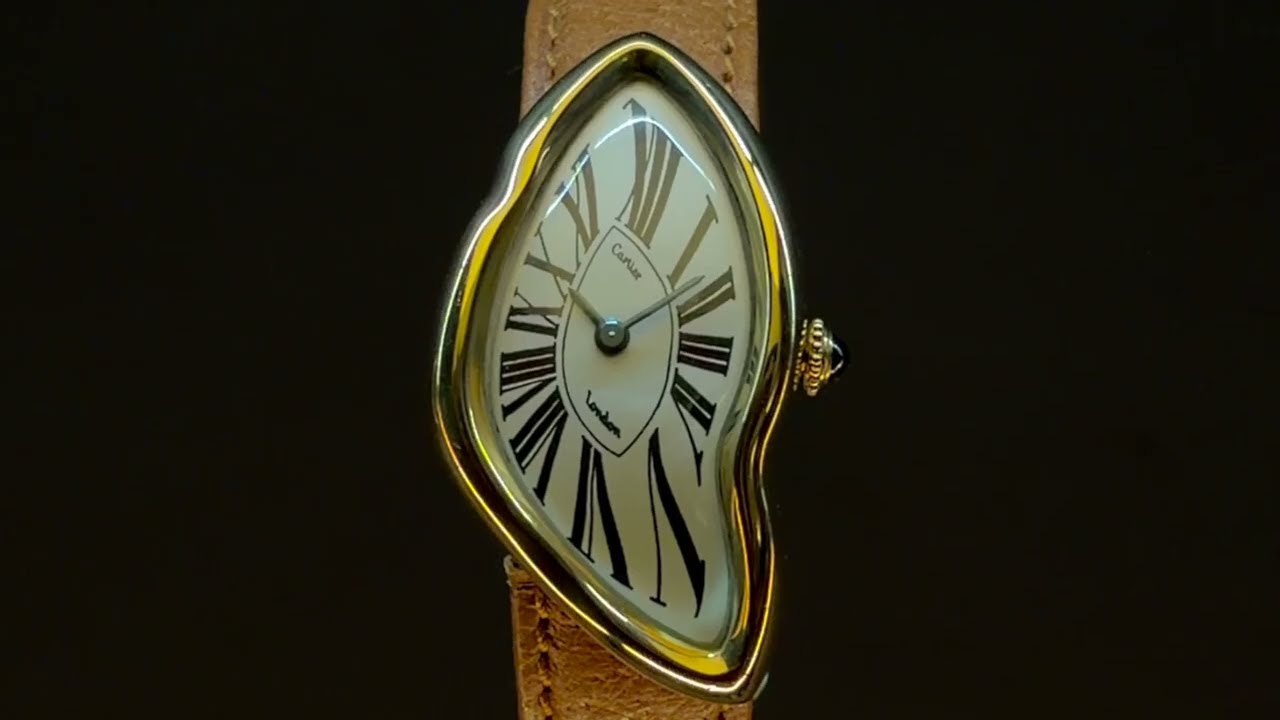
The Reverso is a wristwatch whose case pivots within a fixed outer frame, allowing the wearer to flip the watch face completely over to expose the reverse side. The design was created by Jaeger-LeCoultre, patented in 1931, and retailed by Cartier (sometimes under the name Cabriolet) as part of the firm's interwar watch range. It belongs to the same broader interest in pivoting and protective case mechanisms that also produced the wholly Cartier-designed Basculante.
Case and Dial
The Reverso case is rectangular, sitting within a slightly wider outer frame or carrier that provides the rails along which the inner case slides and pivots. The dial face of Cartier-retailed examples carries the standard Cartier vocabulary: white or cream dial, black Roman numerals, blued steel hands, railway-track minute chapter, and a winding crown with a blue sapphire cabochon. The "Cartier" signature appears on the upper dial. The reverse face (revealed when the case is flipped) is typically plain polished or brushed metal, providing a surface for personal engravings, initials, crests, or dedications. Some examples carry decorative enamel work or engine-turned patterns on the reverse. The visible slide rails on either side of the case, and the gap between the inner case and outer carrier, are the most immediately recognisable visual features, distinguishing the Reverso from any fixed-case rectangular watch.
The Reversible Case
The defining feature is the swivel mechanism built into the case carrier. The inner case slides out of the frame, rotates 180 degrees, and locks back into position. The result is a watch that can be worn with the dial facing up in the conventional way, or reversed to show the back face. The back was often left plain (useful as a surface for personal engravings, initials, a crest, or a dedication) or finished with a decorative motif.
The mechanism requires a case built to tighter tolerances than a conventional watch: the inner case must slide smoothly but lock without play, and the movement must be secured against the additional forces introduced by the pivoting action.
The Cabriolet Name
Cartier's reversible-case watches were known under different designations at different points, with Cabriolet among the names associated with this form. The term reflects the same vocabulary of mobility and transformation that the reversible mechanism embodied: a case that could change its presentation to the world. The Basculante, with its tilting case, belongs to the same family of thinking about protection and adaptability in watch design.
Context in Cartier's Interwar Output
The 1930s saw Cartier exploring a range of shaped, hinged, and pivoting case constructions that moved away from the fixed rectangular form of the Cartier Tank and Cartier Santos toward watches where the case itself was part of the design idea. The Basculante rotated within its frame on a side axis; the Reverso/Cabriolet rotated to expose the reverse. Both approaches share a preoccupation with the watch as a two-sided object rather than a single face on a strap.
The Jaeger-LeCoultre partnership, which fed movements and technical expertise into Cartier's output across this period, is the direct context for the Reverso: a JLC creation that Cartier retailed under its own name, one of several such arrangements between the two houses during the interwar decades.
Sources
- Francesca Cartier Brickell, The Cartiers (Ballantine Books, 2019)
- Wikipedia: Cartier Reverso