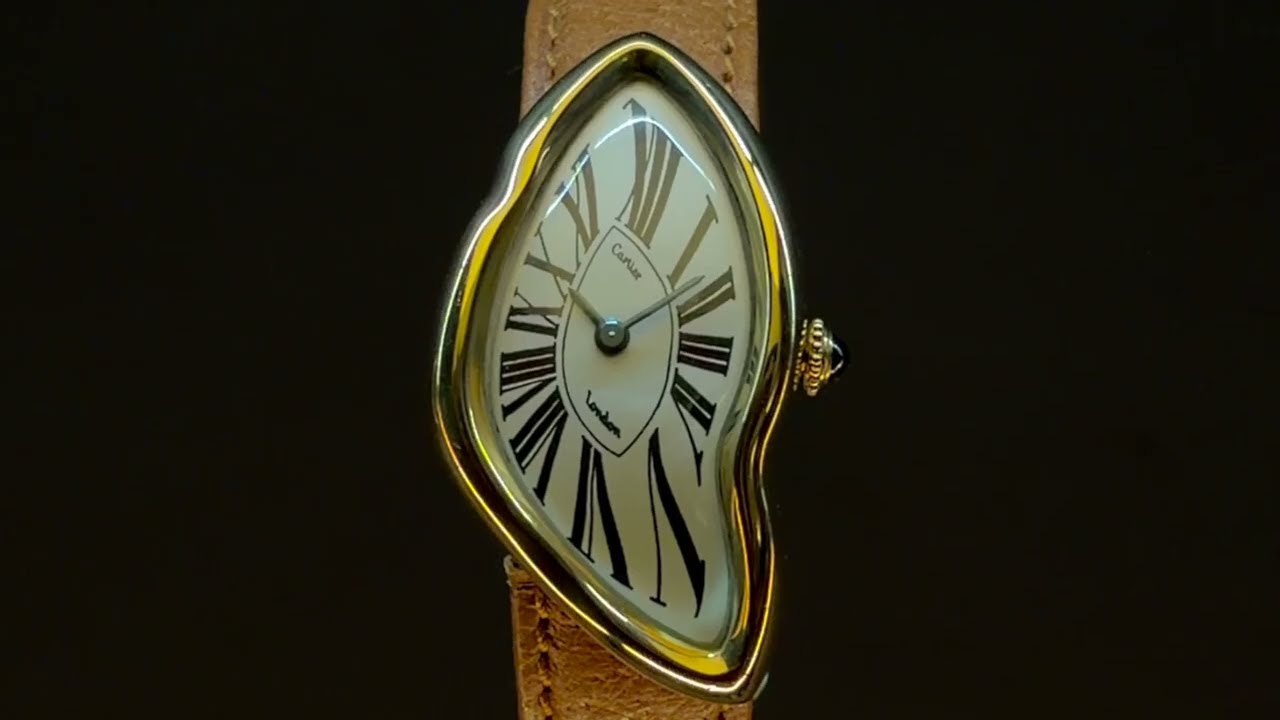
By the 1920s, the wristwatch was becoming dominant for everyday use, but for formal and evening occasions many women wanted something more discreet. Cartier's answer was the purse watch: a flat, typically rectangular or oval case in gold or enamel, with the dial concealed behind a sliding or hinged cover, designed to slip into a small evening bag rather than be worn on the wrist.
These objects occupied the ground between the pocket watch and the decorative case. They belonged to the same world as the vanity cases and nécessaires that Cartier was producing in the same period, where the case itself was as much a piece of Art Deco design as the mechanism inside it. Many were made to match or complement those cases, with the same bold geometry in black enamel and gold that defined Cartier's interwar production.
Case and Dial
The purse watch case is flat and typically rectangular, though oval examples also exist. Dimensions are modest, around 40 by 28mm, designed to slip into an evening bag without bulk. The case exterior is the primary visual surface: engine-turned gold, black enamel with gold geometric borders, or lacquer panels in the Art Deco manner. The dial, visible only when the shutter or cover is opened, is typically off-white or cream with Roman numerals in black and blued steel hands (sometimes moon-type, sometimes sword-type). The minute chapter is often simplified or omitted to accommodate the smaller aperture. Where the Eclipse shutter mechanism is used, the dial is framed by the parting shutters when open, creating a theatrical moment each time the watch is consulted.
Shutter mechanisms
Two approaches to concealing the dial emerged. The guillotine type used a panel that dropped vertically to cover the face. The more theatrical alternative adapted the spring-loaded shutter from the Cartier Eclipse Watch: pressing cabochon sapphire-set pushers on the side panels simultaneously released sprung shutters to reveal the dial, a small performance each time the owner wanted to know the hour.
A broader family
Movements in Cartier purse watches were supplied by specialist Swiss firms, with Vacheron Constantin among the documented makers.
The purse watch sits within a group of Cartier objects from the 1920s and 1930s in which ingenuity of concealment was part of the appeal. The Domino Watch and Dame de Coeur continued this approach: small enough for an evening bag, designed to be displayed as well as used. All of them reflected Louis Cartier's interest in objects that combined function with surprise.
Sources
- Francesca Cartier Brickell, The Cartiers (Ballantine Books, 2019)
- Hans Nadelhoffer, Cartier: Jewelers Extraordinary (Thames and Hudson, 1984; revised 2007), p. 201.
- Christie's, Watches Online Geneva November 2022 Cartier Art Deco enamel Eclipse purse watch