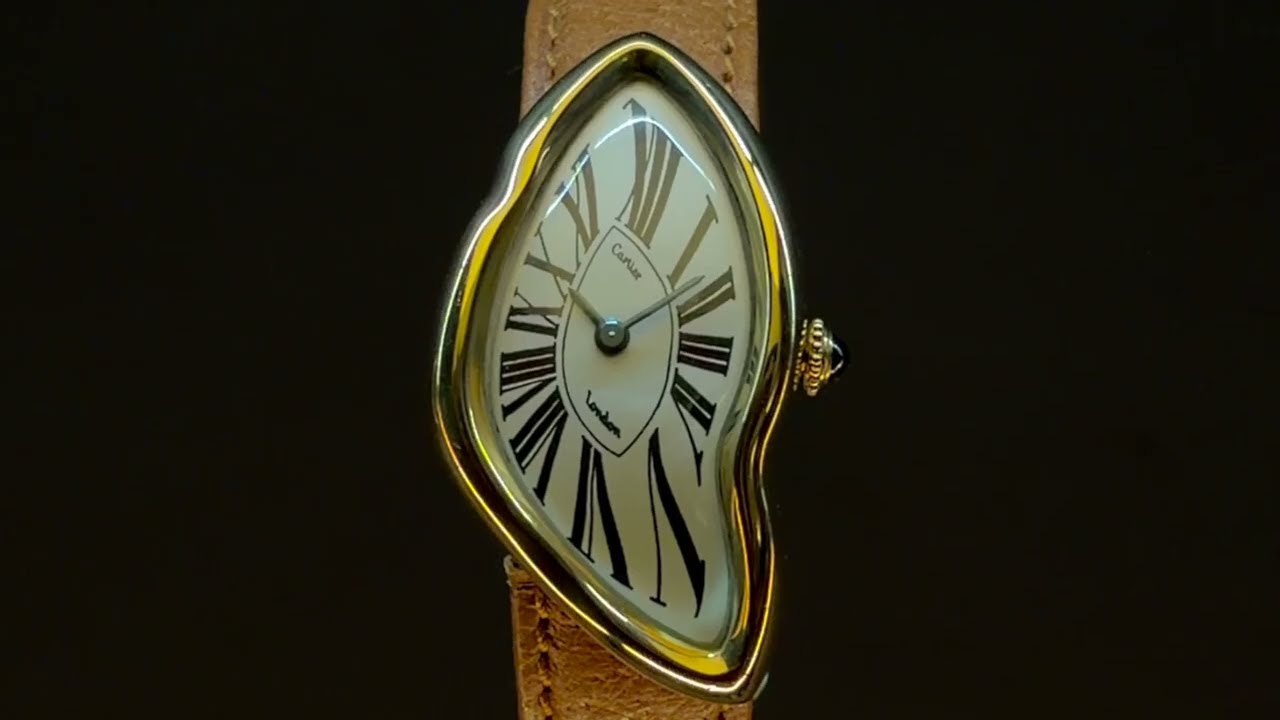
Cintrée is the French word for curved or arched. The Cartier Cintrée is a variant of the Tank wristwatch in which the case bows gently across its width, curving to follow the contour of the wrist. Where the standard Tank presents a flat rectangular profile, the Cintrée takes that same rectangular plan and introduces a subtle longitudinal curve that wraps the watch around the wrist rather than sitting flat against it.
The model was introduced in 1921, the same year as the Tank Chinoise. The case is narrower and more elongated than the standard Tank, with the curve adding both visual lightness and wearing comfort. The strap attachment on surviving examples is typically a déployant (fold-over clasp) rather than a conventional buckle.
The Cintrée belongs to a cluster of Tank variants developed in the early 1920s in close collaboration with the watchmaker Edmond Jaeger, whose firm supplied movements to Cartier under a long-term contract. The same period produced the Tank Allongée and the bell-shaped Cloche, both of which, along with the Cintrée, appear at auction and carry significant collector interest. The Art Deco movement, then at its height, was pushing Cartier's designers toward geometric experimentation with established case forms.
Case and Dial
The Cintrée case follows the general Tank architecture of parallel side-rails (brancards) flanking a central dial zone, but the entire structure bows outward at the back, conforming to the rounded surface of the wrist. Seen from above, the outline reads as a standard Tank rectangle; seen in profile, the case describes a gentle arc. The bezel follows the same curvature, so the dial surface faces slightly upward rather than lying parallel to the ground, making the watch easier to read on the wrist. The dial on period examples carries the standard Cartier vocabulary: white or cream enamel ground, black Roman numerals, a fine railway-track minute chapter, blued steel hands, and the Cartier signature in the upper half. Surviving 1930s examples in gold with déployant clasps are among the most sought-after at auction.
Sources
- Francesca Cartier Brickell, The Cartiers (Ballantine Books, 2019), ch. 5