BLOG

Insights, stories and updates about The Cartiers

The Cartier Diamond Part I

The Cartier Diamond Part I

Quite a few records broken at auction recently, which reminded me of a great auction story: the 1969 battle between #RichardBurton and #RobertKenmore ...

2 min read
Read More →

Pear-shaped brilliant diamond on black, beside Elizabeth Taylor and Richard Burton, 1960s.

Quite a few records broken at auction recently, which reminded me of a great auction story: the 1969 battle between Richard Burton and Robert Kenmore (then the president of Cartier NY) for a pear-shaped 69.42ct diamond ring.

Until then, the auction record for a diamond jewel was $385,000 — for a necklace from the estate of Mae Rovensky — but this knuckleduster ring was expected to smash through that.

Part of the deal was that the new owner could rename it (it was being sold anonymously through Parke-Bernet) and it soon attracted interest from the Sultan of Brunei, Harry Winston and Aristotle Onassis. It was even flown to Gstaad so that Elizabeth Taylor could see it close-up.

When she fell in love with it, her husband, Burton, instructed his agent to bid as high as one million dollars.

The auction began at $200,000, with almost everyone in the room shouting "Yes!" By $500,000 only nine people were still bidding. By $850,000 there were just two bidders left: Kenmore and Burton's agent.

As the bids mounted, the auctioneer worried whether he was receiving the correct signals. He later explained that Kenmore had "told me that as long as his arms were folded, he was bidding." Kenmore, cool as a cucumber standing by the side door, kept his arms crossed as the bids kept rising.

"When the bidding reached $900,000, everyone in the room started hyper-ventilating, but he was stone-faced. The excitement and tension were unbelievable."

The problem was that as the magic $1 million figure was reached, the audience leapt up in excitement: "all of a sudden the audience started standing up and that posed a problem — you couldn't see the bidders." Only when the auction room was asked to sit down did the auctioneer see that Burton's agent had dropped out and that Kenmore appeared to be frozen in the same position, by the door, arms crossed.

"It was only when I knocked it down at $1,050,000 and said 'Cartier' that Kenmore smiled and uncrossed his arms." He — and his nonchalant crossed arms — had won the day and, as the New York Times would later report, the diamond was renamed the Cartier Diamond. But not for long. Burton did not like to let down his leading lady…

(continued in The Cartier Diamond Part II)


Image Gallery

Cartier London TV Bangle

Cartier London TV Bangle

Unexpectedly stumbled across some old jewellery photos as I was rooting around for a dull car registration document this weekend… this b&w one of a go...

2 min read
Read More →

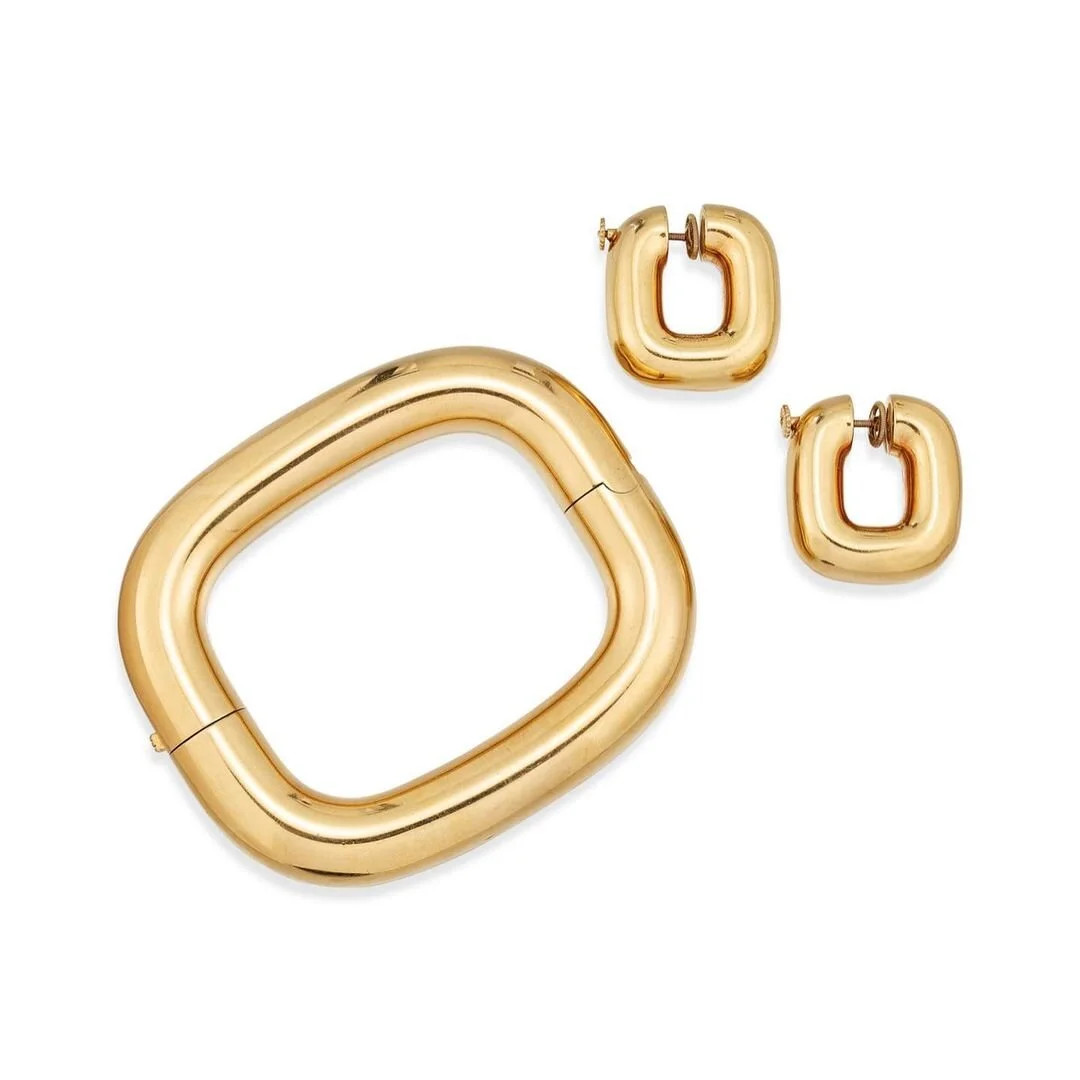
Chunky gold and white metal oval links, flanked by 1960s mod models.

Unexpectedly stumbled across some old jewellery photos as I was rooting around for a dull car registration document this weekend… this b&w one of a gold bangle (bottom image) must have been taken early 70s, when my g-father Jean-Jacques Cartier was running Cartier London. He was Creative Director in #175NewBondStreet (the counterpart to #JeanneToussaint in Paris) through the #swingingsixties, and his innovative designs (such as the #crashwatch) reflect a backdrop of great change. Suddenly it was no longer the done thing to dress like one’s parents, and twinsets and #pearls made way for Mary Quant #miniskirts and chunky jewellery… As formal events like debutante balls were replaced with student rebellions and psychedelic music, Cartier found itself in the luxury industry at a difficult time: there was simply not the same demand for high-end jewels anymore. JJC was forced to adapt.

Unlike many of his peers, he chose not to go down the costume jewellery route, but he did experiment with designs. This #goldbracelet (known as the #TVbangle) fitted the bill. It was rebellious in its shape, looked great with the fashions of the day and was less expensive than precious-gem jewels but it was still distinctly #CartierLondon, in terms of design and craftmanship. He didn’t make many – for JJC, part of the luxury was exclusivity - so it was timely to stumble across this photo, just after one of these bangles was sold at @bonhamsjewels.

It has the numbering on the back but I don’t know the numbering of the #Bonhams bangle, so I can’t be sure it’s the exact same one, still it’s extremely similar! The estimate for the 1973 #goldbangle had been £ 6-8000 but it smashed through that, ending up at £37,750. Think that must be a record: 3 yrs ago, @Christiesjewels sold one with a pair of #earrings.

What with the #PebbleWatch record last week, seems 1970s Cartier London is having a moment… rather ironic given the burdens of excruciatingly high luxury taxes, less wealth and changing tastes meant that it was incredibly hard to sell luxury items back then. Would love to know what you think of it today – would you wear it?

Image Gallery

Image 2

!

The Cartier Pebble Watch and Jean-Jacques Cartier

The Cartier Pebble Watch and Jean-Jacques Cartier

Another week, another record for vintage Cartier London. This time the spotlight was on the Cartier Pebble (sometimes known as the 'baseball'), which was...

1 min read
Read More →

Man in glasses and suit, beside a gold Cartier watch with square dial and brown strap.

Another week, another record for vintage Cartier London. This time the spotlight was on the Cartier Pebble (sometimes known as the 'baseball'), which was up for auction at Phillips in Geneva with an estimate of CHF 50,000–100,000.

This one was made in 1972, under my grandfather Jean-Jacques Cartier. An artist at heart, he was a lover of design (pictured here just after studying at the École des Arts Décoratifs).

As with all Cartier London watches at that time, the unusual gold pebble-shaped case was made in the Wright and Davies workshop in Clerkenwell by a skilled goldsmith — most likely the highly skilled workshop head, Sam Mayo.

Once checked, the cases would be packed into a briefcase with the other cases, deployment buckles and made-to-measure straps completed that week, and given to the young apprentice who would jump on the 38 bus to Piccadilly Circus and walk the ten minutes to 175 New Bond Street.

No taxis, security vans or security guards: the tried and tested Cartier formula was that no one would ever suspect a scruffy-looking boy on a bus was carrying anything worth stealing. Entering through the staff entrance, the apprentice would head upstairs into the small watchmaking division and hand everything over to master watchmaker Eric Denton.

What's amazing about these watches is that so many individual parts were handmade: from the case to the dial, to the hands, to the sapphire winder. Each watch took several months to make and if you wanted one, you put your name on the waiting list and just had to wait.

Today, you're likely to wait even longer for these vintage pebbles — they are even rarer than the more famous Crash Watch, and the few that Jean-Jacques did make were in two sizes for men and women.

Some auctions are almost gladiatorial — yesterday's was like that. The bidding was fast and furious, ultimately coming down to blow after blow between two bidders: one in Michigan and the other in Monaco. And the final price? I think even my grandfather would have been astounded: a mind-blowing CHF 403,200.

Cartier’s ‘New’ Watch Bracelet (in the 1910s)

Cartier’s ‘New’ Watch Bracelet (in the 1910s)

A century ago, the papers both sides of the Atlantic were filled with excitement about Cartier's new bracelets.

1 min read
Read More →

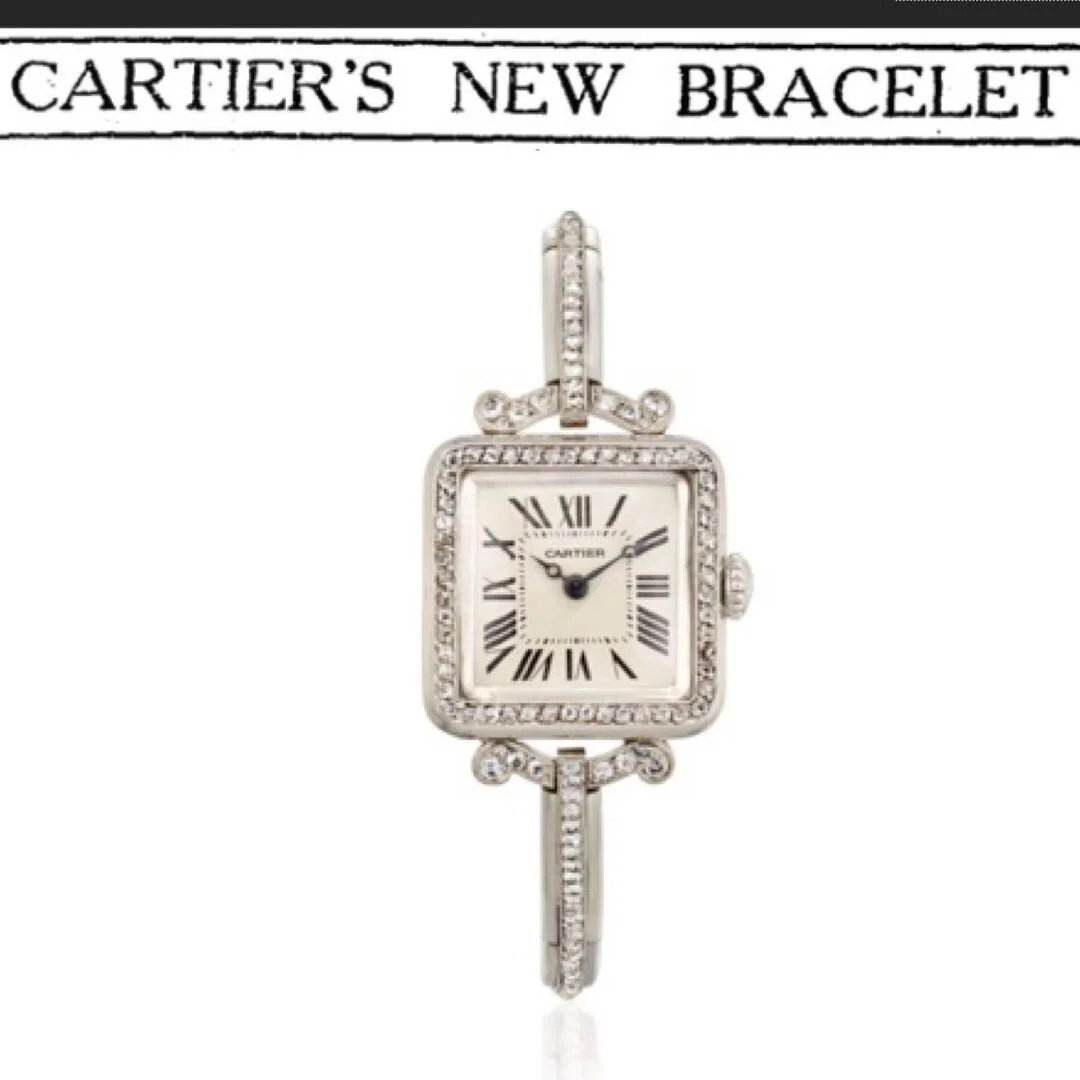
Vintage Cartier square diamond wristwatch with Roman numerals and a diamond bangle bracelet.

A century ago, the papers both sides of the Atlantic were filled with excitement about ‘Cartier’s new bracelets’ (2nd image): "Over here", a Paris correspondent wrote, "the smart world looks to Cartier for new inventions in jewellery…The wrist watch, which is Cartier’s, is now the fashion of the hour. Women are changing all kinds of jewellery for this new bauble." There’s been heightened interest recently in antique Cartier watches for men (and indeed the revival of old designs like the #Cloche at #WatchesandWonder2021), but the early #womenswatches have their own magic too. Part beautiful jewel, part practical timepiece, they preceded Cartier’s men’s watches by quite a few years. By the time the #CartierTank came to the market in 1919, Cartier’s delicate #watchbracelet for women, generally with a moiré silk or #diamondstrap, had already become something of a status symbol among fashionable women in London, Paris and New York (in her 1909 novel Elizabeth Visits America, #ElinorGlyn described a ladies’ luncheon in a New York mansion where the women were "all dressed in the most expensive, magnificent frocks from Paris and lovely jeweled Cartier watches")Wonder if this particular example of diamond watch ever made it to a ladies’ luncheon in Manhattan… it’s an interesting one because it both reflects the Belle Époque period (with the #rosecutdiamonds, and the curved shape top and bottom) and yet still seems cutting edge today with its expandable platinum and #diamondstrap (no buckle required, it literally just stretches like elastic over one’s wrist). That magic mix of classic and modern was, in a way, the signature of Louis Cartier. He was something of a Steve Jobs of his day, always pushing the boundaries of design and innovation. With his #montresbracelets he insisted on something beautiful but also useful, and according to the international press 100 years ago, he succeeded: "There is this to say about the bracelet watch, that it is the most useful piece of jewelry that has been invented for many seasons." Useful indeed... it still keeps time! Which would you choose: classic tank or antique watch bracelet?

Image Gallery

Image 2

!

Louis Francois Cartier's First Maker's Mark

Louis Francois Cartier's First Maker's Mark

The story of Louis-François Cartier’s first maker’s mark — the official stamp registered in the 1840s that marked the beginning of the Cartier jewelry house.

2 min read
Read More →

Cartier's 1847 maker's mark: L, heart playing card, and C inside a diamond outline.

Today, 17th April 2021, marks the day of Prince Philip's funeral. It's been moving watching the coverage - a beautiful farewell and celebration of an extraordinary life.

Looking back on a life well lived (see previous post) reminds me that 17 April also marks another man's legacy... 174 years ago today, #LouisFrancoisCartier registered his first maker's mark, essentially signifying the beginning of Cartier.

As any entrepreneur knows, however, in many ways the formal registration of a business name or symbol isn't really the beginning. The reality for the 27-year-old Louis-Francois was that his long journey had started over a decade earlier during gruelling years as a poorly paid, overworked, jeweller's apprentice. But the registration of this maker's mark - a lozenge shape incorporating his initials separated by an Ace of Hearts - symbolised an fundamental step forwards in an ambitious man's journey, a sliding doors moment that would not only change the course of his life, but also that of his descendants and the thousands of people who would go on to work for #Cartier.

I have often wondered about the significance behind the Ace of Hearts. There's the play on words (in French, a 'cartier' means a maker of playing cards) and maybe, like his g-g-g-g-grandchildren (my kids!), he enjoyed a good card game, but why the Ace of Hearts specifically? Ideas welcome....the romantic in me likes to think perhaps it reflects the love he had for his family ('I am your devoted father and friend' he wrote to his son, 'you and I are inseparable') and the importance he placed on kindness ('be very kind' was his advice for the next generations).

Whatever the reason, I rather love this symbol's simplicity and symmetry - both features that would come to represent the Cartier style. And while I can't imagine that 174 yrs ago Louis-Francois had any inkling of the troubles that lay ahead (just a few months later, his business would almost be wiped out by violent revolution) or the extent of the inspirational legacy he would leave behind, I do hope that he took the time to celebrate the success of making it that far (even if only with a family game of cards...)

[Louis-François Cartier](/glossary/louis-francois-cartier/) (1819–1904)
Louis-François Cartier (1819–1904). Wikimedia Commons / Public Domain.
Prince Philip visiting English Art Works

Prince Philip visiting English Art Works

Such sad news about Prince Philip. It's been moving to read so many tributes this weekend and see wonderful images of his 99 years.

1 min read
Read More →

A man in a suit leans over to watch a jeweller at his workshop bench.

Such sad news about Prince Philip. It's been moving to read so many tributes this weekend and see wonderful images of his 99 years. I'm adding to that in a very small way with this photo — passed down to me by my grandfather Jean-Jacques Cartier, who stands in the background in the glasses — of one of the Duke of Edinburgh's visits to Cartier London many decades ago.

He was, those who worked at 175 New Bond Street at the time recalled, a very special visitor — and not just because he was part of the royal family. He was so genuinely interested in the design and craftsmanship that went into the pieces.

So passionate was Prince Philip about design that in 1956 he started his own award, the Prize for Elegant Design (now known as the Prince Philip Designers Prize), to encourage innovative design in the difficult years of post-war Britain. It became the longest-running design prize in history. He also designed several items of jewellery for his wife, the Queen.

This photo was taken in the English Art Works workshop on the 3rd floor of 175 New Bond Street. There are other photos of the royal visits to Cartier London — including those taken in the smart showroom on the ground floor — but I love this one because I think it speaks volumes.

For Prince Philip, a visit to Cartier wasn't simply about seeing the latest jewels; he wanted to really understand how they were created upstairs in the workshop and to speak to the talented designers and craftsmen behind the scenes.

Cartier Bird Brooch

Cartier Bird Brooch

A little Cartier gold [#birdbrooch](https://www.instagram.com/explore/tags/birdbrooch/) with ruby eye for you all this Easter, perching on top of some...

1 min read
Read More →

Gold bird brooch with ruby eye and diamond, in red box, surrounded by bird sketches.

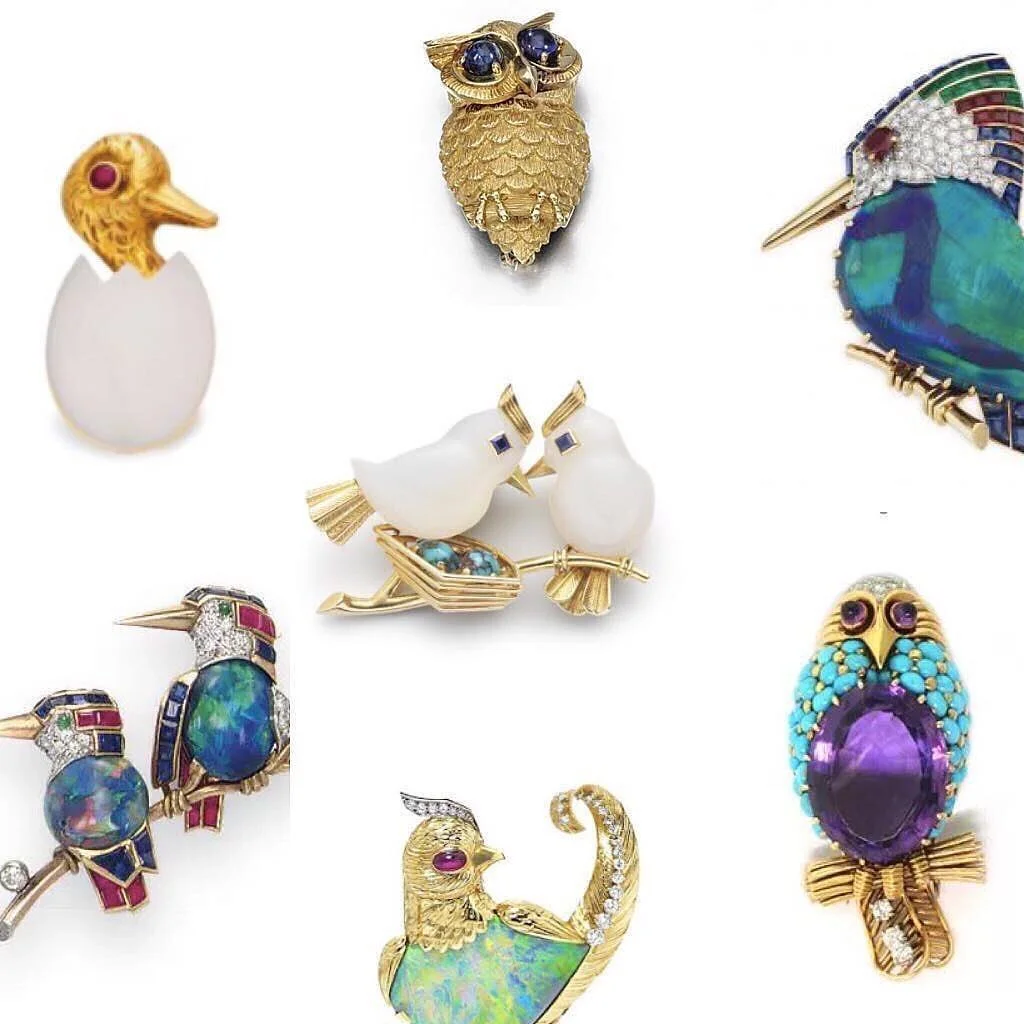
A little Cartier gold #birdbrooch with ruby eye for you all this Easter, perching on top of some sketches by my grandfather, #JeanJacquesCartier. As a child, I remember being mesmerised when he conjured up all types of creatures out of thin air with his trusty pencil. He loved animals (more in his element in the stable with the horse and his dogs than entertaining guests), and in the lead up to Easter, he would suggest that Cartier's jewellery designers should focus on designs for #birdjewelry.

Once the #jewelrydesigns had been approved and meticulously made by the #EnglishArtWorks workshop above the showroom, he would create little Spring-themed scenes in his windows to delight those walking past. I can imagine him out on New Bond Street, looking in at the windows, checking and rechecking that the finished look was just right. He was something of a perfectionist, well actually that's an understatement...as evidenced by the fact that "the best is good enough" became something of a catchphrase in the Cartier London showroom!

Image Gallery

Image 2

!

The Williamson Pink Diamond Cartier Brooch

The Williamson Pink Diamond Cartier Brooch

Anyone else love the Queen's Williamson diamond brooch? Made 68 years ago by Cartier London, it's mounted in platinum and comprised of many diamonds of...

2 min read
Read More →
The [Williamson Pink Diamond](/glossary/williamson-pink-diamond/) Cartier Brooch

Anyone else love the Queen's Williamson diamond brooch? Made 68 years ago by Cartier London, it's mounted in platinum and comprised of many diamonds of different cuts (brilliants, baguettes and marquises), including one of the finest pink diamonds in existence.

It was such fun to go behind the scenes of this piece in the Cartiers and the British Royal Family online lecture as we travelled from 1937, when an 11-year-old Princess Elizabeth was awed by "a sort of haze of wonder as Papa was crowned", through to this 2009 meeting between Her Majesty and the Obamas.

The story of this brooch started in 1947 when Princess Elizabeth received a special wedding gift from the Canadian monarchist Dr Williamson: an enormous 54.5 ct rough pink diamond (soon after cut into a 23.6 ct brilliant).

A few years later (the delay is explained in the webinar), the gleaming pink diamond was deposited at 175 New Bond Street for the Cartier London team to work their magic.

It was a process that involved many skilled individuals. First, up on the top floor, the firm's head designer Frederick Mew worked on pencil sketches which were then whittled down to a few workable designs.

Each one was painted, life-size and once approved, the final design was passed downstairs to the expert mounters, setters and polishers in the English Art Works workshop.

Finally, down one level more, Jean-Jacques Cartier would closely inspect the finished creation, checking each diamond was angled in just the right way to catch the light, ensuring the back of the jewel was as perfect as the front, and the clasp was strong, secure and discreet.

Worn by Her Majesty many times over the decades, usually with pearls (eg. image 2: a 1954 portrait with a young Prince Charles and Princess Anne) — the Williamson Brooch so perfectly epitomises Pierre Cartier's belief that:

"A jewel which is classic in design, which contains stones of good quality, always remains an object of beauty." — Pierre Cartier

I particularly love the little details, like how the petals curl at the edges, and the marquise diamonds make the most perfect buds on the baguette-diamond stem…


Image Gallery

Credit: Getty Images, as referenced in The Cartiers

Wallis Simpson's Cartier London Engagement Ring

Wallis Simpson's Cartier London Engagement Ring

Jewellery means many things to many people. Wallis Simpson's Cartier engagement ring went further — it came to symbolise the choice between love and duty.

2 min read
Read More →

Wallis Simpson in B&W, next to her vintage emerald and diamond ring.

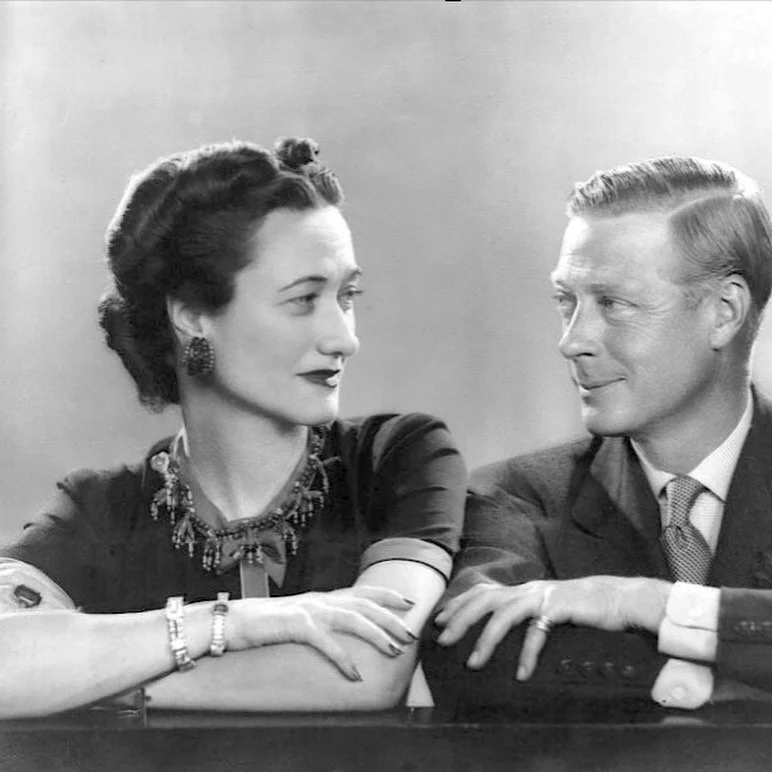
Jewellery can mean many things to many people. Take engagement rings — much more than the value of their constituent parts, they become imbued with emotional weight too. This one stands out, however, because its significance stretches far beyond a couple.

It would come to symbolise the choice between love and duty, a decision that would change the course of history for an entire country. I've long been fascinated by antique jewels for their power to bring history to life.

The many chapters of an individual gem can shed light on not only those who owned it, but also those who sourced it and fashioned it into a wearable work of art. In the case of this ring, it all started in the 1930s when Jacques Cartier sent a trusted salesman to Baghdad to buy gems.

On his arrival, the salesman was informed that the gem sale had to be conducted secretly — he was forbidden to telegraph any details back to London except that he needed more money. Trusting his employee, Jacques had it wired over without delay. For such a large price, he supposed, Cartier would be acquiring an enormous number of precious gems.

But when his salesman returned, he only had a small pouch. Out of it, he produced an emerald the size of a bird's egg. As a gemstone expert, Jacques marvelled at the chance to hold an emerald so magnificent it had belonged to the Great Mughal. Yet as a businessman, he was dismayed.

Before the Russian Revolution, Cartier would have had no problem finding buyers for such a gem. But the 1930s was a different era. The only option was to cut the emerald in two. Though it pained Jacques to do so, he had to think of the business. One polished half was sold to an American millionaire.

The other (19.77 cts) was chosen by the King as the centrepiece for a platinum engagement ring for Wallis Simpson. Traditionally, emeralds are not used for engagement rings — compared to diamonds, the stone is soft and can scratch easily.

But Edward VIII wasn't interested in tradition. Half a century later, this ring was sold at Sotheby's (in its 1950s gold and diamond setting) for $1.9m. How much of the value lies in the stories it tells?


Image Gallery

Image 2

!

The Story Behind The Royal Family’s Enduring Love Affair With Cartier

The Story Behind The Royal Family’s Enduring Love Affair With Cartier

Really fun to see my article in British Vogue — 'The Story Behind The Royal Family's Enduring Love Affair With Cartier' — complete with wonderfully...

1 min read
Read More →

Catherine, Princess of Wales, in a dark green dress, wearing a large diamond necklace.

Really fun to see my article in British Vogue — 'The Story Behind The Royal Family's Enduring Love Affair With Cartier' — complete with wonderfully evocative images of the royal family wearing Cartier jewels through the decades, including this one of the Queen and the Duchess of Cambridge in the fabulous Hyderabad diamond necklace.

My thanks to Rachel Garrahan, Jewellery and Watch Director at British Vogue, for asking me to write this piece on the back of the online royal jewels lectures I've been giving with Caroline de Guitaut.


Further reading: 'The Story Behind The Royal Family's Enduring Love Affair With Cartier' — British Vogue (February 2021) · 'Cartier and Royalty' — Royal Collection Trust · 'Cartier: Style and History' — Grand Palais exhibition catalogue (2013) · Noble Jewels from the Collection of Her Royal Highness the Duchess of WindsorSotheby's Geneva (1987)

Image Gallery

A 1914 Tonneau Watch sold by Cartier London

A 1914 Tonneau Watch sold by Cartier London

There’s been a lot of excitement about vintage Cartier watches lately.

2 min read
Read More →

Vintage gold Cartier tonneau watch with cream dial, Roman numerals, and brown leather strap.

There’s been a lot of excitement about vintage Cartier watches lately. Of course, vintage is not always a v. precise term: in Cartier’s case, it spans over 100 years (the first wristwatches for men were produced right at the start of the 20th century). Which is why I was so intrigued to see this particularly early example come up @fellowsauctions this week: a tonneau sold in London in Oct 1914, when my great-grandfather, Jacques Cartier, ran the 175 New Bond Street branch.

The #tonneau (translates as ‘barrel’) was one of Cartier’s earliest ever models, first created in 1906. That’s a year before Cartier signed a contract with watchmaker #EdmondJaeger (promising him annual orders equivalent to $1m today) and over a decade before the creation of the iconic Tank. Interestingly this watch doesn’t have a sapphire winder but, even at this very early stage, it shares the same numbering quirk on the dial that continues to this day, where the roman numeral ‘IV’ is replaced with the ‘IIII’; an important detail for the symmetry-loving Cartiers as it ensured a better balance with the ‘VIII’.

This watch would have been made under Louis Cartier in Paris and shipped across the Channel for sale in the London showroom (#CartierLondon didn’t have its own workshop until the 1920s). It was then gifted to a Scottish Captain going off to fight at the Western Front with his Highland regiment in May 1915 (the inscription - 2nd image - reads “A.D. Thomson, 51st High Div., 1/5/15”). Meanwhile, Jacques Cartier, fighting in the French cavalry, had just weeks earlier been gassed in the trenches on the Western Front. Which makes this watch all the more poignant for me: a link between him and the Scottish Captain joined in the common fight against their enemies.

Fortunately, both Jacques and the captain would survive the war…as would this #cartierwatch . I love how old and worn it looks today; not just a miniature working (yes it still works) work of art but also such an evocative piece of history that tells a story of those who made it, sold it and wore it.

Image Gallery

The Cartier Triple or ‘Trinity’ Ring

The Cartier Triple or ‘Trinity’ Ring

Thanks to Vogue India for asking me to contribute to their Valentine’s issue with a story behind a piece of jewellery I wear that signifies love.

1 min read
Read More →

Smiling Francesca Cartier Brickell wears a three-band gold Cartier Trinity ring on her left hand.

Thanks to @vogueindia @priyankaskhanna for asking me to contribute to their Valentine’s issue with a story behind a piece of jewellery I wear that signifies love. I chose my #triplering which I know from previous posts has a special significance with many of you all over the world. Here’s my story:

The first Cartier piece I ever owned was a Trinity Ring that I was given by my parents when I turned 18. I loved it, so wearable and chic. It’s made of three interlaced bands of yellow gold, white gold and pink gold which my grandfather (#JeanJacquesCartier) told me symbolised loyalty, friendship and love.

Legends about the origin of this ring abound as I write in my book on The Cartiers - some say it was made by my great-great-uncle #LouisCartier for his friend, the artist and writer #JeanCocteau in the 1920s, and that it was inspired by Cocteau’s opium-fuelled dream about the rings around Saturn. Whether or not this story is apocryphal, the role Cocteau played in boosting its popularity is indisputable (he was the literary bad boy of Paris at the time!). But even today, around 100 years after it first appeared in the Cartiers’ branches in London, Paris and New York as an affordable alternative to its high end jewellery for both men and women, it remains iconic.

Sadly, I lost my own ring when swimming in the Mediterranean soon after my parents gave it to me. I was devastated - a special gift like that is tied in with so much emotion. Fortunately, years later, my husband (who had heard this sob story a fair few times) surprised me with another trinity ring as a perfect birthday gift. I love it - and amazingly it works just as well now with any outfit as it did 25 years ago! Such a timeless piece, and so evocative too, I hardly ever take it off.

#trinityring #lovejewelry #valentines #lovering #lovejewellery #valentinejewelry #cartierisforlovers

Image Gallery

Image 2

Red book cover "The Cartiers" with a classic yellow, white, and rose gold Trinity ring.

!

Thank you to all who joined Part I of 'The Cartiers and the British Royal Family'

Thank you to all who joined Part I of 'The Cartiers and the British Royal Family'

Well, that was majestic! Thank you to all who joined Part I of 'The Cartiers and the British Royal Family' live session yesterday.

1 min read
Read More →

Queen Elizabeth II in diamond tiara and necklace; close-ups of diamond and pearl jewels.

Well, that was majestic! Thank you to all who joined Part I of 'The Cartiers and the British Royal Family' live session yesterday.

It was such fun to explore the stories behind some of the phenomenal jewels in the Royal Collection with Caroline de Guitaut — as those of you who tuned in will know — a wealth of knowledge on the subject. We kicked off the session in the late 19th century when, while struggling to keep his father's small family firm afloat during the Paris Commune, a young Alfred Cartier fled to London with jewels to sell to the royal court. We then journeyed all the way through to 2011 when the Duchess of Cambridge wore the Queen's Halo Tiara as she walked down the aisle.

In between, there were coronations (great for an aspiring jewellery business), presentations at court (also good), Edwardian Christmases at Sandringham (remembered as 'Dickens in a Cartier setting' by the future Duke of Windsor), pearl-seeking adventures, Indian celebrations, elegant royal weddings and cataclysmic world-shaking events from war to the Great Depression.

Caroline also explained the different types of jewels in the Royal Collection, distinguishing between the Crown Jewels (kept in the Tower of London and used for coronations), historic jewels, heirloom jewels — like the diamond diadem in this image, made for the coronation of George IV — and the personal jewels of Her Majesty the Queen, including the Cartier necklace in this Dorothy Wilding portrait of Queen Elizabeth II at the start of her reign.

For me, this was a special webinar: I grew up hearing magical stories about the Cartiers' royal creations from my grandfather, so it was wonderful to share the history with so many of you.

For those who couldn't make it, the good news is that the recording is available to view. And more good news: we had just too many stories and jewels to squeeze into one event, so watch this space for details of Part II.

Pearls for your Debutante Daughter

Pearls for your Debutante Daughter

When Jacques Cartier moved his family across the Atlantic to England in the 1920s, he found himself, for a jeweller, in the right place at the right time.

1 min read
Read More →

1930s bride in tiara, graduated pearl necklace with diamond clasp, and Louis Cartier.

When Jacques Cartier moved his family across the Atlantic to England in the 1920s, he found himself, for a jeweller, in the right place at the right time. "All of society seemed to be en fête," the Duke of Windsor would recall of the postwar years, as "most of the great houses in London opened their doors for a flourish of hospitality such as will never be seen again." There were extravagant dinners, "served on gold or silver plates by footmen in the family livery with knee breeches, white stockings, buckled shoes, and powdered hair," and dancing under the light of thousands of candles.

It wasn't unusual to receive four invitations a night and quite acceptable to move from one to the next. And when the private parties had finished, there were the West End nightclubs, "an almost continuous ball from midnight until dawn." Jewels of course were de rigueur, and nowhere more so than in the presence of royalty.

Unlike their French neighbours (who no longer had a monarchy), British high society revolved around the Crown, and the high point of a young lady's life was her presentation at court in front of the King and Queen — the moment that formally launched her into society.

Strict rules around the dress code for this event had been in place for decades: everything from the gloves to the length of one's train to the number of feathers in one's hair was prescribed, and the gems were traditionally white and simple for the young ladies (it was their mothers who could go all out in big stones).

Jacques Cartier, who had visited the Persian Gulf in search of the finest natural pearls in the world, was well placed to offer his expertise, and "Pearls for your Debutante Daughter" became one of the early catchy taglines of Cartier London. Pictured here is the effortlessly chic future Duchess of Argyll — named the debutante of the year in 1930 — in a look that still holds up today.

The Cartier London Halo Tiara

The Cartier London Halo Tiara

The Cartier Halo tiara: made by Cartier London in 1936, worn by Princess Elizabeth on her wedding day, and by Kate Middleton in 2011.

1 min read
Read More →

Cartier platinum and diamond scroll tiara, worn by Queen Elizabeth, Catherine, and Princess Margaret.

As far back as I can remember I've been fascinated by the links between the Cartiers and the British royal family.

It was this relationship, perhaps above all others, which enabled the Cartier brothers to fulfil their childhood dream of turning their grandfather's small Parisian store into the leading jewellery firm in the world.

It was after all Edward VII who famously called Cartier 'king of jewellers and jewellers of kings' — a phrase which must rank right up there among the most apt examples of a self-fulfilling prophecy. As soon as he said it, it became indisputably true and because of his early patronage, Cartier was awarded not simply the British royal warrant but further warrants from royal families across Europe.

All of which hopefully goes some way to explaining why I was so excited to be speaking with Caroline de Guitaut, Deputy Surveyor of the Queen's Works of Art at the Royal Collection Trust, about the Cartiers and the British royal family for my next webinar.

We uncovered the stories behind jewels acquired by generations of the royal family, such as the 1930s Halo Tiara pictured here — made under my great-grandfather Jacques Cartier for the future King George VI as a gift for his wife, the future Queen Mother (left), later lent to Princess Margaret for her sister's coronation (right) and to the Duchess of Cambridge for her wedding to Prince William (centre).

We also took attendees on a journey through time: from the dazzling seasons and headache-inducing tiaras of Edwardian court life, to the princely gem-rich celebrations in bejewelled India and the glamour of the 1930s debutantes, all the way through to the changing fashions of post-war Britain and more recent royal weddings.

The Cartier Trinity Ring: its origins

The Cartier Trinity Ring: its origins

Stories surrounding the origin of the Cartier Trinity ring are as numerous as its many names. Was it really inspired by Jean Cocteau's dream about Saturn?

2 min read
Read More →

Black and white portrait of Jean Cocteau wearing a Trinity ring; below, the three-gold ring.

Stories surrounding the origin of this ring are as numerous as its many names: the bague trois ors, the bague trois anneaux (the triple gold ring or triple-ringed ring); the rolling ring, the Russian wedding ring or the Trinity ring.

What's clear is that when Cartier launched the simple platinum (later white gold), yellow gold and rose gold interlocking rings in 1924, the pared-back jewel — not a gemstone in sight — was a brave departure from the more extravagant accessories of the time. Legend has it that the ring was inspired by a friend of Louis Cartier: the rebellious artist Jean Cocteau.

Perhaps under the influence of opium, Cocteau is said to have told Louis that he had envisaged the rings around Saturn in a dream and wondered if Cartier could transmute their likeness into a ring, because the idea of something so large and universal being represented by something so small and personal entranced him. Whether or not this story is true (even Cocteau's family weren't sure when I asked them), the role the artist played in helping Cartier's triple ring achieve its iconic status is indisputable.

When the literary bad boy of Paris wore two together on his little finger — the six interlocking bands piled up powerfully on top of each other — it became a cult accessory, and not just among gay men.

In the 1940s, it was adopted by one of the most prominent men in Europe, another man who had chosen to defy convention, in his case by giving up the throne for love: the Duke of Windsor (2nd image). Soon after creating the ring, Cartier experimented with other triple jewels.

Elsie de Wolfe was an early adopter of the triple bracelet, while Vogue was also a fan, with a 1925 feature on the "new Jewelry from Cartier," both "amazingly chic" and "very moderate in price" (3rd image — intriguingly, the model Kendall Lee ended up marrying Cartier New York's head salesman, Jules Glaenzer). A hundred-odd years on and the 1920s ring is still going strong: I wear one almost every day (4th image) — love the history behind it but also, it just goes with everything and remains amazingly modern.

I guess it's the simplicity that makes it timeless. Any other triple ring fans out there?


Image Gallery

Jean Cocteau and his Cartier Paris sword

Jean Cocteau and his Cartier Paris sword

Jean Cocteau was an artist of whom Edith Wharton wrote: 'every great line of poetry was a sunrise, every sunset the foundation of the Heavenly City.'

2 min read
Read More →

Academician in robes holds ceremonial sword with stylized face and lyre hilt.

Jean Cocteau was an artist "to whom" according to Edith Wharton, "every great line of poetry was a sunrise, every sunset the foundation of the Heavenly City." He was also an admirer of Cartier, writing in his early 20s that the jeweller was "a subtle magician who captures fragments of the moon on a thread of sun."

Back then, his fame was confined to small literary circles but it soon grew, as did the controversy surrounding him. Cocteau, like his friend Louis Cartier, refused to follow trends. He hungrily explored multiple art forms from poems, novels and plays to sketching, painting, music and film.

Each time he created something new, he pushed the boundaries of what had gone before so that despite his brilliance, the Académie Française labelled him a "bad pupil." And yet in the end, his genius would win out: at 66, Cocteau was finally invited to join their prestigious literary body.

For his inaugural two-hour speech, Cocteau delighted the crowds with not only his wit but also his outfit: he wore Lanvin robes and in his left hand held a remarkable Cartier sword.

Cartier had been making these swords since the 1930s (each one resulted from conversations between a Cartier designer and the future academician to reflect his life's work) but this one was different: it was designed by Jean Cocteau himself. Like his writings, Cocteau's sword was signed with a star (in diamonds and rubies).

The handguard traced the profile of Orpheus, his mythological muse. The scabbard evoked the grille surrounding the gardens of the Palais-Royal, his home; and at its tip, a hand clutched an ivory ball referencing the snow-covered stone in Les Enfants Terribles.

The gems were gifted by friends, including Coco Chanel. Sadly Louis Cartier didn't live long enough to see his friend become one of 'les immortels' (as academicians are known), but his brother Pierre Cartier and Jeanne Toussaint remained friends with Cocteau for the rest of their lives.

Meanwhile the sword, a symbolic work of art by and for a great artist, stands out as one of the Cartiers' most unique creations for a client who would prove inspirational in more ways than one — including inspiring the Cartier Trinity Ring.

The Inspiration Behind the Cartier Panthers

The Inspiration Behind the Cartier Panthers

Inspiration is a funny thing, can’t know when or where it will strike. Even when it does, it’s not like it can be neatly packaged or explained.

2 min read
Read More →

Vintage Cartier panther sketches on paper next to a diamond, emerald, and onyx Panthère jewel.

Inspiration is a funny thing, can’t know when or where it will strike. Even when it does, it’s not like it can be neatly packaged or explained.

Take the Cartier panthers…Much has been written about the role of Jeanne Toussaint with Cartier’s panther jewels.

She was Louis Cartier’s lover for a time and later the artistic director in Paris; and on the panther theme: her nickname was Pan Pan, she was an early adopter of the leopard skin coat, and she owned a panther vanity case.

A strong stylish woman in a man’s world, she became friends with the Duchess of Windsor (more on her soon) who shared a love of the big cat jewels.

My grandfather told me other stories about the inspiration behind the Cartier panthers: how his father had been entranced by the big cats on trips to India through the 1920s and 30s, and how – on returning home - he used to love reading his young children The Jungle Book at night, lingering over illustrations of Bagheera the Panther.

Later, in both Paris and London, the firm’s designers – like Pierre Lemarchand and Dennis Gardner - would head off to the zoo on lunch breaks, sketching all kinds of animals – everything from flamingos to tigers – that they would then use as inspiration for glittering jewels.

And then, just when you think you’ve understood the source of inspiration, something else turns up – like this book of drawings that I stumbled across not so long ago.

Those eagle-eyed might be able to see “J Cartier” so it must have belonged to my great-grandfather, Jacques Cartier, the same man so bowled over by the grace and power of the panthers in the wild. Perhaps it doesn’t matter where the inspiration comes from, just great when it comes at all!

What’s interesting is how a motif like the Cartier panther has interacted with so many people over decades - from designers to craftsmen to clients – and continues to do so.

Take the diamond and onyx panther bracelet on the right, the beautifully articulated one that the Duchess of Windsor bought in 1952.

A decade ago it went under the hammer at Sotheby’s and ended up breaking 2 auction records: the most expensive bracelet ever sold, and the most expensive Cartier item too. It reached $7m.

Cartier Diamond Kokoshnik

Cartier Diamond Kokoshnik

When it comes to tiaras, it's hard to beat those commissioned by the Romanovs.

1 min read
Read More →

Platinum and diamond bracelet with central ruby cluster, on a 1908 Cartier document.

When it comes to tiaras, it's hard to beat those commissioned by the Romanovs.

This Cartier diamond kokoshnik was made for Grand Duchess Vladimir, inspired by her purchase of a historic 5.22ct ruby once owned by Empress Josephine. On the receipt, you might be able to make out part of the name "Vladimir..." and the date (1908) when she deposited seven rubies with Cartier to transform into a creation worthy of "the grandest of all the grand duchesses."

She was obviously happy with the result because she'd not only go on to order many more jewels from the Cartiers — she'd also introduce them to her high society circle. The turning point came in December 1910 when Louis Cartier, after years of trying to break into the Russian market, travelled to St Petersburg to meet with the Grand Duchess in the hope of securing a stall at her famous Christmas charity bazaar.

He admitted to feeling 'intimidated' in her presence (unusual for someone as confident as him!), but his mission was successful: he was offered a prime spot at the palace bazaar and two princesses as glamorous sales assistants. Unfortunately, it didn't go quite to plan, at least not to start with — to hear more about the behind-the-scenes arrest of an enraged Louis and the seizure of his little red boxes, check out the webinar — but in the end, he and his bejewelled creations made the type of impact other jewellers could only dream of (he made the equivalent of $18m today in that single sale).

Needless to say, the local jewellers weren't best pleased: "One hundred years after Napoleon…" the Russian media bitterly announced, "there is another invasion of Russia by the French!" This tiara was one of many smuggled out of Russia during the devastating revolution, later sold back to Cartier and then on to Nancy Leeds, when she was Princess Anastasia of Greece and Denmark.


Grand Duchess Vladimir: A legendary Cartier Client

Grand Duchess Vladimir: A legendary Cartier Client

Grand Duchess Vladimir, born Marie of Mecklenburg-Schwerin, joined the Romanov Dynasty in 1874 when she married Grand Duke Vladimir Alexandrovich, unc...

1 min read
Read More →

1874 Vladimir and 1913 Leeds diamond and pearl tiaras, with portraits of women wearing similar pieces.

Grand Duchess Vladimir, born Marie of Mecklenburg-Schwerin, joined the Romanov Dynasty in 1874 when she married Grand Duke Vladimir Alexandrovich, uncle to the last Emperor, Nicholas II. A prominent hostess in Saint Petersburg, she was known as the "grandest of all the grand duchesses."

Her jewellery collection was the stuff of legend. In 1902, Consuelo Vanderbilt — the dollar princess who had married the 9th Duke of Marlborough and was no stranger to important jewels herself — recalled visiting her in Russia: "She had a majestic personality, but could be both gracious and charming.

After dinner she showed me her jewels set out in glass cases in her dressing room. There were endless parures of diamonds, emeralds, rubies and pearls."

The Duchess was not only one of the Cartiers' best clients in the early 20th century — she also became a friend of Louis Cartier. It was through her, and her famous Christmas bazaar in St Petersburg, that Cartier became the jeweller of choice for the Romanovs, then the wealthiest dynasty in the world.

When Louis asked to borrow her famous 1874 diamond and pearl tiara by court jeweller Bolin (top picture), she agreed with pleasure and lent it to him in 1911 for six months.

Over that time he studied it closely, in awe of its beauty and craftsmanship, and it would go on to inspire him to create magnificent new jewels — such as the Leeds Tiara in 1913 (bottom picture) for Nancy Leeds, the future Princess Anastasia of Greece and Denmark.

It was such fun speaking to Prince Dimitri about this and many other stories from the intertwining lives of our ancestors in our recent webinar. As the great-great-grandson of Grand Duchess Vladimir, he took us behind the scenes of the opulent Romanov world and to the real people in those palaces living through that devastating revolution.

The recording is now available from the Webinars tab. And for those asking about Prince Dimitri's book Once Upon a Diamond — packed full of family stories and previously unpublished images — it would make a wonderful gift.


Queen Marie of Romania’s Cartier Sapphire Pendant

Queen Marie of Romania’s Cartier Sapphire Pendant

In 2003, this 478 ct sapphire sold for CHF 1.9mn at a Christies’ auction.

2 min read
Read More →

Painting of a woman in a sapphire headpiece and necklace, beside a large cushion-cut sapphire pendant.

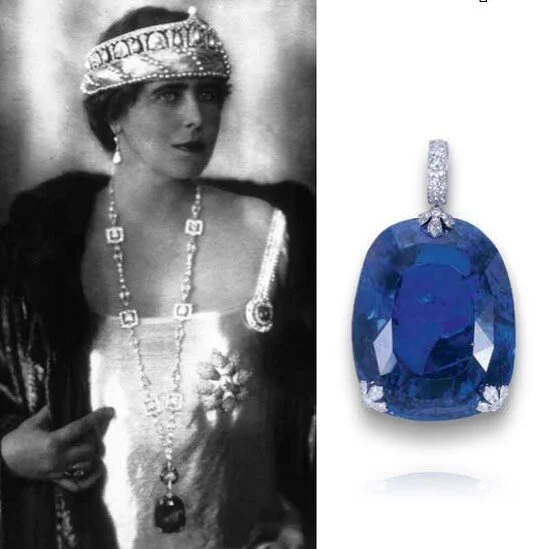
In 2003, this 478 ct #sapphire sold for CHF 1.9mn at a Christies’ auction. 104 years earlier, it was the star of the show in a post-WW1 Cartier jewellery exhibition in Louis Cartier’s favourite seaside town of San Sebastián. Back then, it attracted significant interest but failed to sell: when Queen Victoria Eugenia of Spain tried it on, her husband remarked of the 1.25mn franc price tag: "Only the nouveaux riches can afford such luxuries…we kings are the nouveaux pauvres of today!"

A couple of years later, however, it was a king who ended up buying it: King Ferdinand of Romania. He gave it to his glamorous wife, Queen Marie(wearing it here in a 1924 portrait by de Lazslo), as a coronation gift and she wore it often, especially as it went so well with her newly acquired Cartier Vladimir #sapphiretiara (one of the many Romanov jewels smuggled out of Russia during the revolution and sold to fund a life in exile).

As queen, Marie was one of the first royals to become a modern celebrity, thanks to her brilliant negotiating skills at the Treaty of Versailles, her willingness to engage with people of all backgrounds and her readiness to publish books and articles. When she visited the US in 1926 to "see the country, meet the people and put Romania on the map", #PierreCartier invited her to #CartierNewYork (he seemed "very eager that I should visit his shop"). Much to his delight, she agreed and the visit made it into all the papers. But that wasn’t enough for savvy businessman Pierre: determined to ensure the royal magic remained long after the press had died away, he made a plaque for the chair the Queen had sat on, reading: "On this chair sat her Majesty, Queen Marie of Rumania, when she paid a visit to the House of Cartier." He instinctively understood the power of celebrity endorsement and that by impressing a potential client, he was halfway to a sale.

For those interested in hearing and seeing more, you’re welcome to join for Thursday’s webinar when @prince.dimitri and I will be sharing more behind-the-scenes family stories about some seriously impressive #royaljewels and those who wore them...

Image Gallery

Image 2

!

Princess Marie Bonaparte's Cartier Tiara

Princess Marie Bonaparte's Cartier Tiara

Princess Marie Bonaparte was quite a catch. Not only was she the great-great-niece of Napoleon, she was also wealthy through her mother's family.

2 min read
Read More →

1920s diamond and black gemstone laurel leaf tiara, worn by a woman in profile.

Princess Marie Bonaparte was quite a catch. Not only was she the great-great-niece of Napoleon, she was also wealthy through her mother's family (real estate developers). No surprise then that when she was courted by the son of a King, it was considered an ideal match.

In 1907, at 25 years old, she walked down the aisle with Prince George of Greece and Denmark in Athens. To the Cartier brothers' delight, the wedding jewellery was commissioned from Cartier — royal weddings were like gold dust, both for the boost in sales and for the association with a princess bride, not dissimilar to today really.

In fact, so proud were the team at 13 Rue de la Paix that they held an exhibition, with this diamond tiara the star of the show. The design was a nod to the princess' heritage and the family she was marrying into: the wreath evoked tiaras worn by Bonaparte women, while olive wreaths were worn by brides in ancient Greece. And, in a clever multi-gem twist, the eleven emerald 'olives' could be swapped out for diamonds if desired.

Researching royal weddings is always fun but hearing from those in some way personally connected to them takes it to another level. This rings especially true when speaking to Prince Dimitri (as I've been doing in preparation for our upcoming Cartiers/Romanovs virtual event) as he brings so many of the Cartiers' royal clients — who were members of his family — vividly to life.

Take Princess Marie (or Aunt Mimi as she was known) — turns out she was a real character: intellectual, independent and eccentric. She studied with Sigmund Freud in Vienna (later smuggling him out when the Nazis wanted to arrest him), wrote books on sexuality, became a leading authority in her field and interviewed murderers in prison to determine the cause of their violence.

The photos of Princess Marie in the tiara (2nd image of her wedding day and almost five decades later at Queen Elizabeth II's coronation) come from Prince Dimitri's book Once Upon a Diamond. Highly recommend it — as Galerie Magazine brilliantly summed up, "the most glamorous family scrapbook you'll ever read."


Image Gallery

Image 2

!

The Cartiers and The Romanovs

The Cartiers and The Romanovs

I'm so excited for this month's talk when I'll be joined by Prince Dimitri — the great-great-great-grandson of Tsar Alexander II — for a uniquely personal...

1 min read
Read More →

Diamond parure, painting of Empress Maria Feodorovna wearing royal jewels, diamond tiara, and note.

I'm so excited for this month's talk when I'll be joined by Prince Dimitri — the great-great-great-grandson of Tsar Alexander II — for a uniquely personal journey back in time to the opulent palaces of pre-revolutionary Russia. Diamonds and high drama is a beguiling mix at the best of times but in the context of the Romanovs it becomes intoxicating.

This image shows one of Cartier's best clients of the early 20th century: Grand Duchess Vladimir, wearing her Cartier tiara and devant de corsage.

Behind her is an original letter I dug up during that decade I spent in the rabbit holes of family research — written by a Cartier representative in 1908 requesting an audience with the Russian royals (it clearly did the trick).

I've been fascinated by Grand Duchess Vladimir for years: how she led the St Petersburg social scene before being forced to flee her country, how her Romanov emeralds ended up adorning Barbara Hutton, and how, decades after her death, a multi-million dollar cache of long-lost jewels were discovered in two pillowcases in Stockholm.

No surprise then that when the opportunity arose to speak to someone directly connected to her extraordinary tale, I jumped at it.

We hope you can join us for this behind-the-scenes webinar on 19 November as we share intertwining stories of the Cartiers and the Romanovs from the perspective of both families.

Yes, there will be gems aplenty — enormous sapphires, emerald necklaces, ruby tiaras and rock crystal bandeaus — but in a way that's just the icing on the cake.

Because as you'll see, the history we've uncovered, with all its twists and turns, is almost more like a Bond film than real life: spies and smuggling, marriages and murders, glamorous costume balls and secret arrests, all set against the fairytale façade of a snow-filled St Petersburg.


The Cartiers Hodinkee Review

The Cartiers Hodinkee Review

Something for the watch lovers now. This picture features in a just-out Hodinkee review of The Cartiers by Jack Forster.

1 min read
Read More →

Four vintage gold Cartier watches: round, angled rectangular, and two rectangular, with black straps.

Something for the watch lovers now. This picture features in a just-out Hodinkee review of The Cartiers by Jack Forster. For those who don't know it, Hodinkee is THE leading watch website/magazine/blog, and Jack Forster is its brilliant editor-in-chief (and author of Cartier Time Art, one of the best Cartier watch books out there).

All of which goes to explain why I was so pleased to see my book not only featured on their front page, but also reviewed in a way that really grasps the essence of what I was trying to achieve: "What is often missed," Jack writes when talking about Cartier pieces, "are the stories of the people behind the creations, which in many cases have been with us so long as to seem to have appeared through some process of spontaneous generation." That's what my grandfather Jean-Jacques Cartier felt too, and a promise I made to him to bring to life those behind the scenes of the family firm was a key motivation for the book.

Take the many skilled hands involved in creating a single vintage watch: the hours, days and weeks to fashion a gold case at the bench, to make the dial from a sheet of silver, to print on the numbers without it smudging, to cut out the hour and minute hands, and to miraculously assemble the component parts of not just a reliable timepiece but also a miniature work of art. Because creativity, as Jack succinctly points out, "cannot be bought by the kilogram from a supplier" — and the growth of luxury didn't just happen by magic: "Cartier was one of those firms that really invented luxury as we have come to know it today, and to read The Cartiers is not only to find oneself immersed in the genuinely gripping story of a business and creative dynasty, but also in the larger history of luxury."