Tema

Watches and Clocks

A guide to Cartier's watches and clocks: from the Santos commission and the Tank to the Crash, the Tortue and the Mystery Clock.

37 términos · 17 artículos

Referencia

  • Animal Mystery Clock The figural group of Cartier mystery clocks, with twelve variants produced between 1922 and 1931, incorporating carved animals, enamelled jade, and oriental forms.
  • Calibre 101 One of the smallest mechanical movements ever made, measuring just 14mm long, used in Cartier's most refined jewellery watches.
  • Cartier Baignoire An oval wristwatch whose name is French for 'bathtub.' Made in yellow gold, white gold, and platinum. Two principal case forms: the standard Baignoire and the dramatically elongated Allongée, also known as the Maxi Oval.
  • Cartier Basculante A pivoting-case wristwatch introduced by Cartier in 1932, designed so the dial can be rotated face-down within its fixed outer frame for protection.
  • Cartier Cintrée A curved, elongated variant of the Tank wristwatch, introduced in 1921 and characterised by its slim bowed case that follows the contour of the wrist.
  • Cartier Cloche A wristwatch in a bell-shaped case, produced primarily in the 1920s and closely associated with the Art Deco period and Louis Cartier's exploration of sculptural case forms.
  • Cartier Clocks From Belle Epoque enamel desk clocks to Art Deco architectural pieces, astronomical comet clocks to the mystery clocks with their floating hands -- Cartier's clock output reflects the same creative range as the jewellery.
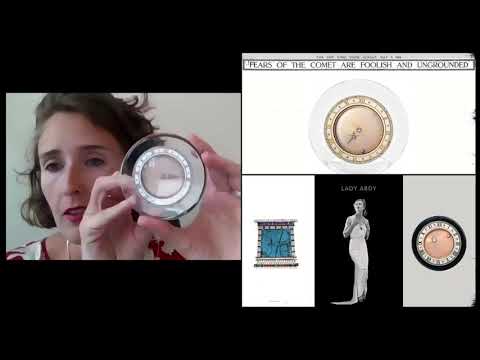
  • Cartier Comet and Astronomical Clocks Semi-mystery desk clocks inspired by the passage of Halley's Comet in 1910, with diamond-set comet hands, rotating dials, and day-and-night indicators.
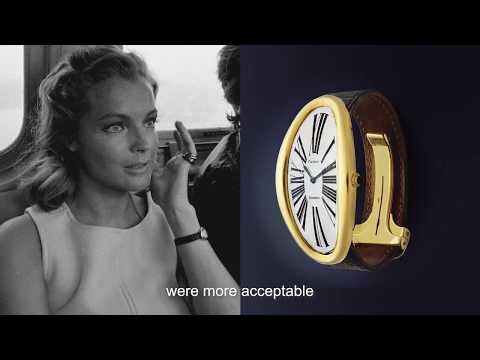
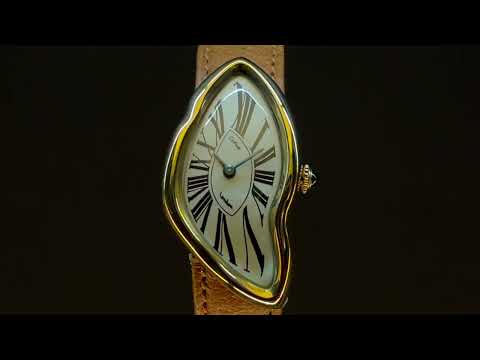
  • Cartier Crash The deliberately distorted asymmetric wristwatch produced by Cartier London from 1967, among the most sought-after vintage Cartier watches.
  • Cartier Decagonal A ten-sided wristwatch case produced by Cartier London under Jean-Jacques Cartier at 175 New Bond Street in the 1960s and 1970s.
  • Cartier Dice Watch A Cartier London novelty wristwatch in which four circular apertures at the corners of the square dial evoke the four-pip face of a dice.
  • Cartier Domino Watch A Cartier novelty watch of the 1930s in which the case was shaped and decorated to evoke a domino playing piece, using black hard stone, ivory, and playing card imagery, promoted by Jeanne Toussaint at Deauville in 1939.
  • Cartier Eclipse Watch A Cartier pocket watch format distinguished by a spring-loaded shutter mechanism that concealed the dial entirely when closed, opened by pressing the cabochon-set crown.
  • Cartier Maxi Oval An elongated oval wristwatch case produced by Cartier London under Jean-Jacques Cartier in the 1960s and 1970s, related to the Baignoire and sharing the same oval vocabulary as the Crash.
  • Cartier Octagonal An eight-sided wristwatch case produced by Cartier London under Jean-Jacques Cartier at 175 New Bond Street in the 1960s and 1970s.
  • Cartier Octagonal Allongée An elongated octagonal wristwatch case produced by Cartier London under Jean-Jacques Cartier at 175 New Bond Street in the 1960s and 1970s.
  • Cartier Pebble A rounded gold wristwatch made by Cartier London in the early 1970s under Jean-Jacques Cartier, rarer than the Crash and among the most sought-after vintage Cartier London pieces.
  • Cartier Pocket Watch Before wristwatches became standard for men, Cartier produced some of the most refined pocket watches of the Belle Époque and Edwardian eras: open-face rounds, the Tonneau, the shutter-mechanism Eclipse, purse watches, and novelty forms including the Domino.
  • Cartier Portique Clock An architectural hardstone and gold clock produced by Cartier in only six examples between 1923 and 1925, among the rarest objects the firm ever made.
  • Cartier Prism Clock A Cartier clock type from the 1930s, patented by Gaston Cusin, that uses internal mirrors and prisms inspired by the underwater periscope to reflect a hidden dial.
  • Cartier Purse Watch Flat, rectangular or oval watch cases designed to be carried in an evening bag rather than a waistcoat pocket, a Cartier speciality of the 1920s and 1930s combining watchmaking with decorative case design.
  • Cartier Reverso A reversible-case wristwatch designed by Jaeger-LeCoultre and retailed by Cartier, also known as the Cabriolet, with a case that pivots within its frame to expose a plain or engraved back face.
  • Cartier Ronde The round-cased watches Cartier produced throughout the early and mid twentieth century, running as a quieter counterpart to the firm's celebrated geometric shapes. The name was formalised only later.
  • Cartier Santos One of the earliest and most influential purpose-designed wristwatches, created for the Brazilian aviator Alberto Santos-Dumont.
  • Cartier Tank The rectangular wristwatch inspired by the overhead view of a WWI tank, one of the most imitated watch designs in history.
  • Cartier Tank à Guichet A Cartier Tank variant introduced in 1928 in which the traditional dial and hands are replaced by two aperture windows displaying the hours and minutes separately; one of the rarest and most architecturally distinctive of all Cartier timepieces.
  • Cartier Tank Chinoise A Cartier wristwatch introduced in 1922 in which the Tank case was elaborated with horizontal bars over the vertical flanks, inspired by the architecture of Chinese temple porticos; among the rarest of the original Tank variants.
  • Cartier Tonneau A watch case shape wider at the centre than at the ends, resembling a barrel, one of Cartier's classic case geometries.
  • Cartier Tortue A curved rectangular case with convex sides that taper to the ends, named for its resemblance to a turtle's shell.
  • Cartier Watches Cartier's wristwatch output from the early Santos through the geometric forms of the interwar period and the post-war designs of the London branch -- a history of shaped cases rather than mechanical complications.
  • Central Axis Mystery Clock The second variant of Cartier mystery clock, using a single central axis mechanism. At least twenty-one variations were created from 1920 onwards.
  • Deployment Clasp A folding gold strap fastener patented by Edmond Jaeger for Cartier's exclusive use in 1909, allowing wristwatch straps to open and close without removing the watch.
  • Jaeger-LeCoultre The Swiss manufacture that supplied many of Cartier's finest watch movements, and maker of the Reverso, one of the landmark watch designs of the twentieth century.
  • Minute Repeater A horological complication that chimes the hours, quarter-hours, and minutes on demand; Cartier produced minute repeater watches from the early twentieth century, with the Tortue form yielding some of the most celebrated examples.
  • Mystery Clock A clock in which the movement is hidden, so the hands appear to float and turn with no visible mechanism driving them.
  • Mystery Clock Model A The first of Cartier's mystery clock forms, with transparent rock crystal columns supporting a floating dial. Produced from 1912 through the late 1940s.
  • Screen Mystery Clock A fire-screen-shaped mystery clock produced by Cartier in only seven examples between 1923 and 1928, also known as the Enseigne mystery clock.

Del blog

Seminarios relacionados

The Cartiers: Watches

The Cartiers: Watches

Cartier began making men's wristwatches in the early twentieth century, at a time when wristwatches were considered women's jewellery and men wore pocket watches. This short film explores how the Cartiers created a new category and persuaded men to wear one.

Ver el seminario →

Vídeos relacionados